
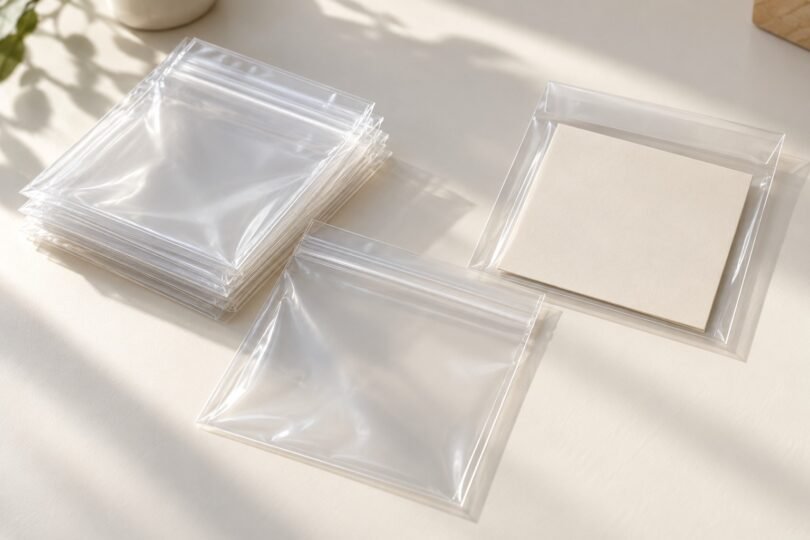

The most useful way to choose 12 x 12 clear plastic bags is to start with what must fit inside and how the bag will close. A true 12-inch-square interior, an open-top bag with 12-inch nominal dimensions, and an oversized sleeve designed for 12 x 12 artwork are different products. A flap or zipper also changes how much room you can actually use.
For repeated access, look at a zipper bag with stated inner dimensions. For presenting square prints, consider an oversized adhesive-flap sleeve. For bulk packing with your own ties, tape or sealer, an open-top polyethylene bag may be the better match. These comparisons use supplier specifications, with fit limitations called out where measurements are incomplete.
Three clearly specified options
ClearBags ZC1212: a 12 x 12 zipper bag
ClearBags ZC1212 is a clear polypropylene bag with a resealable zipper. It is listed at 2.0 mil thickness and sold in packs of 100. The supplier’s additional information identifies the dimensions as inner width by length, with the opening side listed first and a sizing tolerance of plus or minus 1/16 inch.
This is the most direct match here for someone asking for a nominal 12 x 12 usable compartment with a built-in closure. Even so, a rigid item exactly 12 inches wide deserves a sample fit: the tolerance and the item’s thickness can matter. The product specification marks food suitability as “Yes,” but does not provide cooking, hot-fill or freezer conditions on the page. Verify your intended food application before ordering.
ClearBags B12X12: an oversized sleeve for square artwork
ClearBags B12X12 is a 100-pack of clear BOPP/OPP sleeves with 1.6 mil film and a resealable adhesive strip on the flap. Its listed outer dimensions are 12 7/16 by 12 1/4 inches. The supplier describes it for 12 x 12 art, photos and selected backed or matted pieces, including products up to about 5/16 inch thick.
This is an example of a bag sized for a 12 x 12 item rather than a bag that measures exactly 12 x 12. The page does not separately establish a full usable-interior measurement or flap length. Do not count the flap as extra storage space. ClearBags identifies this specific sleeve as acid- and lignin-free and archival safe; that statement should not be transferred to unrelated transparent bags.
Interplas PB21212: open-top bags for bulk packaging
Interplas PB21212 is a clear, low-density polyethylene flat bag listed at 12 x 12 inches and 2 mil thickness. The case contains 1,000 bags. It has an open top, with no integrated zipper or adhesive flap. Interplas lists twist ties, bag tape and heat sealing as closure options.
The supplier states that this product meets FDA requirements for food packaging and storage. That supports considering it for an appropriate food-contact use, but does not establish every temperature or process you might want. Its page does not separately specify a seam-to-seam usable interior. Allow for the space your chosen closure consumes and confirm fit before committing to a full case.
Measure the item in its finished form
Lay out the actual item you want to package, including backing board, folded fabric, protective wrap or any other insert. Measure width, height and thickness. An unmounted sheet can slide into a bag that is too tight once the same sheet is backed or stacked. Square dimensions alone do not capture that change.
For an adhesive-flap sleeve, ask whether the quoted length is the bag body or the body plus flap. Also check where the adhesive sits. A strip on the flap travels with it as you open the sleeve, so take care when removing paper or delicate surfaces. If repeated removal is important, compare a protective-closure design with adhesive positioned on the bag body.
For a zipper bag, look for a usable length measured below the closure rather than assuming the entire outside height is available. For an open-top bag, leave enough material above the contents to tie, tape or heat-seal it. A bag that barely encloses an item while open may be impossible to close properly.
The practical answer is a sample, especially for artwork or a repeat packing job. Load the complete item, close the bag normally and take it out again. You should not have to force corners through the opening, bow a rigid sheet or stretch the seams to make it fit.
Understand thickness and material
A mil is one-thousandth of an inch: 2 mil means 0.002 inch, while 1.6 mil means 0.0016 inch. It is not the same unit as a millimeter. Thickness helps distinguish otherwise similar listings, but is not a complete measure of puncture resistance or durability. The polymer, seam construction, closure and shape of the contents also matter.
For example, the two 2 mil bags above use different polymers and different closures. Treat their actual specifications as the starting point rather than assuming they will feel or perform identically. For sharp or heavy contents, ask the supplier which film and gauge it recommends. Do not rely on clear film alone to protect an exposed point or blade.
Terms such as “cello,” “poly” and “crystal clear” are not enough to identify the material. Look for a stated polymer such as polypropylene or low-density polyethylene. If that information is missing, clarify it before buying for a use where material compatibility matters.
Food, photographs and safety need separate checks
Transparency does not establish food-contact suitability, and a recycling symbol does not establish archival performance. Match any claim to the exact item number. If you plan to use a bag with oily foods, warm products or long storage, ask for the relevant intended-use conditions. If you are protecting valuable photographs or artwork, verify the material and preservation requirements rather than choosing on appearance alone.
Keep loose bags and discarded film away from children. Children’s Hospital of Philadelphia warns against letting children play with plastic bags. Pets also need protection: the FDA identifies food-storage and other plastic bags as a suffocation risk for pets. Store unused packaging securely and dispose of damaged bags promptly.
If you sell packaged products, check the warning and packaging requirements for your destination and sales platform. A plain bag is not automatically supplied with a required warning, and the presence of a warning does not establish compliance with every rule. Verify the actual pack rather than assuming its photo shows every marking.
Buy the smallest quantity that proves the fit
Compare cost per usable bag, including delivery and any closure supplies you need. A 1,000-bag case is poor value if most of it sits unused or the contents turn out to need a larger size. Conversely, a 100-pack is a sensible way to establish a repeatable packing process before scaling up.
Choose ZC1212 when a specified square inner compartment and zipper match the job, B12X12 when its artwork fit and flap suit the presentation, or PB21212 when an open-top bulk bag fits your workflow. In every case, confirm the SKU, dimensions, thickness, polymer, closure and quantity together. Those six details are more useful than a long list of nearly identical product names.


