
The right 15-gallon water tank depends first on what it will hold. An RV drinking-water reservoir, a gray-water tank, an aquarium and a pressure tank serve different purposes. A matching gallon number does not make them interchangeable, and a fuel caddy or chemical sprayer is not a substitute for a drinking-water container.
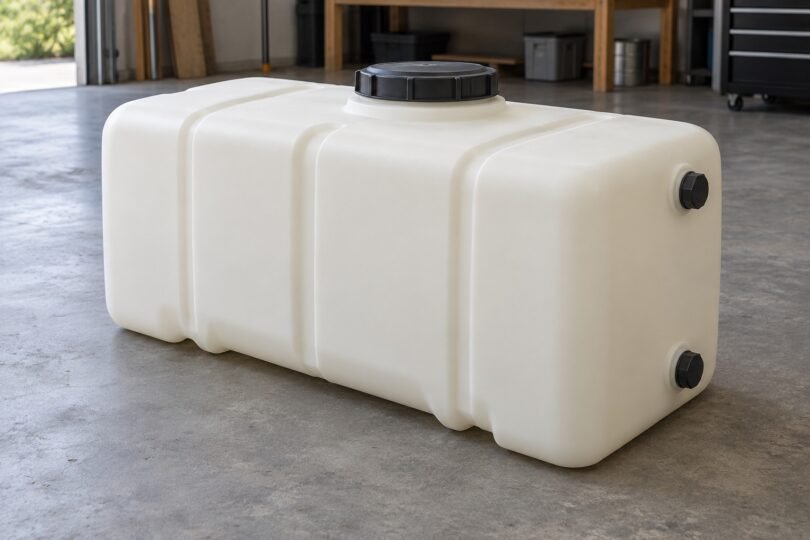
For a fixed RV or trailer installation, the Class A Customs T-1500 and UM-1500 are two documented 15-gallon options with different shapes. Compare their dimensions, fitting locations and support requirements against your installation. For household emergency water, also consider whether several smaller drinking-water containers would be easier to fill, move and use.
Choose the correct type of tank first
| Intended use | What to look for | Key distinction |
|---|---|---|
| Drinking water | A container the manufacturer explicitly identifies for potable or drinking-water storage | Its material, fittings, cleanliness and previous contents all matter. |
| Gray water | A tank intended for the wastewater from the relevant sink or shower system | Keep it separate from the drinking-water supply. |
| Black water or waste transport | A dedicated sewage holding tank or waste tote with compatible connections | A fresh/gray-water tank is not automatically suitable for sewage. |
| Aquarium | A fish tank and equipment suited to the intended aquatic setup | Aquarium capacity is not a drinking-water approval. |
| Pressurized water system | A pressure-rated vessel selected for that system | A vented storage tank must not be pressurized. |
For example, the Fluval Flex 15-US-gallon aquarium is listed as a 57-liter aquarium kit with lighting and filtration. It belongs in an aquarium comparison, not a list of RV drinking-water reservoirs. Likewise, Amtrol’s pressure-tank specifications distinguish total tank volume from system drawdown. Neither figure should be treated as an interchangeable storage-tank capacity.
Two 15-gallon RV tank shapes to compare
These are tank-only products with installed tank fittings, not complete pump, hose and mounting packages. A similarly named plumbing-kit bundle requires its own contents check.
The manufacturer pages label both tanks “15 gallons” without specifying U.S. or Imperial gallons. Confirm the U.S. liquid-gallon unit with the manufacturer if capacity is critical to your project.
| Model | Advertised capacity | Manufacturer’s dimensions, excluding fittings | Installed fittings |
|---|---|---|---|
| Class A Customs T-1500 | 15 gallons | 25.5 × 11.75 × 11.75 inches | Two 1.5-inch female NPT and two 0.5-inch female NPT |
| Class A Customs UM-1500 | 15 gallons | 36 × 8.5 × 13 inches | Two 1.5-inch female NPT and two 0.5-inch female NPT |
The manufacturer allows a ±0.25-inch variation in each measurement and says the tanks can be rotated. The 1.5-inch fittings have sealed membranes; the 0.5-inch fittings are open. Use the product photographs and installation guidance to establish the connection layout before ordering.
Choose the T-1500 when its shorter, roughly square cross-section suits the space. Consider the UM-1500 when its longer, shallower shape suits your proposed installation. “Under mount” is not a promise of fit under a particular vehicle: measure the available space and have the support arrangement checked.
Class A Customs describes these fresh/gray tanks as made from medium-density polyethylene (MDPE) and suitable for fresh drinking water or gray water. Its material and installation guidance distinguishes NSF-certified material from certification of each finished tank; the tanks do not carry an NSF logo. For a food-service installation, confirm the exact tank’s acceptance with the relevant inspector before purchasing. Do not turn a material-compliance statement into a blanket “FDA approved” or “NSF certified tank” claim.
Capacity, usable water and filled weight
Check the unit used in a listing. Using NIST’s conversion factors, 15 U.S. liquid gallons is about 56.8 liters, while 15 Imperial gallons is about 68.2 liters. If a seller gives only “gallons” and the market or specification is unclear, request the capacity in liters.
Nominal capacity also does not guarantee that every gallon can be drawn through the outlet in your installation. Fill level, tank orientation and the height of the pickup or outlet affect the amount available to use. Neither tank page provides a guaranteed usable draw-off volume for your setup. Ask about that if you need a firm minimum reserve; do not calculate internal capacity from outside dimensions alone.
For planning, 15 U.S. gallons of water alone weighs about 125 pounds, or 57 kilograms, using approximately 8.34 pounds per gallon. Add the tank, hoses, supports and other equipment. Class A Customs estimates the UM-1500 at about 12 pounds empty and roughly 138 pounds full on its product page. That estimate is not a mounting-system load rating. Moving-vehicle loads also need to be considered by the installer.
Venting, fittings and mounting: check before installation
The two Class A Customs tanks are non-pressurized. The manufacturer’s guidance requires a vent that allows air in and out during use and a gravity-filling arrangement. Do not screw a pressurized garden-hose supply into a sealed tank connection. An RV system can have pressurized plumbing downstream of a pump while its supply tank remains vented.
- Allow connection space: Measure the tank body plus elbows, hoses, clamps, vent routing and room to service or drain it.
- Match threads: NPT size is a connection specification. Check adapters and the complete plumbing plan, rather than assuming a similarly sized hose will attach directly.
- Support and restrain the tank: Class A Customs calls for a level, supported installation with bracing to prevent movement. It warns against hanging the tank by ratchet straps.
- Protect an external installation: Account for road debris, ground clearance and access. The maker does not supply a universal bracket system for these fresh/gray tanks.
Follow the manufacturer’s installation requirements and use a qualified installer when designing a fixed vehicle system. A pump’s advertised pressure does not give the tank a pressure rating.
For emergency drinking-water storage
Use a container intended for drinking water and follow the maker’s cleaning and sanitizing instructions before filling it. Never reuse a container that held fuel, pesticides or other toxic chemicals. Tank color and a “BPA-free” description alone do not establish suitability for drinking water.
The CDC’s emergency-water guidance recommends at least one gallon per person per day for three days, with more for needs such as hot weather and pets. On that baseline, 15 usable U.S. gallons represents 15 person-days, or five days for three people; actual requirements and usable capacity may be higher and lower respectively. Keep a reserve rather than planning to empty the tank completely.
The CDC advises replacing home-filled stored water every six months, labeling it with the storage date, and storing it away from sunlight and toxic substances. Consult its full sanitizing instructions and the tank maker’s directions; cleaning a container and treating unsafe water are different tasks.
A final check before ordering
Confirm the exact model, approved use, capacity unit, orientation, fitting layout and package contents. Then compare the installed cost, including plumbing and adequate support. If those details fit your project, a documented 15-gallon tank can be a sensible choice. If they do not, a different shape or several smaller containers will serve you better than a tank selected by its gallon number alone.