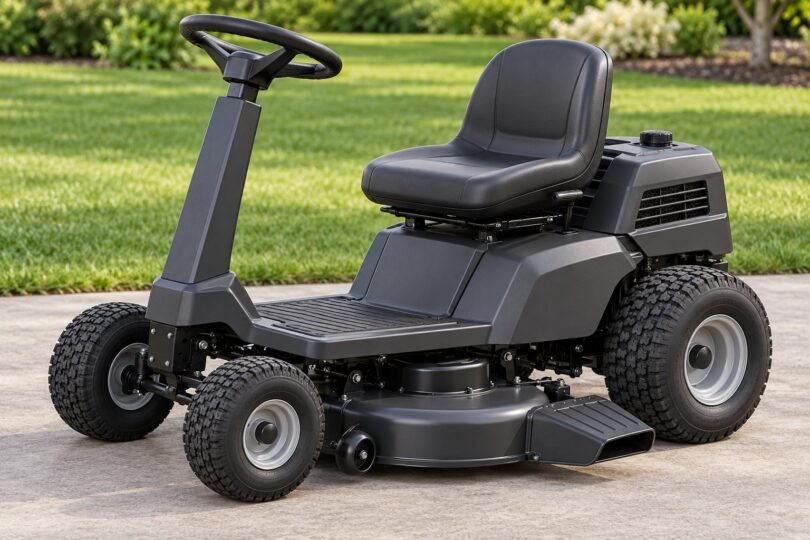

A 30-inch riding mower makes sense when you want to sit while mowing but have limited storage or a narrow route into the yard. Start by checking the route, terrain and exact model number. The 30-inch measurement describes the cutting swath; it does not promise that the complete mower will fit through a 30-inch opening.
For a straightforward gas-powered option, compare the Troy-Bilt TB30B with the hydrostatic Cub Cadet CC30H. If you are considering a battery-powered CC30E, establish which battery generation is actually being offered. The models below are compared using manufacturer specifications and operating guidance, rather than claimed hands-on testing.
Which 30-inch riding mower suits your yard?
- Troy-Bilt TB30B, model 13AC26JDA23: a compact gas rider to consider if you prefer a hand-operated speed selector and an included mulch kit.
- Cub Cadet CC30H, model 13CC21JDA10: a gas alternative worth comparing if foot-pedal hydrostatic speed control is important to you.
- Cub Cadet CC30E, model 33BA27JDB10: an electric model to investigate only after confirming the battery specification, condition, charger and local service support. Its manufacturer page is in the prior-year-models section.
These are different buying situations, not a ranking of measured cut quality. A mower that cannot negotiate your access route or safely handle the ground is the wrong purchase, regardless of engine size or features.
Compare exact models, not just familiar names
Troy-Bilt TB30B: hand-controlled gas rider
The TB30B 13AC26JDA23 specification lists a 344cc Briggs & Stratton Power Built engine, model 21R707-0152, rated at 10.5 horsepower. Its drive is a continuously variable transmission with six selectable settings controlled by a hand lever, marketed as Shift-on-the-Go. This is a different control arrangement from the CC30H’s foot-pedal hydrostatic system.
The single-blade steel deck cuts 30 inches, with five height positions from 1.5 to 4 inches. A mulch kit is included. Troy-Bilt positions this model for yards up to half an acre and says it is designed for gates 36 inches wide or larger. Those are manufacturer fit and yard-size descriptions, not a guarantee for your gate or a measured mowing-time result.
Cub Cadet CC30H: foot-pedal hydrostatic control
The CC30H 13CC21JDA10 specification lists the same 344cc Briggs & Stratton 21R707-0152 engine and 10.5-horsepower rating, paired with a Tuff Torq TL-200 hydrostatic transmission controlled by a foot pedal. It also specifies a 30-inch single-blade deck, five cutting heights between 1.5 and 4 inches, an included mulch kit and an LED headlight.
The practical comparison is how comfortably you can reach and use the controls. Try the seating position with the machine safely parked. Check pedal reach, steering clearance and how easily you can get on and off. Hydrostatic drive does not make a compact mower suitable for steeper ground, and a headlight does not remove the need for clear visibility.
Cub Cadet CC30E: verify the battery generation
The CC30E 33BA27JDB10 page specifies a 56V MAX, 60Ah, 3,000Wh lithium-ion battery. It advertises up to one acre or one hour per charge and roughly four hours to recharge. Treat those figures as manufacturer estimates, not promised results in long grass or with attachments.
Confusingly, Cub Cadet’s older CC30E battery FAQ describes a 30Ah, 1,500Wh battery. Do not combine that older specification with the 60Ah model listing. Ask for a photograph of the actual mower’s identification label and the appropriate battery documentation. A shared CC30E name does not establish matching battery capacity, age or remaining service life.
Will a 30-inch mower fit through your gate?
Measure the usable opening with the gate fully open, including hinges, latches, posts and anything projecting into the route. Then check the complete mower’s widest point in the manufacturer-approved configuration you will use. The deck housing, discharge chute, wheels and attachments can extend beyond the blade’s cutting width.
A nominal 36-inch gate may have less clear space once its hardware is included. Ask the dealer to measure the actual assembled mower rather than relying on the boxed dimensions or a retailer’s generic width field. If clearance is close, request a fit demonstration or written dimensions before arranging delivery.
- Check the approach and exit. A narrow opening immediately beside a wall may not allow a straight approach.
- Measure shed-door width, overhead clearance and the room needed to turn or park.
- Include the bagger and chute if you plan to keep them fitted.
- Do not remove guards, tie up a discharge chute or alter safety switches to make a mower fit.
Measure first and choose the machine second. Enlarging a gate or changing where the mower is stored may affect the total cost more than a small difference in advertised equipment price.
Mulching, bagging and attachment limitations
An included mulch kit is not an included bagger. Confirm the exact accessories supplied with the mower and whether an optional collection system needs additional mounting components. Used machines may be missing parts that came with the original package.
Troy-Bilt’s 19A30014OEM bagger listing describes a 3.25-bushel system for compatible 30-inch rear-engine riders. Match an attachment through the manufacturer’s model-number lookup; “fits 30-inch decks” is not permission to assume that every mower or generation is compatible.
For electric riders, account for both the extra footprint and energy demand. Cub Cadet’s CC30E attachment guidance warns that attachment use can reduce runtime. That FAQ links an earlier model, so confirm parts for the particular machine you are buying. Never improvise ballast or attachment mounts.
Slopes and rollover safety come before convenience
The operator’s manual linked for these gas models prohibits mowing slopes greater than 12 degrees, about a 21% grade, and directs operators to travel up and down permitted slopes. It gives a lower limit for a grass catcher: do not use one above 10 degrees. The linked CC30E manual carries these same mowing and catcher limits. Follow the manual supplied for your exact model and attachment; a numerical limit does not make wet, rutted or unstable ground safe.
The CPSC riding-mower safety guide emphasizes keeping children away under another adult’s supervision, never carrying passengers, and looking behind and down before and during reversing. Children must never ride along, even with the blades stopped. Shut down if anyone enters the mowing area.
Keep away from drop-offs, ditches and embankments. Avoid sudden speed or direction changes, and never try to hold up a tipping mower with your foot. Keep guards and interlocks functional. If the slope, traction or visibility makes you uneasy, use another safe maintenance approach instead of testing the machine’s limits.
Questions to settle before ordering
- What exact machine is being delivered? Put the full model number, included accessories and assembly arrangement on the quotation.
- What is the complete cost? Include delivery, setup, collection accessories, service transport and any storage changes.
- Who will service it? Confirm that a nearby provider supports the engine or battery system and the particular model.
- What will routine care involve? Review the maintenance schedule, fuel or charging instructions and seasonal-storage requirements before buying.
- For a used mower, what is missing? Check manuals, charger where applicable, guards, keys, attachment hardware and service records. Arrange professional inspection if condition is uncertain.
The strongest shortlist is usually small: choose between the TB30B’s hand-controlled drive and the CC30H’s pedal-operated hydrostatic drive, then consider a correctly identified CC30E if electric ownership suits your charging and service arrangements. Confirm gate clearance and terrain suitability before committing to any of them.