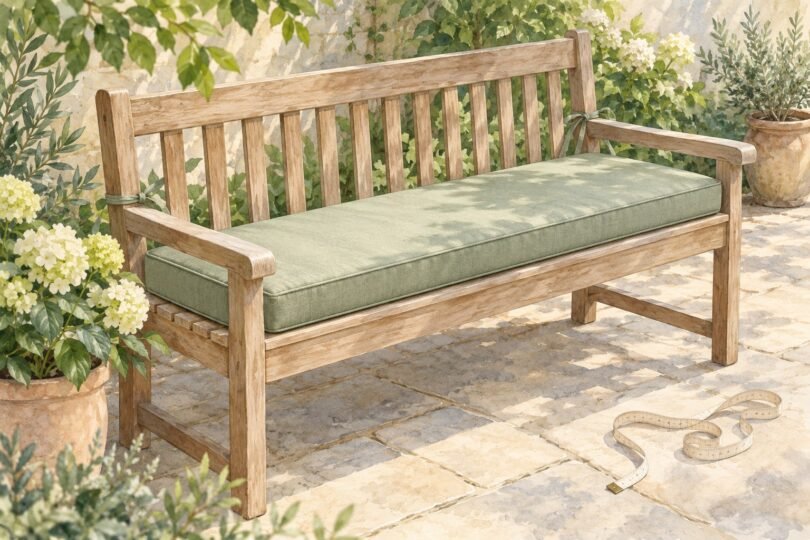

A 40 x 16 outdoor bench cushion should match the usable seat, suit the bench’s exposure to rain, and leave you sitting at a comfortable height. Start with those checks before choosing a color. A cushion described as “40-inch” may be 18 inches deep, while a 40 x 16 model can still have a manufacturing tolerance that matters between fixed armrests.
For a nominal 40 x 16-inch seat, there are two named options below with that listed footprint, plus a custom route when the fit is less forgiving. None should be treated as a guaranteed fit until you measure your own bench and confirm the finished-size allowance.
Measure the bench before ordering
Measure the bare seating surface from side to side and front to back. Between arms, use the inside opening at seat level rather than the bench’s overall outside width. Check the width at the front and back, and the depth at both ends. A tapered seat, rounded rear corners, or posts that project into the seat can require a shaped cushion or a template.
The Us Cushion measuring guide recommends measuring the frame instead of an old pad, which may have stretched or compressed. It also suggests stacking books to compare possible cushion heights against the armrests. Use that as a clearance check; books cannot predict how much a particular fill will compress when you sit.
Write dimensions with their units and labels: 40 inches wide x 16 inches deep x your chosen thickness. Do not add seam allowances or automatically subtract half an inch. Follow the selected maker’s instructions and explain any tight opening before placing a custom order.
Compare the listed dimensions and construction
| Option | Listed size or sizing route | Main point to check |
|---|---|---|
| Navenwelle zs001, Grey – Polyester | 40 x 16 x 2 inches; listed ±0.5-inch tolerance | Fill descriptions conflict; confirm the actual insert |
| Summer Living Direct French Edge and Buttons, JBNFTB4016 | 40 x 16 x 4 inches; description gives 3–4-inch loft | Layered polyester fill and two ties; select outdoor fabric |
| CustomCushions bench builder | Enter the required dimensions and select construction | Confirm finished-size allowance, fill and tie placement |
| Pillow Perfect Delray Navy, SKU 689678 | 45 x 18 inches; current specifications list 3-inch thickness | Larger than a 40 x 16 seat; not an exact replacement |
Navenwelle: a thinner nominal 40 x 16 option
The selected Amazon listing is for one Grey – Polyester cushion, model zs001, ASIN B0D1QJ88V1. It lists a 40 x 16 x 2-inch size and an error allowance of ±0.5 inch. That makes it worth checking if you want a relatively low pad, but it may be unsuitable for a tightly enclosed opening.
The listing describes a zippered, removable cover, machine washing for that cover, and an anti-slip bottom. Its material details need clarification: the bullets describe PU-coated polyester and 75D sponge, while the specification fields say linen polyester and cotton fill. Ask the seller to resolve the composition before buying if fill or fabric is decisive. The product’s waterproof wording does not establish that the seams, zipper and complete cushion keep all rain out.

Navenwelle zs001 Bench Cushion, 40 x 16 x 2 Inches, Grey - Polyester, One Cushion
As an Amazon Associate we earn from qualifying purchases.
Summer Living Direct: a tufted option with ties
The Bench Seat Cushion with French Edge and Buttons includes size code JBNFTB4016, listed as 40 x 16 x 4 inches. Its description specifies layered polyester fiber fill, three fabric-covered buttons, two ties, and a 3–4-inch loft. Read the 4-inch size label alongside that loft range rather than expecting a uniform, rigid four-inch slab.
This is a fabric-selection product, so confirm the exact outdoor fabric, finished measurements and care instructions. The listed construction gives no basis to promise a removable cover or machine-washable complete cushion. Check that the two ties can reach suitable parts of your bench frame. For an enclosed seat, ask about width and depth tolerances as well as the tufted profile.
Custom sizing: useful when small differences matter
The CustomCushions bench builder lets you specify size and construction, choose fabrics and filling, and add ties or trimming. It is a useful route for an unusual corner shape or an opening where an off-the-shelf pad would need to be squeezed into place. Confirm that your chosen fabric and fill are intended for your outdoor setting; a configurable product does not make every combination equally suitable.
Tolerances vary by maker and construction. For example, Cushion.com’s tolerance chart gives a half-inch width/depth tolerance for boxed-edge bench cushions under 60 inches wide, versus one inch for waterfall-edge versions. Those figures apply to that maker’s specified products. They are not a universal allowance to apply to other brands.
A larger cushion is a different size
The Pillow Perfect Delray Navy bench cushion, SKU 689678, illustrates why checking both dimensions matters. It has a navy-and-white leaf pattern, polyester fabric and fill, a zippered cover, and two rear 14-inch ties. Its 45 x 18-inch footprint is five inches wider and two inches deeper than 40 x 16. It is a candidate only if your measured seat accommodates that larger footprint.
The page URL mentions 2.5-inch depth, but the current product specifications say 3 inches. Confirm thickness with the maker if seat height is critical. Do not treat the larger footprint as harmless manufacturing variation.
Choose thickness, fill and fastening together
A deeper pad changes the distance to armrests, a dining table and the backrest. Check those relationships before assuming thicker will feel better. Listed thickness is also different from compressed sitting height. Ask whether a measurement describes the seam, the fullest loft, or an uncompressed insert.
For fill, look for a clear material description and an outdoor-use recommendation. “High density” alone does not tell you the finished sitting feel or drying time. For covers, establish whether you are buying a filled cushion, a replacement cover, or a bare insert. A zipper does not automatically mean the entire assembly can go in a washer.
Ties are useful only when they align with a rail, spindle or another suitable attachment point. Measure that position as well as the seat. A grip backing should be checked against your bench’s surface and care instructions. Neither attachment method compensates for a cushion that overhangs or bunches between the arms.
Water resistance and care
Check the exact fabric and complete cushion construction instead of relying on “outdoor” in a title. Sunbrella says its fabrics range from water-resistant to waterproof; the brand name alone does not settle which one you are buying. Ask about the seams, zipper, insert and recommended rain exposure. Plan somewhere dry to store the cushion when conditions exceed that guidance.
Follow the cushion maker’s care label. For Sunbrella upholstery specifically, the official cleaning guide advises removing loose dirt, blotting liquid spills, cleaning with a mild soap solution, rinsing thoroughly and air drying. It says to consult the furniture manufacturer before removing a casing for machine washing, because construction varies. Do not transfer that fabric’s cleaning instructions to an unknown cover or wash the insert without permission from its maker.
Before ordering, check the final size selection, color, piece count, included fill, fastening and care instructions together. A clearly specified cushion that fits the seat and your storage routine is the useful purchase here.