
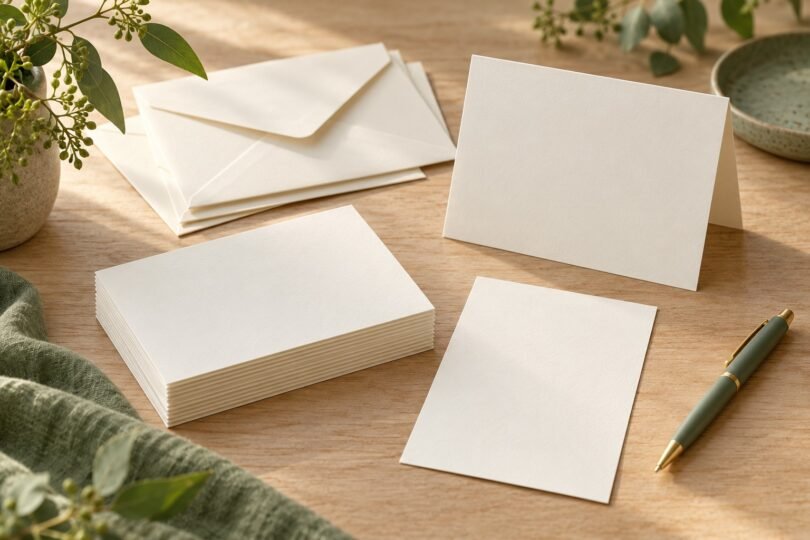

A good 4×6 thank-you card starts with the right format. For a short handwritten message, choose a finished flat card or a ready-designed card with a blank interior. For a custom design printed at home, buy stock matched to both your printer and its template. A product described as “4×6” may refer to a finished card, a photo print, or a sheet before folding, so that number alone is not enough.
This guide compares a small set of clearly identified options and explains the checks that prevent buying the wrong size. It is based on manufacturer specifications and current product listings, not hands-on testing.
Quick choices by the job
- Printing a simple bordered design on a laser printer: Avery 5389, a 100-card pack of white 4×6 flat postcards.
- Printing a full-bleed design on an inkjet printer: Avery 8386, a 100-card pack of matte-white 4×6 flat postcards.
- Writing directly on colored blank stock: JAM Paper Brown Parchment 65lb 4×6 note cards, with quantities ordered in multiples of 25.
- Buying an already-designed thank-you set: VNS Creations Navy Blue 100-pack, listed as 4×6 with a blank interior, envelopes and sticker seals. Confirm the closed versus open dimensions if exact fit matters.
First decide what “4×6” needs to mean
A finished 4×6 flat card measures four by six inches after any trimming or separation. It has two sides and no fold. A folded card with a 4×6 face needs a larger unfolded blank: for example, an eight-by-six-inch blank folded in half along the eight-inch dimension. A four-by-six-inch sheet folded in half instead produces a smaller face. Check the finished size, the unfolded size and the score direction separately.
A 4×6 photo print describes a photograph’s size, not necessarily a writeable greeting card or a mail-ready postcard. Coating, reverse-side printing and thickness still matter. Likewise, an eight-and-a-half-by-eleven-inch print sheet can contain two finished 4×6 cards. Use the full sheet size in the printer setup and the product’s layout template; do not feed separated pieces just because the final card is 4×6.
Check inches rather than relying on envelope or paper labels alone. A seller’s “A6” description may not be the same thing you mean by four by six inches. Measure the actual item that must fit, especially when adding a photograph or a second insert.
Options worth comparing
Avery 5389: flat cards for laser printing
The manufacturer’s 5389 specification identifies 100 finished cards, two per sheet, in 80lb/216gsm matte-white stock. The retained Amazon listing specifies 50 letter-size sheets. This is a practical route for a repeated thank-you message with space left for a handwritten line.
The important restriction is the layout: Avery says 5389 is laser-only and not print-to-the-edge. Leave a deliberate margin rather than forcing borderless artwork into the wrong template. This is blank postcard stock, not a package of preprinted folded thank-you cards. It does not supply a matching-envelope set.

Avery 5389 White 4x6 Laser Postcards, 100 Cards
As an Amazon Associate we earn from qualifying purchases.
Avery 8386: flat cards for inkjet designs that reach the edge
Avery 8386 is the matte-white, 100-card, two-per-sheet option identified for inkjet printing. The stock is listed at 80lb/216gsm, and Avery’s printer-type guidance identifies 8386 as the inkjet print-to-the-edge product. The Amazon variant checked is 100 cards at 4×6 inches, not the differently sized or multipack choices on the same listing.
Choose this when the artwork deliberately extends beyond the finished card boundary. Use the 8386 template’s bleed and safe areas, not the 5389 layout. Avery’s product page contains an inconsistent laser reference in one descriptive bullet, so follow its inkjet specification, dedicated guidance and the instructions on the purchased package.

JAM Paper Brown Parchment 4×6: blank stock for handwriting
JAM Paper item 17534159 is specifically listed as Brown Parchment 65lb 4×6 blank note cards. The ordering choices start at 25 and use multiples of 25. This is a useful alternative if the paper itself supplies the color and you want to write the whole message rather than run a print project.
Keep that weight tied to this exact color and item. The page offers other colors and paper options; they are not evidence that every variant uses identical stock. Budget for envelopes separately unless the selected offer explicitly includes them. No universal printer compatibility is assumed here.
VNS Creations Navy Blue 100-pack: a ready-designed set
The exact Amazon variant checked is Navy Blue, “100 Pack – 4" x 6" (Value Pack).” The listing describes 100 cards with a blank interior, matching envelopes and sticker seals, and specifies 300gsm cardstock. It suits a larger batch of handwritten thank-yous when designing and printing the exterior would add unnecessary work.
The seller calls the cards 4×6 but does not clearly separate closed and unfolded measurements in the text checked. Confirm those measurements before choosing it for an exact-size insert or printing workflow. Also confirm the envelope closure on the delivered package: the listing’s wording is inconsistent. A non-glossy writing surface is a useful feature, but test your pen and allow the ink to dry rather than assuming every ink will resist smearing.

Check the printer before ordering blank cards
Paper weight, thickness and coating are different specifications. A gsm value does not by itself establish that a printer can feed the stock. Check the manual for the exact printer model, allowed media sizes, weight or thickness limits, feed tray and whether that stock supports automatic two-sided printing.
Manufacturer loading instructions are model-specific. For example, Epson’s ET-2980 rear-feeder instructions stress matching the paper-size setting to the loaded paper and warn that feeding problems can occur with manual two-sided printing on previously printed sheets. Those instructions should not be generalized to every Epson, or every other printer.
Run one alignment proof before committing a whole pack. Check the front, reverse, trim boundary and writing space at actual size. If the printer cannot handle the intended material, handwriting on purchased cards or using a print service is more sensible than repeatedly forcing thick stock through it.
Envelopes, pack counts and mailing
JAM’s A4 invitation envelopes are listed at 4.25 by 6.25 inches, giving clearance around a flat 4×6 card. Still test the complete stack: a folded card, photo or thick insert can change fit. An envelope named “4×6” may describe its intended contents rather than its own internal dimensions.
Compare the cost of a complete usable set: card, envelope if needed, printing and postage. A 100-card package with two cards per sheet is 50 sheets, not 200 cards. An assortment’s total also may include designs you will not use. Count recipients and allow a few extras for address mistakes and print proofs.
For U.S. domestic single-piece First-Class Mail postcard pricing, USPS lists rectangular cards from 3.5 by 5 inches to 4.25 by 6 inches, with thickness from 0.007 to 0.016 inch. A flat 4×6 card is within those face dimensions, but thickness and other mailing requirements still apply. An envelope changes the mailpiece; do not assume a postcard stamp covers it. Check current USPS requirements for the finished item, and use the destination country’s postal guidance for other mailings. No postage price is quoted here.
Final buying check
Before ordering, verify the finished dimensions, flat or folded construction, exact color and pack count, writing surface, envelope inclusion and printer requirements. For a personal note, reserve enough room to name the gift or kindness and explain why it mattered. A correctly sized, easy-to-write-on card is more useful than a larger assortment of unrelated stationery.


