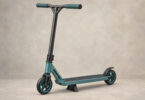

If the old battery in your scooter says 6-DW-7, begin with the scooter’s exact model and version before buying a replacement. That marking appears in listings for 12-volt, roughly 7-amp-hour sealed lead-acid batteries, but it does not identify the complete scooter battery assembly, connector, or wiring harness.
For a Razor scooter, the safest buying route is the genuine replacement specified for its product ID, or a replacement explicitly approved by Razor for that application. Two batteries with matching voltage and capacity can still differ in terminal width, polarity layout, overall height, wiring, and suitability for the scooter.
First identify the complete battery system
Razor’s E300/E300S owner’s manual lists two 12V/7Ah batteries. The manufacturer also describes the E300’s system as 24V using two 12V sealed lead-acid batteries. That is a useful example, not a specification for every Razor model.
In a correctly specified series pack, two 12V, 7Ah batteries provide a nominal 24V, 7Ah system. The amp-hour rating does not become 14Ah. This explains the label differences buyers encounter; it is not a wiring guide. Do not improvise a series connection, change pack voltage, or bypass the original protective components.
Record the scooter’s product ID and version, the full battery label, the number of batteries, and the approved assembly part number. If identification requires access beneath the deck, use the appropriate service instructions or have an authorized service center inspect it. The scooter should be off and disconnected from its charger before battery access.
Replacement routes to compare
1. Genuine Razor W13112430185: check the barcode and version
Razor’s battery page for E200, E300, E300 HD, E300 HDL, and RX200 lists part W13112430185 and provides a barcode-ID check. Use that check rather than assuming that every scooter carrying one of those model names takes the same assembly.
The linked Razor service bulletin is specifically headed E200 V13+ and E300 V11 and V13+. That version-specific scope matters. Ask Razor to confirm the current replacement and instructions for an older or otherwise different version. Confirm whether the supplied assembly includes all required wiring and protective components before ordering.
Choose this route when: you want the manufacturer to establish the appropriate replacement for the complete scooter, especially if its existing harness is damaged or the battery history is unknown.
2. Mighty Max ML7-12: a bare-battery specification comparison
Mighty Max markets an ML7-12 replacement for Enduring 6-DW-7. Its current manufacturer page identifies 12V, 7.2Ah, sealed lead-acid/AGM chemistry, F1 terminals, and dimensions of 5.90 × 2.50 × 3.90 inches. The page offers multiple pack quantities, so verify the selected quantity.
Those numbers describe the battery, not a confirmed Razor-ready assembly. The small capacity difference from 7Ah does not establish compatibility, and the “6-DW-7 replacement” description is the battery seller’s claim rather than Razor approval. Ask for a current dimensional drawing, terminal layout, and confirmation of what the selected package includes. If your measured battery or tray disagrees with a listing, resolve the mismatch before buying.
Consider it only when: the scooter maker or qualified service provider has confirmed that this exact battery specification is suitable and that the approved harness and protective components remain compatible.
3. ExpertPower EXP1270: two F1 batteries, not a complete scooter pack
The ExpertPower EXP1270 product page identifies a 12V, 7Ah sealed lead-acid battery with F1 terminals. Its dimensional drawing gives a 5.94 × 2.56 × 3.70-inch case and a 3.94-inch total height, each with a stated ±0.06-inch tolerance. Allow additional clearance for the installed connector and wire.
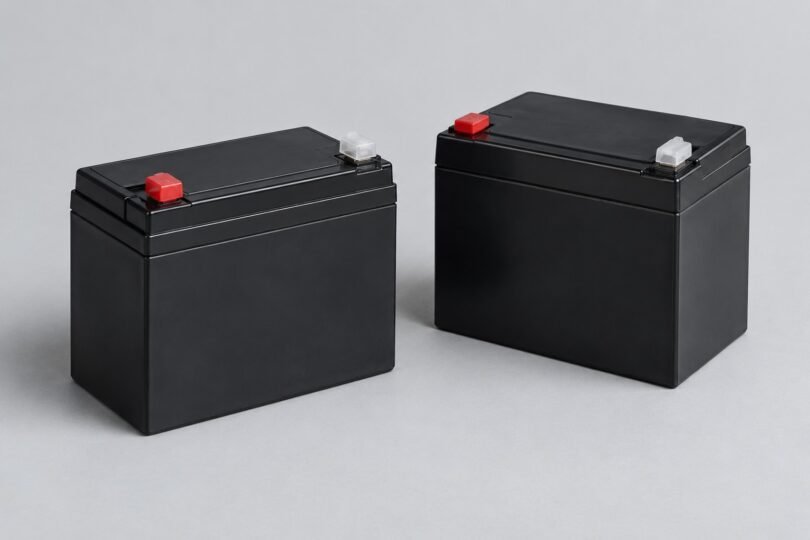
The selected listing below is the two-battery variant. Treat it as a component comparison, not a promise of fit for your Razor. A two-pack does not by itself provide a model-specific wiring harness, fuse arrangement, or mounting solution. Obtain application approval before substituting bare batteries into an existing assembly.
ExpertPower EXP1270 12V 7Ah SLA Batteries with F1 Terminals, 2 batteries
As an Amazon Associate we earn from qualifying purchases.
Seven compatibility checks that matter
- Chemistry: match the manufacturer’s specified battery technology. SLA means sealed lead-acid; AGM describes an absorbed-glass-mat construction used in many such batteries. A lithium or LiFePO4 battery with a similar case is not an approved substitute by appearance.
- Voltage: distinguish the voltage of one battery from the voltage of the complete pack. Match the scooter’s specified system without changing the controller or charger arrangement.
- Capacity and intended use: confirm the specified amp-hour rating and suitability for repeated scooter use. A standby-life claim for an alarm or UPS is not a scooter-runtime promise.
- Dimensions: check length, width, case height, total terminal height, connector clearance, bracket fit, and available cable space. Do not force the deck closed against a battery or wire.
- Terminals: match the exact terminal specification. F1 and F2 terminals are different specifications. Confirm the terminal type against the approved battery and the exact replacement’s dimensional drawing; a visually similar tab is not enough to establish a match.
- Polarity and harness: compare the marked positive and negative terminal locations, connector keying, lead lengths, and approved wiring arrangement. Do not establish polarity from wire color or a generic sales photo alone.
- Package contents: establish whether the order supplies one battery, two batteries, or a complete prewired pack. Confirm the required connector and protective components for the exact scooter version.
A larger amp-hour number is not an automatic upgrade. A different terminal, case height, charging requirement, or harness can outweigh an apparent capacity advantage. Keep the original voltage and chemistry unless the scooter manufacturer provides an explicitly supported replacement system.
Charging and handling precautions
Razor warns that the wrong battery or charger can cause fire or explosion. Battery handling should be done by an adult. Never short the terminals with a tool or other metal object, and do not use or charge a cracked, leaking, swollen, or otherwise damaged battery. Do not open a sealed battery, attempt to refill it, or improvise repairs to burnt or loose connections. The battery service bulletin covers the relevant safety precautions.
Use only the charger recommended for the exact scooter and approved battery system. A matching plug or “24V” sales title does not prove compatibility. Do not use an automotive charger, a generic lithium charger, or a converter selected merely because it fits the charging socket.
Follow the charging duration and storage instructions supplied for your particular version. Razor’s older battery bulletin and newer E300 manual contain different charging schedules; do not combine them into one universal rule. Ask Razor which instructions apply if the replacement paperwork and scooter manual disagree.
Before blaming the battery
Short ride time does not prove the batteries are the only fault. Razor’s E300 troubleshooting guidance also identifies riding conditions, tire pressure, incomplete charging, and brake drag as possible factors. A service center can assess the complete system without guessing from a charger light or a single label.
Avoid buying one new battery to pair with an old, unassessed battery simply because it costs less. Ask the service provider whether the complete matched set should be replaced. Keep the purchase information and the approved part number so a future replacement can be identified without repeating the investigation.
Disposal and final choice
Used sealed lead-acid batteries belong with an approved battery recycler or an accepting battery retailer, not in household trash or a fire. Avoid contact with leaking electrolyte and seek professional handling guidance for a damaged pack. Razor’s battery-care section provides disposal and exposure precautions.
The best 6-DW-7 replacement purchase starts with the scooter’s identity. Confirm its approved assembly first, then compare the exact battery chemistry, voltage, capacity, dimensions, terminals, polarity, harness, and quantity. If any of those remain uncertain, use Razor’s product support or an authorized service center before ordering.