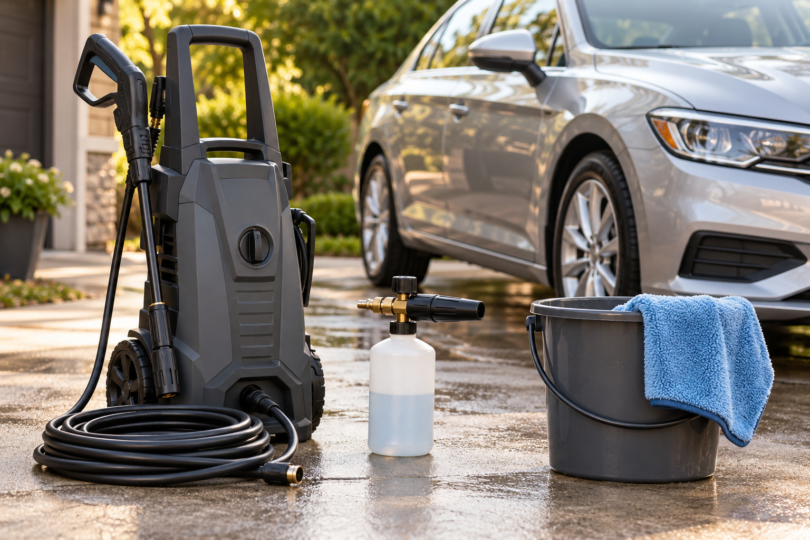

For a home car-washing setup, the Kärcher K1700 Cube is our compact pick and the RYOBI RY142022 is our wheeled pick. Both have a documented 1.2 GPM specification and a practical route to a matching foam attachment. Choose between storage and transport needs first, then check the exact cannon, fittings and operating limits. Neither is a universal match for every foam cannon.
These are feature-based recommendations from manufacturer specifications and instructions. We have not measured their foam output, noise or long-term durability. The comparison covers two corded electric washers and compatible foaming options; foam attachments are separate purchases unless the selected seller explicitly includes them.
The two pressure-washer setups at a glance
| Pressure washer | Published pressure and flow | Foaming option | Best fit and main limit |
|---|---|---|---|
| Kärcher K1700 Cube, yellow, model 1.106-113.0 | 1700 PSI operating pressure; 1.2 GPM maximum water volume | Kärcher Quick Connect Foam Nozzle 8.756-997.0, listed in the model’s accessory sheet | Compact storage; needs a suitable nearby outlet because its manual prohibits extension cords. |
| RYOBI RY142022 | 2000 PSI maximum; 1.2 GPM maximum | RYOBI RY31F04 foamer, 1/4-inch quick-connect inlet, up to 3300 PSI and 4 GPM | Wheels and telescoping handle; the higher PSI number does not establish better foam. |
Read the labels on those numbers: Kärcher’s manual calls 1700 PSI its operating pressure, while the RYOBI manual labels 2000 PSI a maximum rating. These figures are not a side-by-side test under an identical nozzle load. For a third-party cannon, obtain its required flow range and pressure limits before ordering; a matching connector alone does not establish compatibility.
1. Kärcher K1700 Cube: best for compact storage
The K1700 Cube makes sense when you want to carry the washer out for a wash and store it afterwards. Its manufacturer sheet describes a compact body, on/off foot switch, integrated storage bin and 0.3-gallon detergent tank. The yellow 1.106-113.0 configuration is the one compared here.
For a documented foam pairing, choose the Kärcher Quick Connect Foam Nozzle, part 8.756-997.0. Kärcher lists that exact accessory on the K1700 Cube data sheet. Because that model-specific sheet is older, confirm the exact part is still approved for your washer before purchase. The washer’s built-in detergent tank is a separate detergent-delivery option; it does not mean a bottle-style foam cannon is included. Check the chosen package before buying.
The main constraint is electrical reach: the K1700 Cube manual says not to use an extension cord. Plan the washing position around a suitable outlet and the supplied hose and power cord. It also requires a cold-water supply of at least 2 GPM and a garden hose at least 5/8 inch in diameter; that inlet-water requirement is different from the washer’s 1.2 GPM output specification.
Buy this configuration if a carryable, compact washer and a manufacturer-listed foam accessory meet your needs. Pass on it if reaching your work area depends on an extension cord. The black K1700PSB Cube and other K-series variants have different model numbers, so do not treat a color or size substitution as the same purchase.
Kärcher K1700 Cube — Yellow, Model 1.106-113.0
As an Amazon Associate we earn from qualifying purchases.
2. RYOBI RY142022: best for wheeled transport
The RYOBI RY142022 is the more practical choice if you prefer a rolling frame with a telescoping handle. Its product page specifies 2000 PSI and 1.2 GPM, onboard accessory storage and a metal wand with a 1/4-inch quick-connect nozzle coupler. The three listed nozzles are 15-degree, turbo and soap.
The separately sold RYOBI RY31F04 Foam Blaster is a straightforward foaming option to check against this washer. Its manufacturer instruction sheet specifies a 1/4-inch quick-connect plug, a maximum of 3300 PSI and 4 GPM, and cold water only. Those stated upper limits exceed the washer’s published maximums, and the connector types match. This is a specification-based pairing, not a claim that we tested the foam.
RYOBI’s foamer instructions specify its concentrated foaming detergent. Follow the exact accessory instructions when choosing and diluting soap. The washer’s soap tank and low-pressure soap nozzle are a different system; neither the tank nor the included soap tip is the separate RY31F04 attachment.
Buy the RY142022 for its transport and storage arrangement, rather than assuming its larger PSI figure will produce thicker foam. Its operator’s manual specifies a 120 V, 60 Hz, 13-amp supply and detailed electrical precautions. Follow that model’s GFCI and cord instructions, and keep electrical connections dry and away from spray.
Use the RY142022 manufacturer page to confirm the exact package and current seller options.
What to check before buying a washer for a foam cannon
Match the complete connection path
Check the washer outlet, hose ends, gun inlet and accessory connection separately. A 1/4-inch quick-connect nozzle fitting does not describe every connection in the system. Keep every component within its pressure, flow and temperature ratings, and use accessories approved for the washer. Do not force mismatched fittings or assume an adapter resolves a rating mismatch.
Check the supply as well as the output
A washer needs adequate incoming water and the specified electrical supply. For example, the K1700 Cube calls for at least 2 GPM at the water supply even though its published maximum output is 1.2 GPM. Confirm these requirements at the place you plan to wash, and budget for the approved foam accessory as part of the setup.
Treat foam as part of the wash
Use detergent approved by both the washer and the foam attachment, and follow the product label for the surface being cleaned. Do not assume thicker foam proves better cleaning or paint safety. Kärcher’s cleaning instructions warn against allowing detergent to dry on a vehicle and advise testing an inconspicuous area first.
Safe handling matters more than extra pressure
Wear the eye and other protective equipment specified in the manual, use stable footing, and keep bystanders and pets outside the work area. Never aim the jet at people, animals, electrical equipment or the washer itself. High-pressure spray can penetrate skin; seek medical attention immediately if that happens.
Test the GFCI as instructed before use and stop if it fails. Keep plugs and connections dry and off the ground, and never handle a plug with wet hands. Do not bypass electrical protection or improvise around a tripping circuit. Follow the exact washer’s rules for cords; the K1700 Cube expressly forbids extension cords.
Shut off the equipment and relieve stored pressure according to the manual before removing parts or changing connections. Engage the trigger safety lock when appropriate. Follow the vehicle and washer instructions for nozzle choice and distance, starting with a small inconspicuous test area; do not assume a turbo nozzle is suitable for paint.
Frequently asked questions
Which pressure washer is best for a foam cannon at home?
Of these two, choose the K1700 Cube for compact storage and the RY142022 for its wheeled frame. Confirm the exact foamer, connector, supply and operating limits before buying. Neither recommendation promises a particular foam thickness.
Is 1.2 GPM enough for every foam cannon?
No universal minimum applies across the accessories considered here. Buy against the cannon manufacturer’s requirements. The Kärcher accessory is explicitly listed for the K1700 Cube, while the RYOBI pairing is based on its matching connection and published upper limits. Do not assume those checks qualify a different cannon.
Is the foam cannon included with these washers?
Treat the named foam attachments as separate purchases unless the selected package says otherwise. The compared K1700 Cube listing identifies the washer and three nozzle types; RYOBI lists three nozzles with its washer. A soap nozzle or detergent tank is not the separate foam attachment.
Can I use an extension cord?
Follow the exact model’s manual. The K1700 Cube manual says not to use one. RYOBI supplies model-specific cord requirements; those do not override Kärcher’s restriction or apply to another washer. Choose a setup that fits your available electrical supply.
Should I buy the highest PSI rating for thicker foam?
No. Compare the cannon’s operating requirements with the washer’s documented output, and consider storage, transport and safe connections. The quoted pressure figures use different labels, so they do not establish which setup produces more foam.