
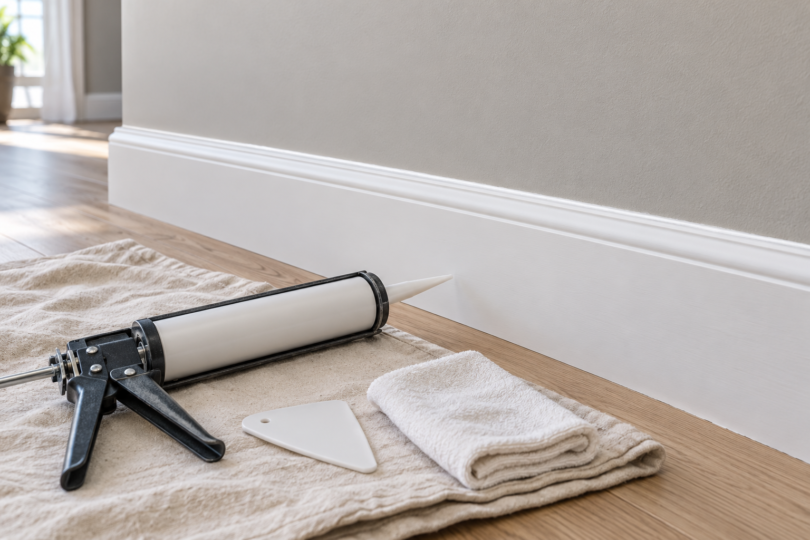

For a small gap where a painted baseboard meets the wall, start with a paintable acrylic caulk whose label covers the trim material and joint size. DAP ALEX PLUS White is a practical small-job option; DYNAFLEX 230 Pro White is worth considering when a published movement rating matters; Sashco Big Stretch White suits a properly sized joint when you can allow a longer wait before interior painting.
This comparison is for interior trim-to-wall seams. A loose board, a damaged wall or a flooring expansion gap calls for its own repair or installation instructions. The recommendations below are based on manufacturer technical documents, not hands-on durability testing.
Caulk for baseboards: three options compared
| Exact version | Best fit | Paint timing | Important limit |
|---|---|---|---|
| DAP ALEX PLUS White, 18128, one 5.5 fl oz squeeze tube | A small ordinary trim-to-wall job without a caulk gun | At least 30 minutes; longer in cool or humid conditions | Up to 1/2 in wide × 1/2 in deep; excludes butt and expansion joints |
| DAP DYNAFLEX 230 Pro White, 07102 / WT099, one 10.1 fl oz cartridge | Painted wood, composite or PVC trim where movement is a concern | Application instructions specify 2–4 hours; allow longer when needed | Up to 2 in wide × 1/2 in deep; a large gap may still need carpentry work |
| Sashco Big Stretch White, 10016, one 10.5 oz cartridge | A suitably sized moving joint with a flexible painting schedule | 1–2 days for interior paint; one week for oil-based paint | Minimum 1/4 in bead; maker prefers 3/8 in or larger |
These are three different formulas and package sizes. White and clear variants can have different instructions, and a case of cartridges is a different purchase from one tube. Paint-ready time is not the same as full drying or cure time.
1. DAP ALEX PLUS White: for a small, straightforward trim job
The white 18128 squeeze tube contains 5.5 fl oz of siliconized acrylic latex caulk. DAP lists baseboards, wood, drywall and other building surfaces among its uses. The small tube is convenient if you have a short run to finish and do not want to buy a cartridge gun. Confirm compatibility with the exact trim surface; the manufacturer calls for pretesting materials and identifies plastics that do not bond well. Check DAP ALEX PLUS sizes and product details.
The white formula’s technical data sheet specifies a maximum joint of 1/2 inch wide by 1/2 inch deep, application from 40°F to 100°F, and at least 30 minutes before latex or oil-based paint. Typical full dry-through and water-ready time are 24 hours, with cold or humidity slowing drying. Wet cleanup uses water; dried excess needs cutting or scraping.
Advantages: Small squeeze-tube format, a short stated wait before painting, and water cleanup. Limitations: DAP explicitly excludes butt joints, expansion joints, surface-defect filling, tuck-pointing and continuous underwater use. The sheet cites ASTM C834 but does not give a ±25% movement rating. Do not use it as a substitute for a movement-rated joint sealant or assume that it is the right filler between two board ends.
2. DAP DYNAFLEX 230 Pro White: for a published movement rating
Look for the Professional/Pro product in White WT099, code 07102, in a 10.1 fl oz cartridge. This is an advanced acrylic elastomeric sealant, not 100% silicone. DAP’s technical sheet identifies wood, composite and PVC trim among its applications and lists ASTM C920 Class 25. You will need a compatible cartridge gun. Check DYNAFLEX 230 Pro White specifications.
The Pro white-and-colors technical sheet gives ±25% dynamic joint movement and permits joints up to 2 inches wide by 1/2 inch deep, using backer rod when depth exceeds 1/2 inch. Although the headline says paintable in two hours, the application directions say to allow 2–4 hours before latex or oil-based paint, longer in cool or humid conditions. The listed application range is 40°F to 100°F; the directions say above 40°F.
Advantages: A stated movement rating and explicit wood, composite and PVC trim uses make this a useful candidate for seams that move. Limitations: It needs a longer painting wait than ALEX PLUS and is not for continuous underwater use or filling surface defects. Typical full dry-through and water-ready time are 24 hours. Clean wet excess with water. The maximum gap rating is a product limit, not a recommendation to hide a poorly fitted baseboard under a two-inch strip of sealant.
3. Sashco Big Stretch White: when you can allow more drying time
Sashco identifies White 10016 as a 10.5 oz cartridge of its water-based, 100% acrylic Big Stretch sealant. Its listed uses include interior baseboards, and supported surfaces include wood, drywall and PVC. It is an option when the bead can meet the manufacturer’s size requirements and your painting schedule has room for a longer wait. Check Big Stretch colors, sizes and manufacturer resources.
The current linked technical sheet calls for a minimum 1/4-inch bead, preferably 3/8 inch or larger, with a maximum joint width of two inches. Insert backer rod in joints deeper than 1/2 inch. The surface-temperature application range is 40°F to 120°F. For this interior task, allow 1–2 days before interior paint, or one week for oil-based paint; the four-hour exterior painting figure is not the interior instruction. Full cure is typically 4–5 days, depending on conditions and bead size.
Advantages: Acrylic chemistry, broad listed surface compatibility and soap-and-water cleanup. Limitations: The minimum bead requirement can make it an awkward choice for a tiny cosmetic seam. Natural shrinkage can leave a concave joint, and flat or brittle paints may crack over a moving bead, so test the finish. It is not for submerged joints or walking surfaces. The sheet lists ASTM C920 Class 25; its maximum-stretch marketing number is not a permissible joint-design allowance.
Choose the joint before choosing the tube
- Identify the seam. The top edge between baseboard and wall is different from a butt joint between board ends or the floor perimeter. Match the sealant instructions to the actual joint. ALEX PLUS’s butt-joint exclusion is especially easy to miss.
- Measure width and depth. Do not choose by gap width alone. Use the selected product’s backer-rod and bead-size instructions, and improve the fit of loose or badly spaced trim before finishing it.
- Check the material and finish. Painted wood, MDF, PVC and other synthetic trim are not automatically interchangeable. DYNAFLEX 230 Pro explicitly lists composite and PVC trim; test unusual coatings and follow your trim manufacturer’s instructions.
- Plan the painting day. Choose the actual color and formula first, then read its technical sheet. Allow extra time for a cool room, humidity or a thick bead; a surface skin does not mean the whole bead has dried.
- Keep wet areas separate. A bathroom baseboard outside splash zones is a different job from a tub, shower or submerged joint. These trim recommendations do not qualify a product for every wet-area application.
- Compare the whole purchase. Check single-tube versus case quantity, net contents, whether you need a caulk gun and the planned bead size. Stated coverage at different bead diameters is not directly comparable.
Preparation that matters more than an extra-wide bead
Remove failed caulk and silicone residue, clean the joint and let it dry. Work on a sound surface. If the baseboard moves when pressed, secure or repair it before treating the remaining seam as a cosmetic sealing job. Use an appropriate filler for nail holes and surface defects rather than assuming that the seam caulk is also a sandable wood filler.
Cut the nozzle for the required bead, apply a continuous line and tool it before a skin forms. Use a finishing tool and follow the selected product’s directions; avoid spreading a broad film over the wall and trim. Clean wet excess promptly. If using masking tape, remove it before the caulk skins over.
Low odor and water cleanup do not mean harmless. Read the label and safety data sheet, ventilate the area and use the specified gloves and eye protection. Keep sealants away from children and pets. Product-specific safety documents are available for ALEX PLUS, DYNAFLEX 230 and Big Stretch Colors.
Frequently asked questions
Can I use construction adhesive instead of caulk?
Choose a product labeled for the sealing job. Construction adhesive is purchased to bond materials, while the products compared here are specified for sealing joints. Paintability or gap-filling language on an adhesive does not establish that it is suitable for a visible baseboard seam.
Should I caulk the bottom of every baseboard?
Follow the flooring manufacturer’s perimeter-gap and moisture-sealing instructions. This guide compares the baseboard-to-wall seam; it does not authorize filling every floor expansion space. Do not assume the same detail works for carpet, wood, laminate and tile.
How soon can I paint baseboard caulk?
For the exact versions here, ALEX PLUS White specifies at least 30 minutes, DYNAFLEX 230 Pro’s application directions specify 2–4 hours, and Big Stretch specifies 1–2 days for interior paints or one week for oil-based paints. Cooler or more humid conditions can require longer. Follow the label on your tube.
Can these products go over old silicone?
Remove the old silicone and residue and prepare a clean, dry surface before using these acrylic products. Sashco specifically identifies poor adhesion to silicone. Covering a failed bead is not a substitute for preparing the joint.
Will caulk fix a loose baseboard or structural crack?
No product in this guide is selected as a structural repair or a fire-rated seal. Repair loose trim and investigate recurring movement or damage before finishing the seam. For a rated joint, use the specified tested system rather than substituting ordinary trim caulk.


