
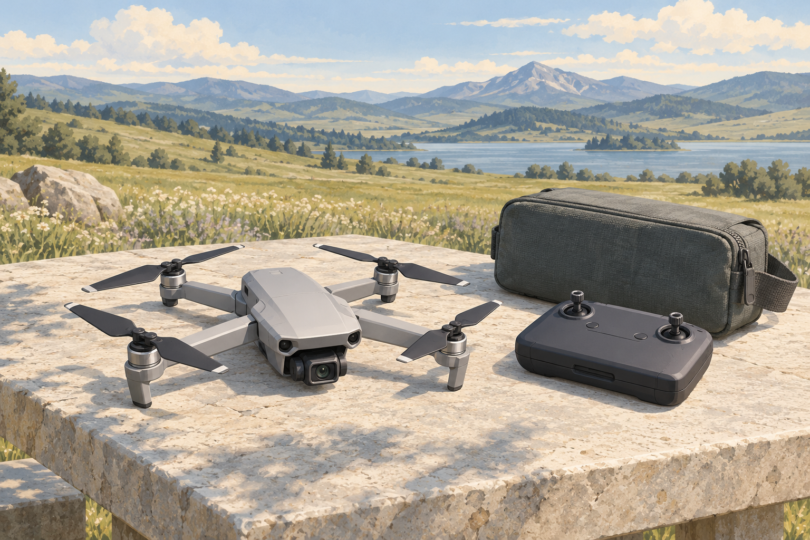

The DJI Mini 4K is our pick for a straightforward first camera drone. Choose the Potensic ATOM 2 Fly More Combo if subject tracking and three included batteries matter more, or the DJI Mini 4 Pro with DJI RC 2 if you want a screen controller, native vertical video, and obstacle sensing.
All three have a three-axis mechanical camera gimbal. That makes them more appropriate for composing aerial photographs and video than a flying orb or a small stunt toy. The recommendations below compare documented features and exact packages; they are not based on our own flight testing. Confirm the selected bundle, seller, condition, and delivered price before buying.
Best camera drones at a glance
| Our pick | Best fit | Exact kit linked | Main limitation |
|---|---|---|---|
| DJI Mini 4K | Learning to frame and fly basic 4K shots | RC-N1C controller; one flight battery; compatible phone needed | No obstacle avoidance or subject-following mode |
| Potensic ATOM 2 Fly More Combo | Tracking shots and more battery changes between charging stops | Standard phone-based controller; three batteries; charging hub and bag | Tracking does not include obstacle avoidance |
| DJI Mini 4 Pro (DJI RC 2) | Portrait video, more camera options, and a built-in controller screen | DJI RC 2; one standard Intelligent Flight Battery | Extra batteries cost more; FAA Remote ID depends on the battery configuration |
The table describes the linked packages, not every bundle sold under those model names. A controller, extra battery, or accessory kit sold separately is not a complete drone.
1. DJI Mini 4K: best straightforward starter
DJI Mini 4K with RC-N1C Controller and One Flight Battery
As an Amazon Associate we earn from qualifying purchases.
Start here if your priority is learning manual flying and making simple landscape clips. The Mini 4K records up to 4K at 30 frames per second, takes 12-megapixel photographs, and stabilizes the camera with a three-axis gimbal. Its QuickShots automate a handful of camera movements, such as circling a subject. They do not turn it into a drone that follows you continuously.
The linked package includes the aircraft, an RC-N1C controller, and one flight battery. The controller uses your compatible smartphone for the DJI Fly app and live view; its face does not contain a screen. Check your phone against the current DJI Fly download and compatibility information before ordering. Budget for a suitable microSD card and USB power adapter if you need them; neither is listed in this kit’s contents.
- Choose it for: a compact first camera-drone kit with straightforward 4K capture.
- Skip it if: you specifically want subject tracking, a controller screen, or automatic obstacle avoidance.
- Battery expectation: DJI specifies a maximum of 31 minutes per battery under controlled test conditions. Only one battery is included, so there is no spare to swap in between flights.
The most important limitation is its lack of obstacle avoidance. Downward positioning sensors help it hold position in suitable conditions; they do not protect it from a tree in its flight path. Its user manual also makes clear that the pilot must avoid obstacles. Use automated shots only with a clear flight path and room to stop.
For U.S. buyers who need to register their drone, there is another cost to consider: DJI’s model-specific FAA guidance lists the Mini 4K as lacking FAA Remote ID. A compliant add-on module or an applicable exception, such as flying within an FAA-Recognized Identification Area (FRIA), is needed when Remote ID rules apply. Do not assume a firmware mention of Remote ID for another country establishes U.S. compliance.
2. Potensic ATOM 2 Fly More Combo: best for tracking and extra batteries
The ATOM 2 is the more interesting choice if you want to frame a moving subject and practice repeated takes. Its AI Track modes include Follow, Parallel, and Spotlight. The camera uses a 1/2-inch sensor and records 4K HDR video at up to 30 frames per second. The advertised “8K” refers to still photographs, not 8K video.
This link selects ATOM 2 (Three Batteries), with the standard controller that holds a phone. It includes three flight batteries, a parallel charging hub, and a shoulder bag. It is different from the separate RC PTD 1 screen-controller package. You need a compatible phone running Potensic Eve for the standard controller; check current app requirements before buying. A phone shown in a product photograph is not included.
- Choose it for: subject-tracking features and a three-battery kit that is useful for several short flights.
- Skip it if: you want the drone to detect and steer around obstacles while following a subject.
- Battery expectation: the manufacturer specifies up to 32 minutes per original battery. The listing’s 96-minute figure adds three separate maximum-duration flights together.
Potensic explicitly says the ATOM 2 does not have obstacle avoidance. Tracking a person near branches or poles still requires an attentive pilot and a clear route. Its vertical video mode tops out at 2.7K; choose the Mini 4 Pro below if native 4K portrait capture is a priority.
The ATOM 2 has built-in Remote ID, and the FAA’s accepted declaration lists this exact model. Keep its firmware current and verify the Remote ID settings and status before a flight that requires it. This is also why the ATOM 2 can be a more convenient starting point than the Mini 4K when registration is needed, although the pilot must still meet the operating rules.
There is a newer ATOM 3. At this check, Potensic’s own ATOM 3 store page explicitly marked it unavailable in the United States. That store-specific restriction is why the ATOM 2 remains on this U.S. shortlist; a global announcement or a dollar price alone does not establish a suitable U.S. offer.
3. DJI Mini 4 Pro with DJI RC 2: best for portrait video and a screen controller
Choose the Mini 4 Pro when you know you will use its camera and flight features. Its 1/1.3-inch sensor, 4K/60fps HDR video, and 10-bit D-Log M option give it more recording choices than the two simpler models above. The gimbal rotates for native vertical shooting, which is particularly useful if you regularly make portrait-format videos.
The selected kit includes DJI RC 2 and one standard Intelligent Flight Battery. RC 2 has its own display and DJI Fly app, so you do not have to mount your phone to see the live view. Internet access is needed for initial activation and updates. The listed kit does not include the Fly More package’s extra batteries, charging hub, or shoulder bag.
- Choose it for: native portrait capture, a screen controller, and more capable flight assistance.
- Skip it if: you mainly want occasional basic 4K clips and would not use the additional camera controls.
- Battery expectation: up to 34 minutes with the included standard battery. The separate Plus battery’s 45-minute specification does not describe this one-battery kit.
The Mini 4 Pro combines omnidirectional vision sensing with obstacle-avoidance features that can brake or bypass in supported modes and conditions. It is still possible to crash. DJI’s manual disables obstacle avoidance in Sport mode and describes limits involving lighting, surfaces, and small obstacles. A camera-drone purchase should not depend on the expectation that sensors will prevent every collision.
Check the battery before relying on FAA Remote ID. DJI’s detailed FAA Remote ID guidance says Mini 4 Pro’s built-in FAA broadcast activates with the Intelligent Flight Battery Plus. The standard battery in this kit does not provide that configuration. If your operation requires Remote ID, plan a compliant configuration before flying. A Plus battery also takes the aircraft above the sub-250-gram class; it is not a way to extend flight time while retaining the same weight exemption.
What to check before choosing a kit
Buy the camera features you will use
All three models offer mechanically stabilized video, but their strengths differ. The Mini 4K suits basic aerial framing. The ATOM 2 adds tracking and more included batteries. The Mini 4 Pro adds native portrait capture, more video options, and broader sensing. “4K” alone does not describe the quality of the lens, stabilization, exposure, or the footage you will get in your conditions.
Compare the complete purchase
Check the controller name and battery count before comparing prices. Also account for a compatible memory card, appropriate charger, spare propellers, and any Remote ID equipment your operation needs. For marketplace offers, verify the actual seller and U.S. warranty coverage. A brand-store banner does not by itself identify the seller or establish warranty eligibility.
Treat flight times and transmission ranges as specifications
DJI’s current Mini 4K specifications measure its 31-minute maximum at 17 kph and the Mini 4 Pro’s specifications measure its 34-minute maximum at 21.6 kph, under controlled windless-equivalent conditions in Photo mode. The Mini 4 Pro test specifies the Brake obstacle setting. Potensic’s ATOM 2 specification measures its 32-minute maximum at 5 m/s in low-altitude, windless conditions. These are manufacturer test figures, not our measured flight times or a target for draining the battery.
Wind, temperature, maneuvering, recording, and your return reserve affect usable time. Return and land with a margin. Likewise, advertised transmission ranges describe radio-link testing, not permitted flying distances. A working video feed does not replace visual line of sight, and Return to Home is a feature you must configure and supervise rather than a guarantee against losing the aircraft.
U.S. flight requirements still matter for small drones
The FAA registration exception applies to drones weighing less than 250 grams that are flown under the Exception for Limited Recreational Operations. Weigh the aircraft as flown, including its battery and accessories. A different battery, guards, lights, or a Remote ID module can change the result. Part 107 operations require registration even below that weight.
Recreational pilots still need to pass TRUST and carry proof, follow an FAA-recognized community-based organization’s safety guidelines, and keep the aircraft within visual line of sight or use a co-located visual observer in direct communication. They must give way to other aircraft, obtain required controlled-airspace authorization, and stay at or below 400 feet in Class G airspace or the authorized altitude in controlled airspace. Check the FAA’s recreational flying rules and local launch-site restrictions before taking off.
Drones that are registered or required to be registered must meet the Remote ID rules, using an appropriate compliant aircraft or broadcast module, or an applicable exception. Check the exact model or module in the FAA Declaration of Compliance database. A manufacturer’s general “under 249g” marketing line is not a complete compliance check.
Frequently asked questions
Which of these drones is best for a beginner?
The DJI Mini 4K is the straightforward choice for learning basic camera-drone flying. Pick the Potensic ATOM 2 Fly More Combo for subject tracking and three included batteries. The DJI Mini 4 Pro with RC 2 is the upgrade for native vertical video, a controller screen, and more flight-assistance features.
Do I need a smartphone to use these drones?
The linked Mini 4K and ATOM 2 kits use a compatible smartphone with their flight apps and standard controllers. The linked Mini 4 Pro includes DJI RC 2, which has a built-in screen and DJI Fly. It still needs internet access for initial activation and updates.
Does a drone under 250 grams need FAA registration?
The exception applies only when the aircraft weighs less than 250 grams as flown and is operated under the limited recreational exception. Part 107 drones require registration regardless of that weight. TRUST and applicable flight rules still apply to recreational flying, and registered or registration-required drones must also meet Remote ID rules or an applicable exception.
Will obstacle sensors prevent a crash?
No. The Mini 4K and ATOM 2 do not have obstacle avoidance. The Mini 4 Pro has omnidirectional sensing and supported avoidance functions, but they have environmental and operating limits, and avoidance is disabled in Sport mode. The pilot remains responsible for a clear flight path.
Does a three-battery drone kit fly for 96 minutes continuously?
No. The ATOM 2’s advertised 96 minutes adds three manufacturer-rated 32-minute maximum flights. You must land to change batteries, and actual usable time depends on conditions and a safe return reserve. The linked Mini 4K and Mini 4 Pro kits each contain one battery, rated up to 31 and 34 minutes respectively.


