
The best comic book storage starts with the size of your collection, including its protective sleeves. For most ungraded Current and Silver Age issues, a short comic box is a practical starting point. Choose a rigid plastic bin if you want a movable partition and locking lid, or cardboard boxes when you need straightforward storage for several runs. Golden Age books, oversized editions, and graded slabs need a separate fit check.
Measure first, then choose the enclosure and shelf space. A box’s advertised comic count is only a guide: thick issues, backing boards, and rigid holders all reduce capacity.
Two useful storage options for ungraded comics
These picks are based on published specifications and fit, rather than hands-on testing. Neither is a universal solution for every comic format.
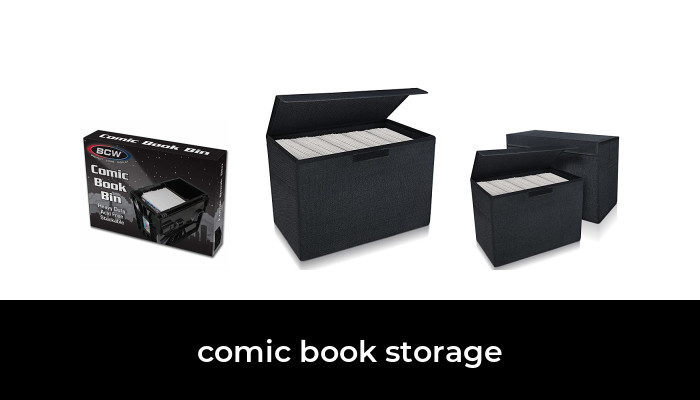
BCW Short Comic Book Bin, black, single

BCW Short Comic Book Bin, Black, Single Unit
As an Amazon Associate we earn from qualifying purchases.
For a growing Current or Silver Age collection. The polypropylene construction, sliding lid locks, and included movable partition make this a useful choice when you want supported storage without filling the whole bin.
- Manufacturer capacity: approximately 150 bagged-and-boarded comics
- Interior: 7⅝ inches wide × 11¼ high × 15½ long
- Limit: not intended for graded slabs; check wider bags before buying
BCW Short Comic Storage Boxes, white, 5-pack

For organizing several ungraded runs. This listing contains five corrugated cardboard boxes. BCW’s standard short box has reinforced handles and a double-thickness bottom, with a removable lid.
- Manufacturer capacity: 150–175 Current or Silver Age comics per box
- Interior per box: 7⅝ inches wide × 10⅞ high × 15½ long
- Limit: cardboard needs a dry location; the box alone does not replace individual protective enclosures
Match the comic, bag, and board before choosing a box
“Modern,” “Silver,” and “Golden” describe useful supply categories, but publication dates do not guarantee identical dimensions. Measure the actual book, allowing for thickness, then check the completed bag-and-board package against the box’s internal width and height.
For reference, these are BCW’s standard bag and board dimensions, not universal comic-book measurements:
| Supply category | Standard bag, width × height | Matching board examples |
|---|---|---|
| Current/Modern | 6⅞ × 10½ inches | Modern: 6⅝ × 10½; Current: 6¾ × 10½ inches |
| Silver/Regular | 7⅛ × 10½ inches | Regular: 6⅞ × 10½; Silver: 7 × 10½ inches |
| Golden Age | 7⅝ × 10½ inches | Golden: 7½ × 10½ inches |
Annuals and thick specials may need wider bags. A Golden bag nominally as wide as a box’s interior leaves no useful clearance; do not force it in. Look for an appropriately wider enclosure instead. Treasury editions, magazines, and hardcovers also require their own measurements.
Graded slabs need wider, taller storage
A slab’s outer case determines fit, even when the comic inside is a standard Modern issue. Measure the case with any protective outer sleeve, and check the lid clearance and partition spacing. Different holder generations and oversized slabs should not be treated as interchangeable.
As a comparison, the BCW Graded Comic Book Bin has an interior measuring 8¾ inches wide × 13¼ high × 15½ long and a stated capacity of about 30 graded comics. That is wider and taller than its ordinary short bin. The manufacturer still recommends checking individual slab dimensions.
Short box or long box?
Short boxes make sense when you frequently move comics between shelves and a reading table, or want separate containers for particular titles. Long boxes hold more in one place, but the additional books also mean more weight to lift and a deeper shelf requirement.
For scale, BCW’s cardboard long box has a 27½-inch interior length and a stated capacity of 250–300 Current or Silver Age comics. Its short box has a 15½-inch interior length. These are product examples, not standardized dimensions for every brand.
Check exterior dimensions for shelving, including space to lift the lid and pull the box out. Leave enough room inside to retrieve an issue without scraping or squeezing neighboring books. Use a suitable partition to support a partially filled row.
Cardboard, polypropylene, and protective sleeves
Cardboard is straightforward to label and sort. Polypropylene bins offer a rigid shell and, on the featured BCW model, an adjustable partition. Neither material makes the room’s conditions irrelevant.
Use appropriately sized, acid-free comic bags and backing boards rather than loose, unsupported books rubbing together. For long-term preservation, look for clearly identified materials. The Library of Congress considers uncoated polyethylene, polypropylene, and polyester stable plastics and advises avoiding PVC and unknown plastics. For paper enclosures, seek acid- and lignin-free materials. Fragile, flaking comics deserve a conservator’s advice before rehousing.
The storage location matters as much as the box
The Library of Congress’s comic-care guidance recommends a cool, clean, stable environment, relatively dry air around 35% relative humidity, and minimal light. Avoid direct sunlight, heating vents, and locations with temperature extremes or leak risk.
A locking lid is not evidence of waterproof or moldproof performance. The Library also warns that plastic containers in high humidity can increase mold risk. Choose a suitable indoor room rather than relying on a bin to make a damp basement, attic, or garage safe.
Label each box with its contents, keep a simple inventory, and inspect the collection periodically. Correct sizing, gentle handling, and consistent conditions do more for a collection than packing the maximum possible number of comics into every box.