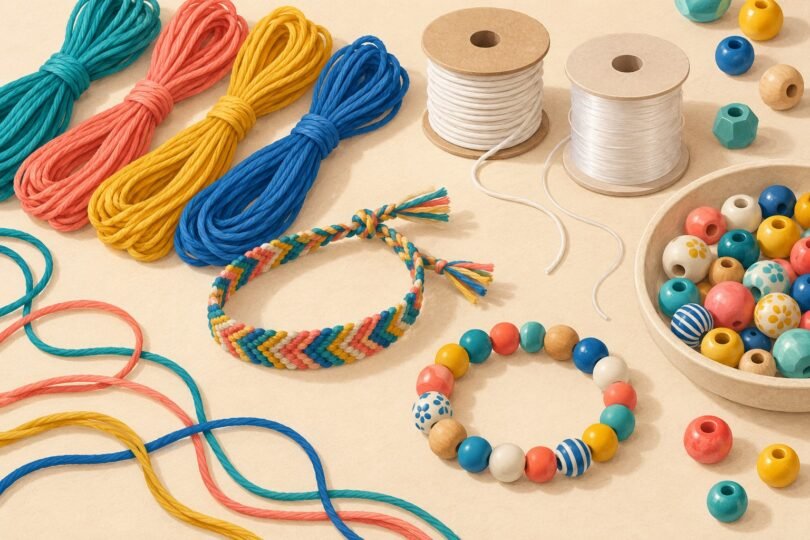

The best string for making bracelets depends on the bracelet you want to make. Use embroidery floss for knotted friendship bracelets, a stable knotting cord for macramé, elastic for a stretch-on beaded bracelet, and flexible beading wire for many clasp-fastened designs. These materials behave differently, so buying the largest mixed bundle is not always the most useful starting point.
First choose the pattern, beads and closure. Then match the cord’s diameter, construction and length to that project. The recommendations below are based on manufacturer specifications and instructions, not hands-on testing or a claim that one material is strongest in every situation.
Match the string to your bracelet
| Bracelet style | Starting material | What to check |
|---|---|---|
| Chevron, striped or braided friendship bracelet | Six-strand cotton embroidery floss | Number of colors, strand count used by the pattern and length per skein |
| Macramé or kumihimo with beads | Nylon knotting or bead cord | Cord thickness, bead-hole clearance and the chosen closure |
| Stretch-on bead bracelet | Jewelry elastic | Smallest bead hole, finished fit and manufacturer’s knot instructions |
| Clasp-fastened stone, crystal or metal bead bracelet | Flexible nylon-coated beading wire | Wire diameter, compatible crimps and room for return passes |
Four useful materials to compare
DMC Six-Strand Embroidery Floss: for classic friendship bracelets
DMC Six-Strand Embroidery Floss, reference 117MC, is 100% cotton and comes in 8-meter, or 8.7-yard, skeins. Its six strands can be separated. For a bracelet pattern that calls for whole floss, use the bundle as directed rather than automatically splitting it into individual strands.
This is a useful starting point for colorful knots and braids. Buy the shades your pattern actually needs, with extra of heavily used background colors. An 8-meter skein describes the length of the bundled floss. If your pattern uses all six strands together, do not multiply that length by six when estimating project yield.
Main limitation: floss is not stretch cord. Plan a tie, loop or other suitable closure, and follow the pattern’s cutting lengths. Do not choose it simply because a bead happens to slide onto it.
Stretch Magic 0.7mm clear, 25 meters: for stretch-on bead bracelets
Pepperell’s Stretch Magic 0.7mm bulk spool contains 25 meters, approximately 82 feet, of elastic bead cord. The clear version is the specific option discussed here. Its diameter is a starting point, not a promise that it fits every seed bead, pearl or gemstone.
Try the cord through the smallest hole in your actual bead mix before stringing the whole bracelet. If your design needs a second pass or a concealed knot, allow for that extra space. Smooth elastic can be slippery to finish, so use the product’s recommended knot rather than assuming a single overhand knot is enough.
Main limitation: an elastic bracelet needs appropriate fit and periodic inspection. More stretch is not a reason to make it too tight, and a large spool does not guarantee a particular number of finished bracelets.

Stretch Magic Clear Elastic Bead Cord, 0.7mm, 25m, One Spool
As an Amazon Associate we earn from qualifying purchases.
S-Lon TEX210: for small macramé and beaded knotwork
The Beadsmith’s S-Lon guide describes TEX210 Bead/Mac Cord as 0.5mm, three-ply twisted, bonded multifilament nylon. It is intended for stringing, kumihimo and macramé. The guide specifies beads with at least a 0.8mm hole for this cord, a useful reminder that matching nominal cord and hole diameters is not enough.
The black TEX210 manufacturer listing specifies 77 yards per spool in a four-spool tube. Check whether a retailer is selling one spool or the whole tube. Do not confuse TEX210 with S-Lon’s finer beadworking threads or heavier 0.9mm cord.
Main limitation: this is knotting cord rather than jewelry elastic. Choose a closure that opens or adjusts as your pattern requires. For an unfamiliar cord, make a short sample first to check knot size and how neatly the ends finish.
Beadalon 49-strand wire: for clasp-fastened bead bracelets
Despite its flexible feel, beading wire is a different material from textile thread or elastic. Beadalon’s manufacturer catalog describes its 49-strand wire as nylon-coated stainless steel. One listed option is Bright, 0.018 inch/0.46mm, in a 30-foot/9.2-meter spool, base code JW11T with length code 0.
For that diameter, the catalog lists a size 2 crimp tube or size 1 crimp bead. Those are Beadalon’s size references, not universal sizing across all brands. Match the wire, finding and tool instructions before making the closure.
Main limitation: this is not stretchy bracelet string. A clasp-based design also needs appropriate findings and room for the wire to return through the crimp and any adjacent beads. Avoid tight bends and do not substitute a knot-only elastic tutorial for a wire-finishing method.
How to choose the right diameter
Start with the smallest bead hole, including spacers, charms and end beads. A bead’s outside diameter tells you little about its hole. Two beads sold as the same size may accept different cords, and a hole that admits one strand may not accept a doubled return pass.
- Test the complete combination. Check cord, needle if used, beads and closure together.
- Inspect the hole edges. Rough or chipped holes can damage stringing material. Set problem beads aside rather than forcing them onto the cord.
- Leave room for the finish. A hidden knot needs a suitable bead hole; a wire return needs clearance through the crimp.
- Check how thickness is described. Round cord has a diameter. Flat or oval elastic may have separate width and thickness measurements, so two products labeled “1mm” need not fit identically.
Knots and glue: follow the specific cord’s instructions
Pepperell’s current Stretch Magic page recommends a Carrick bend, also called a Josephine knot, or a surgeon’s knot. Its knot-tying guidance also permits a small dab of G-S Hypo Cement on the last knot for added security. Follow the illustrated instructions for forming and tightening the knot rather than relying only on its name.
Do not treat that recommendation as approval for every glue on every elastic. Use adhesive compatible with the specific cord, and follow its handling and curing directions. Glue should not be used to rescue a visibly loose knot. Keep enough tail to finish correctly, allow the recommended cure time, and inspect the connection before wearing.
For floss and macramé, finish according to the pattern and fiber. Do not automatically burn the ends: cotton, nylon, coatings and nearby beads react differently to heat. For beading wire, use the specified crimping method and check the finished closure before use.
How much string should you buy?
Use the pattern’s cutting list when available. Knotted bracelets consume much more cord than their finished length, and different strands in the same design may be used at different rates. Leave working tails for starting, finishing and adjusting the fit. Make one sample before cutting supplies for a group.
For budgeting, divide the spool length by your measured cord usage per bracelet, then allow for practice and waste. For example, if your sample uses 0.4 meter, a 25-meter spool gives a theoretical 62 complete cuts before any allowance. That is a planning calculation, not a guaranteed project yield.
Care, storage and crafting with children
Store labeled spools or bobbins away from excessive heat and direct sunlight, and keep leftover cord identified by material and diameter. Inspect bracelets for fraying, damaged coatings, stretched elastic and loose closures. Restring a piece when its condition changes instead of relying on an “unbreakable” claim.
Keep loose beads and small findings away from children under three, and follow each kit’s age guidance. The CPSC explains why small parts can present choking hazards. Older children still need suitable supervision with scissors, needles and adhesives. A cord’s strength or a tight knot does not make small beads safe for a younger child.
For a first project, buy a modest amount of the right material and make a complete sample. Matching the cord to the pattern, beads and closure is more valuable than choosing by spool size or a blanket “best string” ranking.