
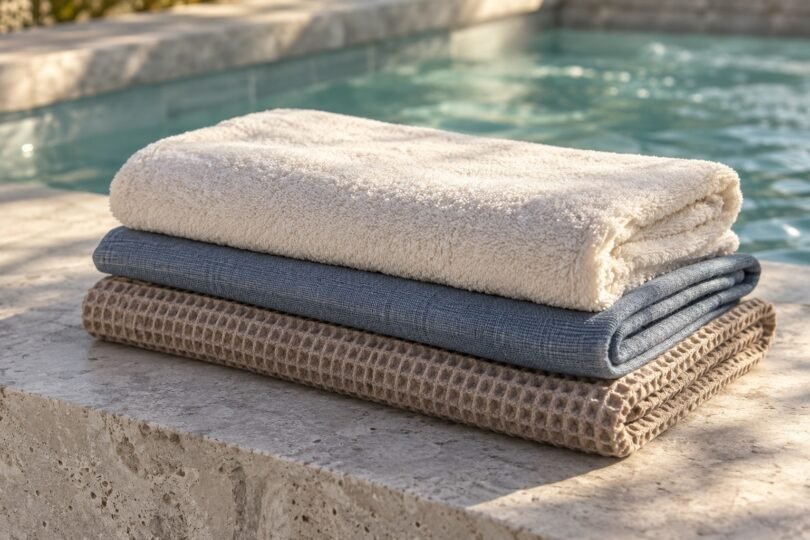

The most useful hot tub towel is large enough to wrap around you, pleasant against wet skin and easy to dry before the next soak. For a home spa, a medium-weight cotton towel is a sensible starting point. Choose a thin flatweave or microfiber towel when packing space and repeat use matter more than a fluffy feel; choose a heavier bath sheet when generous coverage and plushness come first.
There is no need for a towel to carry “hot tub” in its name. Beach towels and bath sheets can do the job well. The important specifications are fabric, dimensions, density, care instructions and the number of usable full-size towels in the package.
Four towel options for different hot tub routines
These choices are based on published product specifications and care guidance, not side-by-side performance testing. The use-case recommendations are practical judgments from those specifications. Select the stated size on each page and check current color choices, price and delivery details before ordering.
L.L.Bean Seaside Beach Towel, Hibiscus: medium-weight cotton
The L.L.Bean Seaside Beach Towel in Hibiscus measures 36 x 68 inches and uses cotton at 450 GSM. L.L.Bean describes it as medium weight and lists machine washing and drying as the care method.
This is a useful middle-ground option if you want a familiar cotton towel with more coverage than a smaller bath towel, without moving to the densest bath-sheet construction. The tradeoff is bulk: compare the folded size and laundry capacity with how many people use the tub. The brand’s performance language is not evidence of a measured drying time in your climate.
Dock & Bay Whitsunday Blue, Large: for compact packing
The Dock & Bay Quick Dry Towel in Whitsunday Blue, Large, is listed at 63 x 35 inches, or 160 x 90cm, and 360g. Its fabric is 83% recycled polyester and 17% recycled polyamide. A hanging loop and carrying pouch make it worth considering for trips to a shared spa or a vacation rental.
Choose this if a slim towel is more useful than terry pile. The smooth microfiber feel is a different experience from fluffy cotton, so buying one first is sensible if you have never used it. Dock & Bay markets the fabric as quick-drying; actual drying depends on airflow and conditions. Select Large and Single if you want the dimensions and quantity discussed here.
Coyuchi Mediterranean Organic Beach Towel: a cotton flatweave
Coyuchi’s Mediterranean Organic Towels use a textured flatweave in 100% organic cotton at 320 GSM. Choose the Beach Towel rather than the Bath Towel or the six-piece set. The beach size is listed as 39 x 71 inches by Coyuchi retailer Holy Lamb Organics.
This is the alternative for someone who wants a lower-density cotton wrap instead of synthetic microfiber. Expect a flatter fabric surface rather than a thick terry pile. Its hand-knotted fringe is also worth considering if you prefer plain, unfussy edges for frequent laundry. Confirm the current beach-size measurements with the seller before purchase.
Frontgate Resort Cotton Bath Sheet: for a substantial wrap
The Frontgate Resort Collection Cotton Bath Sheet, item 22514, is listed at 40 x 72 inches. The collection uses 100% fine-combed, long-staple Turkish cotton at 700 GSM. Select Bath Sheet on the page; the 30 x 58-inch bath towel is a different size.
This is the choice to investigate when a large, plush wrap is the priority and you have space to wash and dry it properly. Its size and fabric density make it a less obvious travel choice. A thicker towel is not automatically the best option if you need several towels to dry between daily sessions or have a small washer.
Choose the size before the color
Measure a towel you already use comfortably. The shorter dimension affects how much of your body it covers from top to bottom when wrapped, while the longer dimension determines how far it reaches around you. Allow some overlap rather than assuming any towel described as “oversized” will fit.
A 30 x 60-inch towel can be convenient for drying off and carrying in a bag. A 36 x 68-inch beach towel gives more fabric to work with, while a 40 x 72-inch bath sheet offers still more coverage. These are examples, not standardized categories: two products both called bath sheets may differ considerably.
For colder evenings, prioritize enough coverage for the walk indoors and keep the towel dry while you soak. A towel left on a damp chair or exposed ledge is less useful when you step out. A dry covered storage spot near the exit often makes more difference than a decorative spa label.
What GSM does and does not tell you
GSM means grams per square meter, a measure of fabric mass over an area. It is not the total weight of the towel. A large towel at moderate GSM can contain more fabric mass than a much smaller towel with a higher number.
For example, a hypothetical 1-square-meter towel at 450 GSM has about 450g of fabric; at 700 GSM, the same area has about 700g. Edges and construction can affect actual product weight. This calculation explains why dimensions and GSM need to be compared together, rather than treating the largest number as a quality score.
Density alone cannot establish softness, absorbency or drying speed. Fiber type, weave, pile, finishing and how the towel is hung all matter. In practical terms, start with moderate-density cotton for an all-purpose home towel, lower-bulk flatweave or microfiber for packing, and dense terry when you specifically want a plush feel.
Quick-drying versus plushness
Think about the job after you dry yourself. Will the towel hang unfolded indoors, sit in a humid pool area, go straight into a washer, or spend an hour in a bag? Even a towel marketed as quick-drying needs a chance to release moisture. A folded pile on a hook provides less exposed surface than spreading the fabric over a rail.
Do not read “quick dry” as a promise that the towel is instantly dry or odor-proof. Compare the manufacturer’s material description and care instructions, then choose a drying routine that fits your home. If you use the hot tub twice in one evening, a second dry towel may be more useful than paying extra for a drying-speed claim with no stated test conditions.
Likewise, cotton origin labels alone do not answer the practical question. Two Turkish-cotton towels can have very different weaves and densities. Decide whether you want loops and cushioning, a drapey flatweave or a smooth synthetic fabric before comparing branding.
Care after hot tub use
Follow the label on the exact towel, especially for washing temperature and bleach. Dock & Bay’s care guidance calls for cold washing below 30°C, avoiding bleach and fabric softener, and air-drying when possible. Its pouches are hand-wash only. Coyuchi’s product page calls for a cold gentle wash with like colors and tumble drying on low.
- Wash before first use if directed by the maker, and follow any instructions for washing new colors separately.
- Spread wet towels out promptly. Do not leave them bundled in a closed bag or storage box between uses.
- Launder soiled towels using the labeled method. Do not make up a stronger cleaning solution just because the towel was used near a spa.
- Dry fully before storing. Keep clean towels in a dry location away from splash and damp outdoor furniture.
- Keep laundry products separate from spa chemicals. A fabric-care label is not an instruction to use concentrated hot tub sanitizer on textiles.
None of these towels should be assumed to be chlorine-proof or bromine-proof. Poolside suitability and colorfastness language do not guarantee immunity to concentrated chemicals or repeated exposure. If bleach is forbidden, a white color does not override that restriction. Avoid substituting a generic internet laundry recipe for the manufacturer’s instructions.
How many towels should you buy?
Start with one full-size towel for each user and enough spare capacity to cover your normal laundry interval. For occasional use, a small rotation may be sufficient; frequent sessions or guests justify more. Count actual bath or beach towels rather than the advertised piece count: a six-piece bath set may include hand towels and washcloths.
For most home setups, begin with a medium-weight cotton option and see whether size or drying time becomes the limiting factor. Move toward flatweave or microfiber if storage and carrying are the problem, or a larger bath sheet if coverage is what is missing. Buy one to evaluate the feel and your laundry routine before committing to a whole matching stack.


