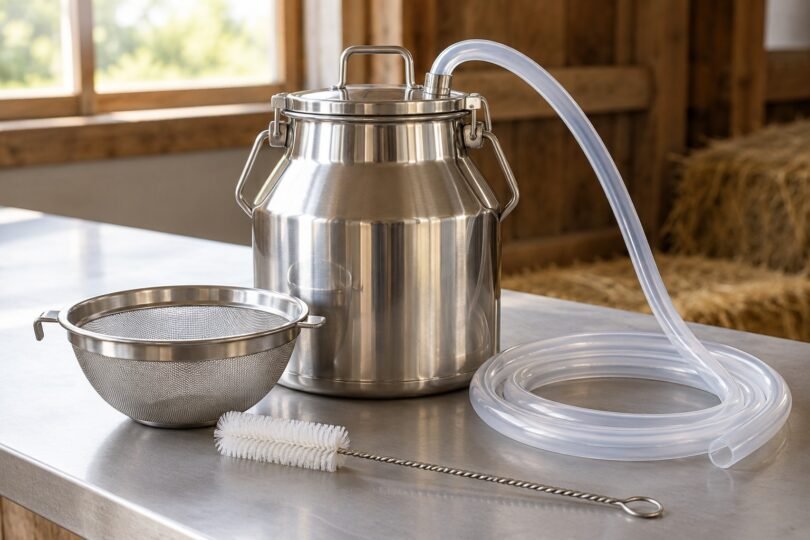

A good cow milker is a complete, serviceable system: a suitable cow cluster, correctly fitted liners, controlled vacuum, working pulsation and equipment you can clean thoroughly after every milking. Bucket capacity and motor power matter, but neither tells you whether a machine fits your cow or your daily routine.
For regular family-cow use, start with a documented bucket system from a supplier that can explain setup and provide replacement parts. A compact cart machine can also be worth comparing when its exact configuration is clear. Before ordering, have an experienced dairy-equipment technician confirm the setup, and discuss the milking routine and any udder-health concerns with your veterinarian.
Which type of cow milker fits your situation?
- Starting from scratch: compare complete systems that include the vacuum supply, regulator, gauge, pulsator, cow cluster, hoses, bucket and lid. Check the itemized list rather than relying on the word “complete.”
- Adding another bucket: an assembly without a pump may make sense, but only if your existing vacuum system has sufficient capacity and compatible connections.
- Milking in different locations: assess wheels, handles, cord requirements and the route from the milking area to the wash area. A wheeled machine is not necessarily easy to lift into a vehicle.
- Keeping both cows and goats: seek a supplier-confirmed configuration for each species. A shared pump does not make the same teat cups, liners and settings suitable for both.
Three documented buying options to compare
Hamby 4501 complete electric bucket system: a service-oriented starting point
The Hamby 4501 basic electric system is listed with a 7-gallon stainless steel bucket and a 1-horsepower portable vacuum supply. The ordering page offers one- and two-cow configurations, so request a written contents list for the exact option you select.
This is a useful starting point for an owner who wants a supplier to help match the milking components. Ask which liner size will ship, what commissioning is available locally and which consumables you should keep on hand. A larger bucket also creates a handling question: plan how you will empty and move it comfortably rather than assuming you must fill it.
If you also need a wash station, compare the separate 4501w wash-package version. Its listing adds a sink, faucet, claw/hose washer and cleaning supplies. Confirm water connections, space and freight unloading arrangements before choosing that package.
VEVOR 25-liter cart milker: check the exact listing, not just the model name
The VEVOR listing ending 010641060601 specifies a 25-liter stainless steel bucket, 550-watt motor, 120-volt/60-Hz supply and wheeled frame. It identifies the model as 9JYZ-1 and says separate goat or sheep suction heads are not included.
Configuration checking is particularly important here: a different VEVOR listing ending 010435925738 also uses 9JYZ-1 but specifies 750 watts. Do not mix the specifications or manuals from these versions.
Before buying, request the exact manual, replacement liner and gasket part numbers, pulsator service information and a confirmed source for those parts. Treat published motor and capacity figures as specifications, not evidence of milking speed, animal comfort or long-term durability. Have the delivered system checked before routine use.
Hamby 1501 with L02 pulsator: an assembly for an existing vacuum supply
The Hamby 1501 + blue L02 bucket assembly is explicitly sold without a vacuum supply. The listed configuration includes a stainless steel bucket, lid, pulsator, cow milking assembly and hoses. It is an option to discuss when replacing a bucket assembly or expanding a compatible system, rather than a standalone machine for a first-time buyer.
Have the supplier verify pump capacity, hose connections and the number of units your system can operate together. Also confirm the actual bucket and pulsator variant on the order: nearby listings and options are not interchangeable simply because their photographs look similar.
Pulsation and regulated vacuum are essential checks
A milking machine uses vacuum to draw milk. Pulsation alternates conditions around the flexible liner so it opens and closes during the cycle. The FAO explanation of machine milking describes why continuous suction without the appropriate liner action can cause pain or damage. A product title saying “automatic” or “adjustable” does not establish that this function is present and working correctly.
Ask for a regulator, readable gauge and serviceable pulsator, plus the manufacturer’s settings for the supplied cluster and liners. Do not turn up suction to chase faster milk flow or copy a generic online vacuum number. The correct setup depends on the complete system and should be checked under operating conditions.
DairyNZ’s machine-testing guidance distinguishes dry, wet, milking-time and cleaning-time checks. That distinction is useful when hiring a technician: a motor that runs and a gauge that moves are not a full performance assessment. Ask what the technician will measure and request the results.
Cow and goat compatibility involves more than cup count
Cow equipment commonly uses a four-cup cluster, while purpose-built goat systems may use two separately connected shells. For example, GEA’s TopFlow sheep-and-goat cluster uses species-specific components and a two-shell arrangement without a conventional claw. It should not be treated as a cow cluster with two cups removed.
Liner mouthpiece, bore, length, shell fit, cluster weight, hose routing and pulsation all deserve attention. DeLaval’s cow-cluster range illustrates how even cattle systems vary in weight, flow capacity, outlets and liner choices. A small cow does not automatically need goat liners, and an adapter that physically connects does not prove functional compatibility.
For a mixed-species setup, give the supplier your exact pump, pulsator, bucket and cluster details. Ask for the approved liners, configuration and operating settings for each species. Get that answer before purchase instead of relying on a marketplace title that mentions several animals.
Can you clean the entire milk-contact path?
Consider the bucket, underside of the lid, gasket channels, claw, liners, valves and milk tubing. Ask which parts disassemble, which brushes fit and whether the recommended wash method reaches every milk-contact surface. A stainless bucket is only one part of the cleaning job.
Penn State Extension’s manual-cleaning guidance separates pre-rinsing, washing, post-rinsing and sanitizing, with time, mechanical action, chemical concentration and temperature affecting the wash. Follow the milker’s instructions and the cleaning-product label for your equipment; do not substitute one universal chemical recipe. Keep cleaning tools for milk-contact parts separate from floor and drain brushes.
Make washing practical before the machine arrives. Check your water supply, washing space, draining area and protective equipment requirements. Ask how to clean without pulling liquid into the vacuum pump. A machine that saves a few minutes during collection may still be awkward to own if its hoses and fittings are difficult to disassemble and dry.
Daily checks that protect the routine
Penn State’s equipment-maintenance guidance highlights blocked air vents, cracked pulsation tubes, twisted liners and pinched hoses. Learn where these components are on your machine and inspect them consistently. Replace worn parts according to the supplier’s schedule and condition, keeping a record of dates and part numbers.
Watch the cow as well as the equipment. Persistent cup slipping, repeated kicking, a changed milking pattern or unusual teat appearance warrants investigation. AHDB notes that discolored, congested or ringed teats can accompany vacuum, pulsation, overmilking or liner-selection problems. Stop and seek equipment or veterinary advice rather than tightening the setup or increasing vacuum to compensate.
A milker cannot diagnose or guarantee prevention of mastitis. Nor does a closed bucket make raw milk safe to drink. CDC explains that raw milk can carry harmful germs; equipment selection does not replace appropriate milk handling, cooling or pasteurization.
Questions to settle before ordering
- Exactly which bucket, cluster, liners, pump and pulsator are included?
- Who will confirm fit and check the machine before regular use?
- Can you buy liners, hoses, gaskets and pulsator parts by part number?
- Does the power supply match your location, and can you handle the machine safely?
- What must be disassembled and washed after each use?
- What are the return conditions after assembly or livestock use, and who handles service?
The strongest choice is the system you can operate consistently, clean thoroughly and keep supported. Choose those fundamentals first, then compare capacity, portability and the total cost of ownership.