

A brake line holder should match the part of the brake system it supports. A clip for rigid steel tubing, a lock clip at a flexible hose connection and an anchor that guides a moving hose have different jobs. Buying by the words “brake line holder” alone can produce the wrong hardware.
For a stock vehicle, start with the original support type and the vehicle manufacturer’s parts information. Measure and identify the mounting point as well as the line. The products below are specific options to compare after those checks, not universal replacements. Brakes are safety-critical: damaged tubing, a leaking hose or an uncertain mounting arrangement needs professional assessment.
Identify which kind of holder you need
- Rigid-line support: Holds hard tubing along the body, chassis or axle. Match tube outside diameter, number of slots, attachment method and routing.
- Flexible-hose lock clip: Secures a hose end fitting into its bracket. Its opening and shape must match the fitting’s retention groove and bracket.
- Hose-routing anchor: Controls the position of a flexible hose or associated sensor wire while allowing the necessary steering and suspension movement.
- Adapter mounting tab: Provides a mounting point for a compatible bulkhead adapter or hose-end connection. A tab’s large opening is not necessarily the size of the brake tubing.
- Bicycle cable or hose guide: Fits a bicycle frame’s cable-routing system. This is a separate application from automotive chassis hardware.
Brake line locks and hill-hold valves are another category entirely: they act on hydraulic pressure. They are not substitutes for missing clips, brackets or line supports.
Brake line holders for specific applications
Dorman 800-285 for two 3/16-inch rigid lines
Dorman 800-285 is a plastic brake-tubing clip with two 3/16-inch slots. The selected Amazon listing is a five-pack. This is a candidate when the original support holds two tubes of that diameter and the clip’s mounting arrangement matches the vehicle.
Dorman’s specification page identifies the material, slot size and application-specific replacement purpose. The “two” in the product description refers to the line slots, not the number of clips in the Amazon package. Check both details before ordering. Matching tube diameter alone is insufficient if the clip cannot attach securely to the original mounting point.

Dorman 800-285 Plastic Brake Tubing Clips, Two 3/16-Inch Slots, 5-Pack
As an Amazon Associate we earn from qualifying purchases.
Allstar Performance ALL18310 for specified 3/16-inch clamp applications
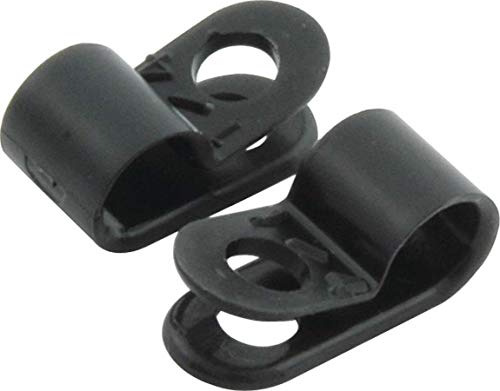
Allstar ALL18310 is a black nylon line clamp sold in a ten-pack. The Allstar manufacturer catalog identifies a 3/16-inch clamp size and a 3/16-inch mounting hole for this nylon-clamp family. Those are separate measurements: one concerns the line being supported, the other the attachment fastener.
This style can be useful where an appropriately specified single-line clamp is required. Its nylon construction does not establish suitability for every underbody location, especially near heat or where an original molded multi-line support performs a different job. Confirm the intended application and mounting requirements with the vehicle or component manufacturer. Do not tighten a mismatched clamp until the tube deforms.
Dorman 13987 for compatible hose-end retaining brackets
Dorman 13987 is a steel brake hydraulic hose lock clip, supplied as four clips. The manufacturer’s specifications list a black-oxide finish and a 0.5-inch inside opening. Its purpose is retaining a compatible hose-end fitting in a bracket, so it should not be selected as a 1/2-inch cushioned clamp for a length of tubing.
Use Dorman’s vehicle-fit lookup and compare the original clip and fitting arrangement. A broad make-and-year range in a search result does not confirm every trim or mounting position. If the bracket itself is rusted through or distorted, replacing only the removable clip does not repair the support.

Allstar Performance ALL60029 for compatible adapter mounts
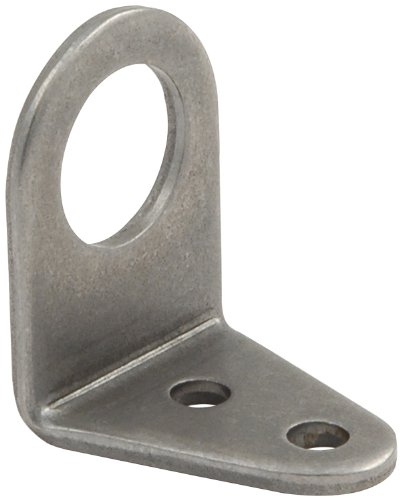
ALL60029 is a pair of steel bolt-on brake-line adapter tabs. Allstar’s catalog identifies a 5/8-inch adapter opening; the product description also identifies two 3/16-inch bolt-mounting holes. These dimensions describe different parts of the tab and should not be confused with a tubing-clamp diameter.
This is fabrication or replacement bracket hardware for a properly matched adapter arrangement. It does not include the engineering decision about where to place a connection, and it should not be treated as a complete hose-retention kit. Confirm the adapter, required lock clip or nut, fasteners and mounting surface before buying. Leave changes to brake-line routing or structural mounting points to a qualified installer.
TeraFlex 1101255 for a compatible flexible-hose routing installation
TeraFlex 1101255 is the five-inch brake-line anchor version with a single 0.50-inch mounting hole. One kit contains two anchors and eight UV-resistant cable ties with stainless-steel grippers. Its molded rubber body and internal support are designed to guide a flexible brake line and associated sensor wire in the intended installation.
The manufacturer’s 1101255 instructions describe lower-shock-mount installation and require checking the line position through steering lock and axle articulation. This does not make it a universal fix for a hose that is too short after a lift. Confirm the vehicle, suspension configuration and hose length first. An anchor must preserve required movement while keeping the hose away from damaging contact.
What to check before ordering
Take clear photographs of the original holder, the mounting surface and the surrounding routing. If a clip has disappeared, examine an equivalent intact support only as a reference, then confirm the correct part through the vehicle’s parts information. Do not assume adjacent brake, fuel and electrical lines use identical supports.
- Line size: Measure the rigid tube’s outside diameter, not its flare nut. For a flexible hose, follow the hose and anchor manufacturer’s specification rather than guessing from appearance.
- Mounting method: Identify the original stud, body hole, bracket slot or bolt location. A correct-size clip with the wrong attachment is still the wrong part.
- Number and spacing of channels: Multi-line holders must preserve the intended separation and route.
- Material and environment: Check heat, moisture, abrasion exposure and any protective cushion specified for that location.
- Package contents: Distinguish the number of clips from the number of channels, and a two-anchor kit from a single individual anchor.
Also inspect why the old holder failed. A broken clip may be accompanied by worn tubing, a damaged coating, a corroded bracket or a hose that has been rubbing. Hiding that area under a new clamp can leave the underlying fault unresolved.
Installation and safety limits
Restore the manufacturer’s routing and support locations rather than inventing a universal clip-spacing rule. The UK’s DVSA defect guidance treats inadequately supported pipes, chafing, kinks, stretching and other hose damage as important brake-system defects. It is a useful safety reference, not a replacement for your vehicle’s service procedure or local inspection requirements.
Do not drill blindly into a body or frame section, force a hose into a sharp bend, clamp moving hose rigidly to the wrong component or use ordinary cable ties as a substitute for specified brake hardware. Ties supplied as part of an engineered anchor kit should be installed only as that kit directs.
If installation would require opening a hydraulic connection, replacing damaged tubing or changing the brake circuit, have the work performed and checked by someone qualified for that system. Bleeding, leak checks and any required ABS procedure must follow the vehicle manufacturer’s instructions. A new holder cannot seal a leak or make a weakened line safe. Do not drive with leaking brake fluid, a soft pedal or visibly damaged brake plumbing; arrange repair and suitable vehicle transport.
If you meant a bicycle brake-line holder
Look for the frame or fork manufacturer’s specified hose guide, cable clip or routing port part. Confirm whether it carries a hydraulic hose or a mechanical cable housing, along with its mounting interface and diameter. Keep the hose or cable clear of the wheel and allow the movement specified for the bicycle. The automotive parts above are not bicycle fitment recommendations.
The bottom line
Choose a rigid-line clip for rigid tubing, a matching lock clip for a hose-end bracket, and an engineered anchor for a flexible-hose routing problem. Dorman 800-285, Allstar ALL18310, Dorman 13987, Allstar ALL60029 and TeraFlex 1101255 illustrate those different jobs. The best purchase is the exact holder that restores the intended support without damaging the line or restricting necessary movement.
Image note: Existing category illustration retained from original article.