
A wall-mounted binder holder needs enough clear space for the entire closed binder, plus mounting hardware suited to its loaded weight. Start with a purpose-built binder rack rather than a shallow letter-file pocket. The ring size printed on a binder is not its outside thickness, and a rack’s advertised depth is not automatically its usable interior depth.
ZING’s 7199 is a sensible starting point for a visible reference-book station. Brady’s 2014 provides another clearly identified single-binder design. Performore’s OLSDSRACK is a further option, but conflicting dimension fields make it a conditional choice. This comparison uses published specifications, not physical load or installation tests.
Wall-mounted binder holders to compare
| Holder | Published size | Useful distinction | Important limit |
|---|---|---|---|
| ZING 7199, yellow | 14 W × 9 H × 4.5 D inches | Purpose-built SDS binder rack; mounting hardware included | Outside measurements; no verified internal clearance or maximum load |
| Brady 2014, yellow | 14 W × 9 H × 4.5 D inches | Manufacturer explicitly specifies one three-ring binder | Confirm fasteners, interior clearance and permitted load |
| Performore OLSDSRACK, one-pack | Description states 13.5 × 10 × 5 inches | Binder/manual rack with two mounting screws described | Other listing fields conflict; clarify dimensions before ordering |
ZING 7199: a straightforward binder station
The ZING manufacturer catalog describes the 7199 as a wire holder for SDS binders and safety procedures. It uses recycled steel, measures 9 inches high by 14 inches wide by 4.5 inches deep, and includes mounting hardware. The matching Amazon listing identifies the yellow model as 7199, UPC 789532328034.
This is the clearest starting point when you already own a binder and want a dedicated place to return it. An open wire basket leaves much of the cover visible, which is useful for a prominently labeled operating manual or safety reference.
The catalog also lists a white 7199-WHITE version with the same stated dimensions. Color is a presentation choice, not evidence of a different capacity. Neither listing establishes a maximum loaded-binder weight or a guaranteed interior opening, so get those details confirmed when the fit is close or the binder is heavy.
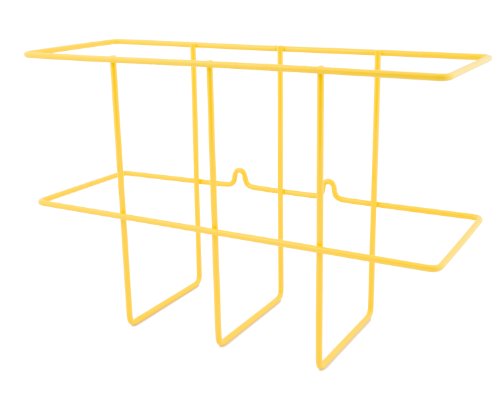
ZING Green Products 7199 Wall Mount Wire Basket SDS Binder Holder with Mounting Hardware, 14 by 9 by 4.5 Inch
As an Amazon Associate we earn from qualifying purchases.
Brady 2014: an explicitly single-binder alternative
Brady’s 2014 holder is a yellow, PVC-coated steel rack described by the manufacturer as holding one three-ring binder. Its published size is 9 inches high, 14 inches wide and 4.5 inches deep. Match part 2014 and UPC 754473459802 when comparing sellers; Brady also sells differently numbered holders and complete stations.
This is worth considering when you want one book in one fixed location, rather than several pockets for incoming paperwork. The specification does not give permission to stack multiple full binders simply because they seem to fit. Nor does it provide a numeric weight rating.
Brady’s product page does not establish which wall-specific fasteners you will need. Confirm the supplied hardware and installation requirements before purchase. This is a direct-manufacturer option here because an exact Amazon product match was not sufficiently verified.
Performore OLSDSRACK: check the measurements first
The verified Amazon one-pack listing identifies this yellow binder display rack as model OLSDSRACK, UPC 662921003227. It describes storage for SDS books, equipment manuals and procedure books, with two mounting screws included. It is a binder-oriented product rather than a letter organizer.
There is an important listing discrepancy: the descriptive bullet gives 13.5 × 10 × 5 inches, while another dimensions field shows 5 D × 10 W × 5 H inches. Neither is a documented interior measurement. Ask the seller for the clear opening, base width and usable front-to-back depth before ordering for a specific binder. Choose the ZING or Brady route instead if you cannot resolve that uncertainty.
The linked item is the one-pack rack. Do not assume that pictures of a binder, sign or a larger station mean those accessories are included; verify the exact package contents.

Measure the binder, not just the rings
Measure the book when it contains the pages, dividers and sheet protectors you actually use. A cover can extend past the paper, and an overfilled binder may bulge wider at the open edge than at its spine. Thick tabs and zippered covers need their own clearance.
- Measure height and cover width. Include projecting tabs or handles.
- Measure its maximum closed thickness. Do not substitute the ring diameter.
- Check the rack’s narrowest internal point. Tapered sides, wire bends and front lips can reduce space.
- Allow removal room above it. A binder must lift clear without hitting a shelf or cabinet.
- Weigh the fully loaded binder. Compare that with a confirmed rack and mounting-system rating.
If the supplier gives only overall dimensions, ask for internal measurements. A trial fit within the return period is useful, but do it before drilling new holes or modifying the rack.
Mounting: the wall is part of the system
A steel rack’s strength does not tell you how much the finished installation can support. The wall material, fasteners, mounting-hole arrangement and condition of the surface all matter. Follow the holder’s instructions and the fastener manufacturer’s directions for the actual substrate. Included screws are not universal anchors for drywall, masonry, tile and hollow doors.
Place the rack where the intended users can comfortably remove and replace the binder. Keep it clear of door swings, narrow passageways and frequently bumped work surfaces. Before drilling, check for concealed services and use an appropriate installer if the wall construction is uncertain. Do not improvise adhesive mounting for a loaded binder unless the complete product system explicitly permits it.
After installation, check for movement, loose fixings and damage during routine use. Do not use a casual tug test as a substitute for a missing load rating, or keep adding books until the basket visibly flexes.
When a rack is the wrong format
For several large binders, a properly rated shelf with bookends may be easier to use than squeezing books into a single basket. For loose letters or thin folders, a shallow multi-pocket wall organizer may be enough. Choose by the actual contents instead of treating the words “file holder” and “binder holder” as interchangeable.
An open rack also leaves documents exposed. A dusty workshop, splash-prone station or public area may need a suitable enclosure, while preserving the access the task requires.
A binder rack does not complete an SDS program
For workplace safety data sheets, OSHA’s Hazard Communication standard, paragraph (g)(8), requires ready access during each work shift in employees’ work areas. A yellow basket alone does not establish compliance. The correct sheets must be present and accessible, and the workplace’s wider labeling, training and hazard-communication requirements still apply.
Bottom line
Begin with ZING 7199 for a simple binder station, compare Brady 2014 for a documented single-binder design, and treat Performore OLSDSRACK as a measurement-confirmation option. The deciding checks are usable clearance, loaded weight, suitable fasteners and easy removal, rather than the number of pockets or an unsupported “heavy-duty” claim.
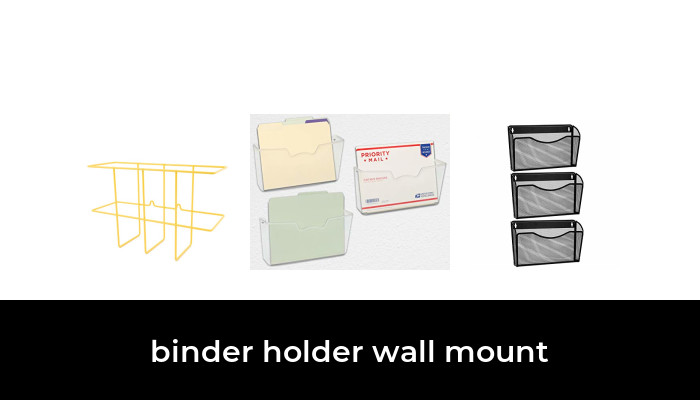
Image note: Examples of wall-mounted document storage. Capacity, load limits and binder fit depend on the exact product.