
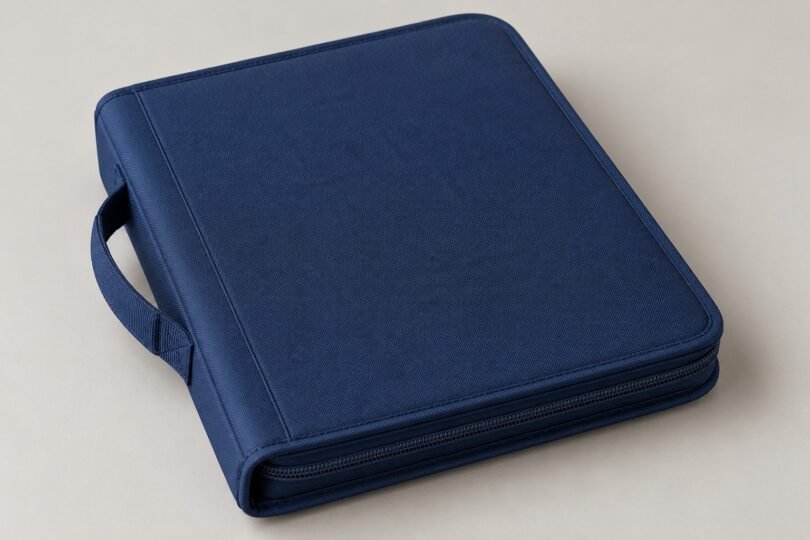

The right Case-it binder depends on what you carry: a stack of handouts, two separate sets of class notes, or a laptop alongside your paperwork. Start with the layout, then check the ring size, closed dimensions and exact model. A bigger ring does not automatically make a binder a better fit for your bag or your daily routine.
For a built-in expanding file, start with the Mighty Zip Tab. For two independently organized sections, look at the Dual. For a padded device pocket, compare the Universal. The specifications below come from product listings and manufacturer information; they are not results from hands-on durability testing.
Which Case-it binder suits your routine?
- Loose handouts and several subjects: the Mighty Zip Tab D-146 combines one ring mechanism with an expanding file.
- Two distinct groups of work: the Dual DUAL-101 has two separate 1.5-inch D-ring mechanisms inside one cover.
- Paperwork plus a small laptop or tablet: the Universal LT-007 adds a padded technology pocket.
- A printed cover with file storage: the Printed Mighty Zip Tab D-146-P offers the same broad organization concept as the solid-color Mighty.
These are different formats, rather than a ranking from best to worst. Match the organization system to the way you retrieve papers. A large binder that stays at home because it is awkward to carry is less useful than a smaller, regularly maintained setup.
Mighty Zip Tab D-146: for papers that need sorting
The Case-it Mighty Zip Tab uses three 3-inch O-rings. Its expanding file has five colored tabs and six pockets, giving you a place for loose assignments before you punch or file them. A U-shaped zipper provides access to that file area, while the angled main zipper is designed to keep the fabric gusset away from the writing surface.
Case-it also lists a front zip pocket, carry handle and shoulder strap. Its current dimension graphic shows a closed body measuring 13.11 inches high, 12.99 inches wide and 3.74 inches deep. Measure your bag opening against those exterior dimensions, not just the 3-inch ring specification.
This layout makes sense when you regularly collect loose sheets. However, the current solid-color page does not state a numeric sheet capacity in its description. Do not treat a seller’s 600-sheet headline as a universal promise across every Mighty variant. Check the exact color and model listing before ordering.
Dual DUAL-101: for keeping two sets of notes separate
The Case-it Dual has two 1.5-inch D-ring mechanisms inside a single zippered binder. Case-it describes it as a 3-inch-capacity binder, but that means two separate ring sections. It does not give you one uninterrupted 3-inch stack.
Hook-and-loop hold-down pages help secure the contents on either side and incorporate storage for small supplies. The manufacturer also lists mesh pockets, a handle and an adjustable shoulder strap. A useful arrangement would be class notes on one side and current assignments on the other, or two projects that should remain separate.
Choose this model for separation rather than a headline sheet count. Case-it’s current page does not give a numeric paper capacity or a complete closed-size measurement in its text. Confirm those details for the exact listing if bag fit is tight. Also check whether a removable pencil pouch is included; do not assume every seller’s accessory bundle is identical.
Universal LT-007: for carrying a device with your notes
The Case-it Universal combines three 2-inch O-rings with a padded laptop/tablet pocket, an angled zipper, a carry handle and a shoulder strap. The current manufacturer page advertises a 13.3-inch laptop or tablet and claims room for up to 350 sheets.
There is an important listing conflict: the Amazon entry for LT-007-BLK below has a 400-page capacity field, while its feature text says 350 sheets. Case-it’s current page also says 350. Treat these as listing claims, not independently verified capacities, and leave room for dividers and accessories rather than planning to fill an advertised maximum.
Case-it Universal LT-007-BLK, black, 2-inch rings, one binder
As an Amazon Associate we earn from qualifying purchases.
The linked Amazon item identifies the black LT-007-BLK and a one-binder unit count. A 13-inch or 13.3-inch device label usually refers to screen size, so it is not enough to confirm a particular laptop will fit. Compare your device’s actual width, height and thickness, including its case, with the pocket before relying on this as your everyday carry solution.
Printed Mighty Zip Tab D-146-P: choose the exact variant
The Printed Mighty Zip Tab lists 3-inch O-rings, a six-pocket expanding file with five colored tabs, a front zipper pocket, and a handle and shoulder strap. Case-it’s current description claims up to 570 sheets for this model.
That figure is a manufacturer claim, not a tested result here. It also illustrates why “Mighty Zip Tab” alone is not precise enough when comparing listings. Confirm the D-146-P model, chosen print and quantity. A gallery containing several patterns normally shows choices, not a pack containing every design.
Ring size, sheet capacity and exterior size are different
Ring size describes the paper-holding mechanism. Exterior dimensions describe the closed binder’s footprint. Neither number tells you exactly how comfortably a loaded binder will fit alongside books, a lunch container and a device in your bag.
A sheet-capacity claim needs context too. Thick paper, plastic sleeves, tabbed dividers and punched folders take up more room than an equivalent count of ordinary loose sheets. Bulky stationery in the pockets can also make the cover harder to close even when the rings are not full. Leave working space so pages turn without catching and the zipper closes without force.
Before choosing a larger size, sort your current paperwork into “needed this week” and “archive.” You may save more space by removing finished material than by buying a larger binder. If a school supply list specifies a ring size or separate binders for different classes, follow that requirement before optimizing the layout.
Check bag fit and daily access before buying
- Measure the opening. A backpack’s widest internal point may be larger than the zipper opening you have to pass the binder through.
- Allow for depth. Compare all three closed dimensions. Ring capacity alone is not the binder’s thickness.
- Consider access. Decide whether you mainly retrieve loose handouts, turn pages in the rings, or remove a device throughout the day.
- Check carrying options. A handle helps with short transfers; a shoulder strap offers another way to carry the binder. Neither removes the weight of its contents.
- Inspect the delivered item. Look for aligned ring ends, smooth zipper travel, secure strap attachments and the accessories named in your order.
If exact dimensions are missing or inconsistent between sellers, ask for the closed external measurements before ordering. Do not substitute shipping-carton dimensions or measurements from a similarly named Case-it model.
One binder, two ring sections or a multipack?
The Dual’s “2-in-1” name describes its internal arrangement. It does not mean that two separate binders arrive. Likewise, a five-subject file or six-pocket organizer describes compartments, not the number of products in the package.
Read the selected variant, quantity and included-components fields together. A low headline price can refer to a different color, an older model or one item within a larger comparison. For classroom purchases, calculate the delivered cost per binder only after confirming the number of complete binders and any shipping charges.
A practical choice
Pick the Mighty Zip Tab when an expanding file is your priority, the Dual when two separate ring sections solve a real organization problem, and the Universal when you need its device pocket. Then verify the exact model, dimensions, accessories and unit count. Those checks are more useful than an unsupported “best binder” score or a capacity number copied across the whole range.


