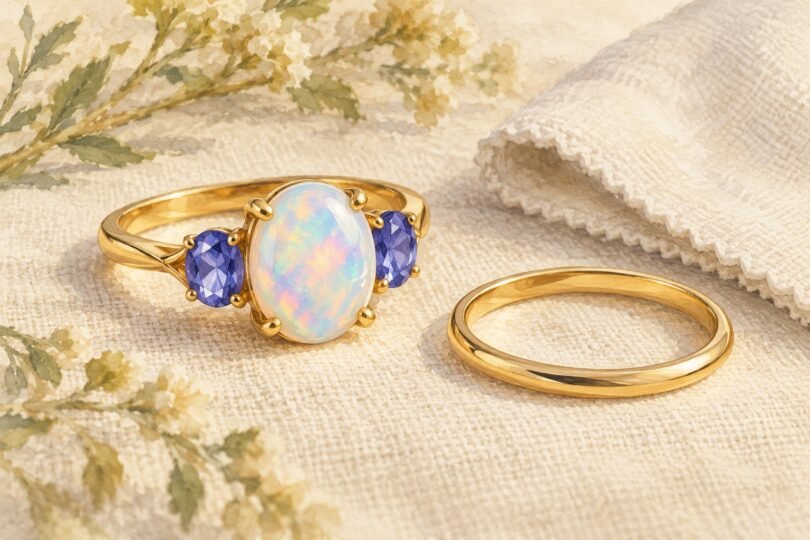

Tanzanite and opal engagement rings can mean a ring containing both gemstones or a choice between two different center stones. For a combined design, look for a specification that names opal and tanzanite separately. A blue accent is not proof of tanzanite, and an opal ring with clear cubic zirconia accents does not contain both stones.
The combination offers a distinctive contrast: a softly glowing opal beside faceted blue-violet stones. Its suitability depends on how you wear a ring, the actual materials and the setting. Start with gemstone identity and care requirements, then compare dimensions and metal. A beautiful ring can still demand more attention than you want to give an everyday engagement ring.
Combined-stone designs to compare
These maker-listed examples put both stones in one ring. Their dimensions describe the stones, not the complete ring head or its height above your finger. Choose the correct country and finger size before ordering, and ask for additional views if the setting profile matters to you.
LBG 9ct rose gold trilogy, design R2017/4/50
The LBG Opal & Tanzanite Ring has a 6 × 4 mm oval opal between two 4 mm round tanzanites. The maker identifies the metal as 9ct rose gold and the gemstone creation as natural; it also states that it works with solid precious metals. This is a three-stone, or trilogy, arrangement.
Consider this layout if you want a distinct center and two side stones. Before buying, request the head height, band width and a side view with a wedding band. The stone measurements alone cannot tell you whether a straight band will sit flush. Confirm any treatment details with the maker for the stones supplied in your ring.
LBG 9ct yellow gold cluster, design 2140/4/50
The LBG Opal & Tanzanite Cluster Ring places a 7 × 5 mm oval opal inside a surround of eight 3 mm tanzanites. Its product attributes specify 9ct yellow gold and natural gemstone creation. The maker’s solid-metal statement applies here too.
This arrangement puts more blue-violet stones around the opal. Compare the overall head measurements before assuming it will look only slightly larger than the trilogy. Eight surrounding settings also give you more individual stone seats to inspect. Ask how the maker handles a loose or damaged stone, including the process and likely cost, rather than assuming accidental damage is covered.
LetsBuyGold sterling silver trilogy, listed size 6.75
The Amazon listing for model 2017/4/50-SS-6.75 identifies one solid 925 sterling silver ring with natural opal and tanzanite. Its description specifies a 6 × 4 mm oval opal and two 4 mm tanzanites, with a presentation box included. This exact listing is size 6.75; do not assume a different size shares the same product code.

LetsBuyGold 925 Sterling Silver Opal and Tanzanite Trilogy Ring, Size 6.75
As an Amazon Associate we earn from qualifying purchases.
The listing has inconsistent style labeling: its title and three-stone description say trilogy, while a specification field says solitaire. Use the written stone count and inspect the selected product image. Confirm sizing and any surface finish with the seller. Silver is a different metal choice from the two gold examples, even where the stone layout looks similar.
Natural, created and simulated mean different things
Read the description of each stone, including the small accents. A listing may combine a natural center, lab-created material and simulated side stones in the same ring.
- Natural: describes a gem formed in nature. It does not by itself mean untreated, or identify where that particular stone came from.
- Laboratory-created or synthetic: in gemological usage, a manufactured counterpart with essentially the same composition and structure as its natural counterpart. GIA explains this distinction in its gem identification introduction. Ask what material a seller means by “created opal.”
- Simulated: a material chosen to resemble another gem. “Simulated tanzanite” is not a promise of tanzanite; request the actual material. GIA’s guide to simulants explains that imitations have different properties from the gems they resemble.
- Assembled opal: doublets and triplets join layers together. They can contain natural opal without being a single solid piece. Ask whether the center is solid, a doublet or a triplet, and obtain care instructions for that construction.
“Opal,” “fire opal,” a photograph or a vivid color is not a complete material disclosure. Similarly, a seller’s quality label or authenticity card is not automatically an independent laboratory identification report. If a report is important to your purchase, ask which laboratory issued it and whether it identifies the actual stone being supplied.
How durable are opal and tanzanite?
GIA’s opal care guide gives opal a Mohs hardness range of 5 to 6.5 and describes its toughness as very poor to fair. That means scratches and breakage deserve attention. High heat or abrupt temperature changes can cause fractures, and intense light that heats the stone can cause crazing.
GIA’s tanzanite care guide lists hardness at 6 to 7, with fair to poor toughness. Tanzanite also has cleavage, a tendency to break along particular directions when struck. Its higher hardness number does not make a tanzanite ring immune to impact damage.
Hardness measures resistance to scratching; toughness concerns breaking or chipping. GIA also considers stability, including responses to heat and chemicals. For a ring with both stones, plan around the needs of both. A protective setting may reduce some exposure, but it cannot remove the materials’ limitations.
Think through your routine before deciding. If you regularly knock rings against equipment, grip gym weights or work with abrasive materials, taking this ring off for those activities should be part of the plan. If frequent removal feels impractical, discuss a more durable center-stone choice with a jeweler and reserve opal and tanzanite for a ring worn more selectively.
Check the metal, finger size and setting
Keep solid gold, sterling silver and gold-plated jewelry separate in your comparison. “18K gold plated” describes a surface layer; it does not say the entire ring is solid 18K gold. Ask for the underlying metal and any surface finish. A white-metal appearance alone does not identify white gold, silver or plating.
Use a jeweler’s measurement or the maker’s country-specific sizing system. LBG recommends professional finger measurement and checking a multisizer at different times and temperatures. A US size and a UK letter are different systems. Also confirm whether the exact design can be resized and whether a customized size changes return eligibility.
Inspect how securely the center and side stones sit, whether edges are exposed, and whether the ring catches clothing. Request current photographs or a video of the offered stone when appearance is important. Photos help with shape and layout; they cannot establish gemstone identity, metal purity or durability by themselves.
Care before and after the proposal
GIA recommends warm, soapy water for these gems and specifically rules out ultrasonic and steam cleaning for tanzanite. Its opal guidance also limits cleaning to warm, soapy water. For assembled, treated or imitation stones, confirm the complete ring’s instructions before wet cleaning; do not assume general gemstone advice covers adhesives or coatings.
Avoid abrupt temperature changes, harsh cleaning products and hard knocks. Tell a jeweler which stones and treatments are present before resizing, polishing or repair. Have a loose stone or damaged setting checked before wearing the ring again. Choose a design you enjoy and a care routine you can realistically maintain.