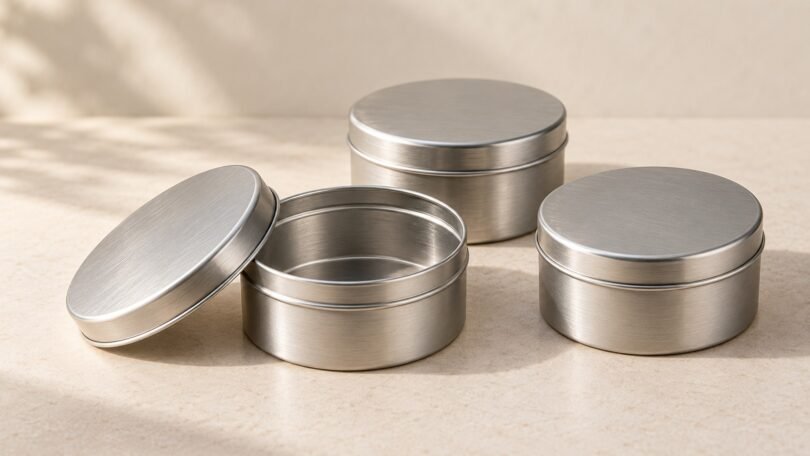

Before buying 5 oz metal tins, decide what “5 oz” needs to mean. A container labeled 5 oz may describe an approximate product weight, a nominal size or a liquid volume. Those measurements are not interchangeable. For storage, start with the internal space and closure. For candles, use the supplier’s wax-fill specification and a container intended for that purpose.
The options below address different versions of this search: a roughly 150 ml screw-top tin, a vessel specified for 5 oz of candle wax, a tall tin sold as a 5 oz food-packaging container, and a nearby-size storage alternative. They are not four equivalent containers.
First, separate volume from weight
- Fluid ounces measure volume. Five US fluid ounces is approximately 148 ml. A 150 ml container is therefore close in volume, but its practical fill level may be lower.
- Ounces by weight measure mass. Five ounces is approximately 142 g. The space that amount occupies depends on the material being packed.
- Nominal size is a product label. It can be based on an intended use or an older naming convention rather than usable liquid capacity.
- Overflow capacity is a maximum. It describes filling to the brim, leaving no working headspace for the lid, product movement or filling process.
CandleScience’s explanation of container measurements distinguishes estimated wax weight at a fill line from overflow volume and notes that manufacturer size names may reflect a different product. Ask which measurement a seller means before placing a bulk order.
Metal tins to compare by intended use
Doseplus DRA 85.35: a 150 ml aluminum screw-top option
The Doseplus DRA 85.35 round aluminum box is listed at 150 ml, with dimensions of 85 × 35 mm. It has a screw lid and an EPE liner. That makes it a relevant candidate when your requirement is approximately five US fluid ounces of container volume.
The supplier describes uses including cosmetics and food packaging. Confirm suitability for your particular contents, especially when oils, moisture or other ingredients will contact the liner. The page does not establish candle-burning or oven suitability, so do not treat its metal construction as evidence for either application.
Its listed packaging unit is 112 pieces, with customization options also available. Check the quantity terms, sample availability and shipping to your location. This is a useful sourcing option for a packaging project, rather than an assumed single-tin retail purchase.
CandleScience 8 oz Candle Tin: specified for a 5 oz wax fill
If your goal is a candle containing about five ounces of wax, look at the CandleScience 8 oz Candle Tin. Despite the name, its specification lists a wax weight to the fill line of 5.00 oz, or 141.75 g. It is tin-plated steel, 2 inches high, with a 3.07-inch top outside diameter and a 2.95-inch top inside diameter.
The tin comes with a fitting lid and has an interior varnish coating. CandleScience also lists raised feet and a wick-tab outline. Its wax-fill figure is a starting estimate, not a promise that every wax and fragrance formulation will occupy exactly the same space.
This is the candle-specific choice in the shortlist. Use the maker’s guidance to develop the complete candle, then burn-test the actual wax, wick and fragrance combination. The supplier itself describes wick suggestions as starting points for testing.
Sav-on Bags 5 oz Cylinder Tin: a much taller food-packaging format
Sav-on Bags’ 5 oz Cylinder Tin, item family 3000-005-, measures 2⅝ inches in diameter and 6 inches high. The page lists a volume of 2½ cups, says it is food-safe and identifies loose-leaf tea and prepacked specialty products as intended uses.
This shows why a “5 oz” search can return something very different from a small round balm tin. The supplier’s disclaimer says listed size estimates are based on the density of roasted coffee beans and recommends testing a sample with your own product.
Choose this format when you want a tall retail canister. It is not a 5-fluid-ounce tin. The listing says it is not heat-sealable; obtain the precise closure and internal-coating details if your packaging process depends on them. Do not infer candle or hot-fill suitability from its food-packaging description.
Specialty Bottle TND6: a nearby nominal size for small storage
The Specialty Bottle TND6 deep tin is a nominal 6 oz alternative, not an exact 5 oz replacement. Its published dimensions are 2.8 inches wide and 1.8 inches high, and it uses a slip cover with rolled edges. The supplier describes a seamless body.
This option is worth checking for dry craft supplies or small items when the actual dimensions matter more than the capacity label. A removable slip lid may suit repeated access, but the product information does not establish a liquid-tight seal or a five-ounce fill weight for your contents.
Its larger case quantities make sampling especially useful. Confirm usable internal dimensions and the liner or coating specification before deciding whether it meets a food, cosmetic or candle requirement. Do not transfer another supplier’s 6 oz measurements to this model.
Choose the closure before the color
A slip cover pushes onto the body and lifts off. A screw lid uses threads. Neither description by itself proves airtightness, leak resistance or tamper evidence. If those properties matter, ask the supplier for the specific closure performance and any necessary liner, seal or outer packaging.
For loose buttons or craft components, convenient opening and a secure fit may be enough. For a product that could spill during transport, the consequences are different. Check how a filled sample behaves in its shipping packaging rather than relying on a photograph of a closed tin.
Also confirm whether lids are included in the quoted quantity. A listing for 24 pieces can be unclear about whether it means complete containers or separate components. Calculate your cost per usable tin-and-lid set, including delivery and any labels or protective packing.
What to verify for food, balms and candles
Food contact
Ask for suitability for the actual food and storage conditions. A statement about dry tea packaging does not establish compatibility with wet, acidic or oily foods, heating or long-term preservation. If the supplier cannot answer that application-specific question, choose packaging with clearer documentation.
Balms and cosmetic products
Check the body material, internal finish, lid liner and filling temperature with the supplier. Then evaluate the actual formula in a sample over the intended storage period. A tight-fitting lid does not by itself establish that a container is suitable for a water-based product or a warm filling process.
Candle making
Choose a vessel sold for candle use with relevant supplier guidance. Do not turn a general storage tin into a candle container solely because it is metal. A nominal ounce size does not identify a suitable wick or prove that a finished candle will burn safely. Keep lids off burning candles and follow the finished candle’s safety instructions.
A sample-order checklist
- Write the requirement precisely. Specify your product, target net weight or usable volume, desired headspace and closure needs.
- Check real dimensions. Confirm internal width and depth for the contents, plus external dimensions for shelves, labels and mailers.
- Inspect the sample. Look for dents, sharp edges, damaged coatings, lid distortion or a closure that does not fit consistently.
- Trial the intended fill. Measure the actual amount of your product at the planned fill level. Do not use a water capacity as a substitute for the weight of a different material.
- Confirm the specification before scaling up. Keep the supplier’s product code, finish, lid and liner details with your order so a later reorder matches.
Common questions about 5 oz metal tins
Will a 5 oz tin hold five ounces of wax?
Not necessarily. Use the supplier’s wax-weight figure and verify it with your formulation. The CandleScience example above is named 8 oz but specifies a five-ounce wax fill, illustrating the mismatch.
Is a 150 ml tin the same size?
It is close to five US fluid ounces by volume. It is not a guarantee of five ounces by weight, and its shape, lid clearance and recommended fill level still matter.
Which should I buy?
For approximately 150 ml of storage volume, investigate the screw-top option first. For a five-ounce candle fill, start with the documented candle vessel. For tea or coffee packaging, choose by a sample fill of your actual product. The right specification is more useful than the number in the listing title.