
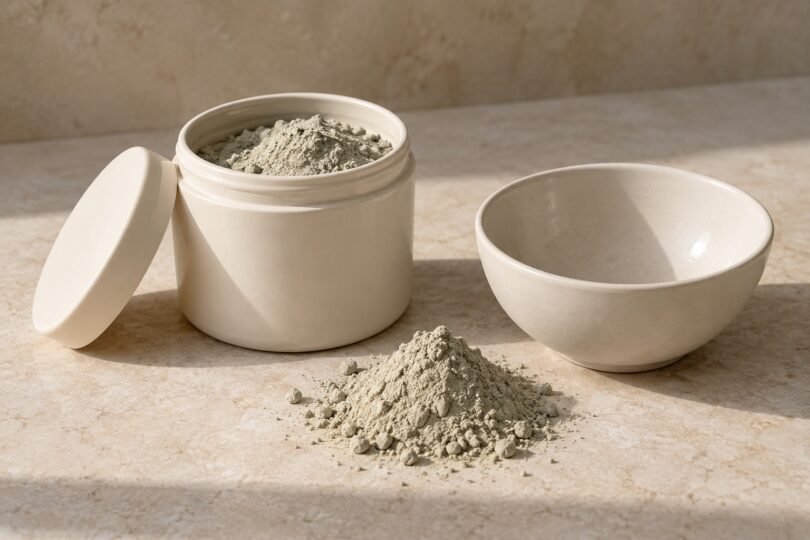

Aztec Secret Indian Healing Clay is a dry calcium bentonite clay powder that you mix before applying as a rinse-off mask. The useful questions are straightforward: which jar are you buying, what does its label say, and is a drying clay mask a sensible addition to your skin-care routine?
“Indian Healing Clay” is the product name. It does not establish that the mask heals acne, repairs damaged skin or removes toxins from the body. This guide separates the manufacturer’s product details from dermatology guidance, so you can judge the purchase without relying on dramatic before-and-after promises.
What is in Aztec Secret Indian Healing Clay?
The manufacturer’s product page identifies the ingredient as calcium bentonite clay and lists 1-pound and 2-pound jar options. It describes the powder as having no added fragrance, additives or animal products. Those are manufacturer specifications, rather than independent laboratory findings.
This is a powder you prepare for use, rather than a ready-mixed cream mask. That difference matters when shopping: a jar of dry clay, a premixed mud mask and a kit containing several accessories are different purchases. Compare the actual product and amount, not just photographs of similarly sized tubs.
A short ingredient list can make a product easier to identify, but it does not guarantee that your skin will tolerate it. FDA explains that natural ingredients still require appropriate safety substantiation. Terms such as “natural” do not establish that a clay is sterile, lead-free or suitable for eating.
Which jar and version should you look for?
The identified Amazon option below is Aztec Secret Indian Healing Clay, Version 2, in a single 16-ounce jar. Its selected size is 16 Ounce (Pack of 1), and its ASIN is B081FK6L1G. Sixteen ounces equals one pound; do not confuse this option with a 32-ounce jar, a multipack or a bundle.

Aztec Secret Indian Healing Clay, Version 2, 16 oz, 1 Jar
As an Amazon Associate we earn from qualifying purchases.
According to the brand’s explanation of Version 2, the clay formulation is the same calcium bentonite clay, with Amazon coding intended to help verify authenticity and origin. “Version 2” is not evidence of stronger results or a new acne treatment.
Before ordering, check the selected size, quantity, seller and return conditions. On delivery, compare the jar with the listing and inspect its packaging and label. A matching ASIN identifies the listing; it does not independently authenticate every jar supplied by every seller. If the package looks inconsistent or its instructions are missing, ask the retailer or manufacturer before using it.
For value, compare the delivered cost per ounce for equivalent products. A larger jar only makes sense if you already know the product suits your routine. A low unit price offers little benefit if you stop using it after the first application.
What can a clay mask realistically do?
The American Academy of Dermatology includes bentonite among mask ingredients that can absorb oil. That supports a modest cosmetic role for clay. It does not establish that this particular product cures acne, permanently changes pore size or removes toxins from the bloodstream.
The same AAD guidance says masks cannot replace treatment for conditions such as acne or eczema. A less oily feel after rinsing is different from evidence that a medical condition has improved. Tightening while a mask dries is also not a test of its effectiveness.
FDA distinguishes products used for cleansing and appearance from those intended to treat disease in its explanation of cosmetics and drugs. Treat claims about “healing,” “detox” or treating skin disease critically, even when they appear alongside a familiar brand name. Manufacturer marketing and customer anecdotes do not replace clinical evidence.
Who should be cautious?
Be especially cautious if your skin is sensitive, already dry, peeling or irritated. Postpone experimenting on broken, sunburned or otherwise damaged skin. If you have an active skin condition or are unsure whether the mask fits a prescribed routine, ask your dermatologist first.
Trying to remove every trace of oil can be counterproductive. The AAD’s acne-care guidance warns that drying and scrubbing can irritate skin and worsen breakouts. A clay mask should not become an excuse to scrub harder or repeatedly wash your face.
Some acne treatments already cause dryness. The AAD explains that moisturizer can help skin tolerate those treatments. Do not change prescribed treatment or add a drying mask to compensate for irritation without professional advice. Skipping an optional mask is a reasonable choice.
How to approach the label directions
Read the directions on the jar you receive before starting. The identified listing includes water as a mixing option and specifies nonmetal mixing equipment. It gives different contact times for delicate and normal skin; those are label limits, not a reason to endure discomfort.
- Test first. Follow the jar’s small-area test instructions before facial use. The AAD’s product-testing guide also recommends trying new skin-care products on small areas first. Keep a rinse-off product on only for its directed contact time.
- Keep preparation simple. Use clean equipment and the label’s water option. Make the amount needed for that application. There is no need to add essential oils, exfoliating acids or household ingredients to make the mask “stronger.”
- Follow the application instructions. Keep it away from eyes and lips. The listing describes an approximately 1/8- to 1/4-inch layer; extra thickness is not evidence of better results.
- Watch the clock and your skin. Listed contact times are 5–10 minutes for delicate skin and 15–20 minutes for normal skin. A shorter maximum does not establish suitability for sensitive skin. Never leave it on overnight.
- Rinse gently. Remove it with warm water as directed, without scrubbing. Follow with your usual suitable moisturizer. Stop immediately if discomfort develops.
The manufacturer’s product page suggests weekly use. Do not increase frequency simply because your skin is oily or you have acne. Leaving masks on too long or using them too often can cause irritation, according to the AAD.
Is redness or stinging a sign that it is working?
No. Although the manufacturer mentions temporary redness, redness is not a measure of cleansing or “detox.” Burning, stinging or itching is a reason to wash a mask off immediately. Do not wait for a timer to finish or assume discomfort means better results.
If a reaction develops, stop using the product. The AAD’s product-testing guidance advises against using a product again after a skin reaction and recommends dermatology care for severe reactions. Seek medical advice for persistent or worsening symptoms rather than repeatedly trying another mixture.
Storage and hygiene
Keep the powder in its original labeled container. Wash your hands, use clean tools and close the jar securely after use. Avoid getting water into the stored powder; prepare a fresh portion separately rather than putting wet leftovers back in the tub.
FDA’s cosmetic-safety advice emphasizes following labels, keeping containers clean and closed, and avoiding temperature extremes. It also advises discarding cosmetics that change color or smell. Do not improvise an expiration date or assume a dry-looking product can never deteriorate.
Common buying questions
Do you have to use apple cider vinegar?
No. Water is an option in the listed directions. This guide does not recommend an acid-mixing recipe or a stronger homemade formula. Follow your jar’s instructions and stop if the mixture irritates your skin.
Can you eat or drink this clay?
No. The identified product is labeled for external use. A facial-mask powder should not be treated as a food, supplement or remedy for digestive problems.
Does “natural” prove purity?
No. An ingredient description is not a batch-specific contaminant test. If purity documentation matters to your purchase, ask the manufacturer for relevant testing and its scope. Findings about another company’s clay cannot establish the condition of an Aztec Secret jar.
Is it an essential skin-care purchase?
No. Consider it an optional rinse-off product, with preparation and cleanup to account for. Clear labeling, realistic expectations and skin tolerance matter more than a large tub, a dramatic product name or an impressive list of promised benefits.
