
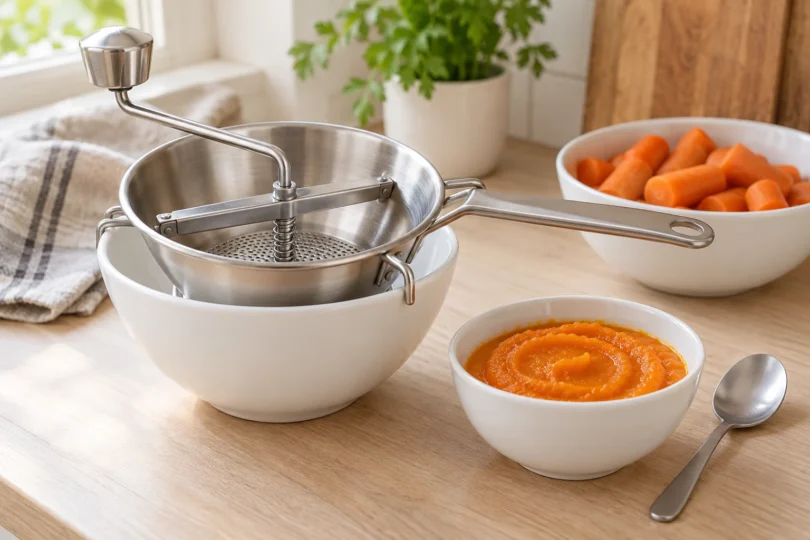

The best baby food mill grinder depends on how much food you prepare and the texture your child can manage. Our shortlist has three distinct uses: the green sprouts Fresh Baby Food Mill for small portions, the OXO Good Grips Food Mill for larger kitchen batches, and the OXO Tot Food Masher when you only need to mash soft food in a bowl.
A mill or masher does not cook food or decide whether a texture is appropriate for your baby. Choose the tool around your feeding routine, then follow age-appropriate preparation and storage guidance.
Best baby food mills and mashers at a glance
| Pick | Best fit | Design | Main limit |
|---|---|---|---|
| green sprouts Fresh Baby Food Mill | Small portions without electricity | Hand mill with an 8-ounce serving bowl | Cooked food must cool before entering the mill |
| OXO Good Grips Food Mill, 1071478 | Larger batches and other kitchen tasks | 2.3-quart mill with three grinding discs | Needs a separate receiving bowl or pot |
| OXO Tot Food Masher, 61130700 | Mashing soft food in a portable bowl | Ridged bowl and nesting masher with lid | Does not pass food through a straining disc |
1. green sprouts Fresh Baby Food Mill: best for small portions
Choose this if: you want a compact hand mill rather than a countertop appliance. The manufacturer’s Fresh Baby Food Mill, SKU 182300-560-00, has a built-in 8-ounce (236 mL) serving bowl and works without batteries or electricity.
Why it makes the list: it is designed to process soft, cooked foods and separate skins and seeds. That makes it a more relevant choice for straining a small portion than a simple bowl masher.
What to check: green sprouts specifically says to let cooked food cool before filling the mill and not to add hot contents or heat the plastic. Fully disassemble it for cleaning; the parts are top-rack dishwasher safe and should dry completely before reassembly. Its small bowl is the reason to choose it for modest portions, rather than treating it as a large-batch mill.
View the green sprouts mill and current ordering options.
2. OXO Good Grips Food Mill: best for larger kitchen batches
Choose this if: you want one mill for baby-food preparation as well as sauces or other family cooking. OXO identifies this Food Mill as model 1071478 and lists a 2.3-quart capacity, a stainless-steel inner bowl and three discs for fine, medium and coarse results.
Why it makes the list: the interchangeable discs give it a different role from the smaller baby-specific mill. OXO’s use-and-care guide identifies the fine disc for baby-food purees and explains how to position the mill over a bowl or pot. Its legs fold for storage, and the release mechanism lets you remove the disc for cleaning.
What to check: OXO’s specifications list dimensions of 14.75 × 10.25 × 7.25 inches. Plan space for the tool and receiving container. A fine disc is a processing choice, not a guarantee that every ingredient will emerge at a suitable feeding texture; inspect the finished food before serving.
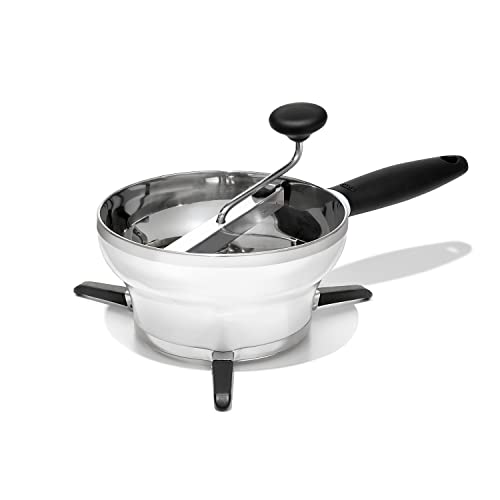
OXO Good Grips Food Mill, Model 1071478, 2.3-Quart
As an Amazon Associate we earn from qualifying purchases.
3. OXO Tot Food Masher: best when you only need a bowl and masher
Choose this if: you want to mash soft fruit or cooked vegetables directly in a small bowl. This pick is the OXO Tot Food Masher, SKU 61130700, not OXO’s separate Mash Maker Baby Food Mill.
Why it makes the list: the masher works against ridges inside the bowl, and its head has no holes for food to lodge in. The handle comes apart so the masher fits inside the bowl under its lid. OXO marks the product dishwasher safe. The nesting design is useful when packing the tool for a meal away from home.
What to check: this is a masher, not a crank-operated mill with a screen. Choose it for foods and textures that need mashing rather than straining. A lid makes the parts easier to carry; it does not establish that prepared food can travel without refrigeration.
View the exact OXO Tot Food Masher.
How to choose a baby food mill
Match the tool to the job
For occasional spoonfuls of already-soft food, consider whether a fork or masher already does what you need. Choose a mill when pushing food through a disc is useful, and a larger mill when you have other cooking jobs for it. Compare the amount you will actually prepare with the effort of assembling and washing the tool.
Consider texture before capacity
The CDC recommends introducing solid foods at about 6 months, with developmental readiness also mattering. Very smooth mashed, pureed or strained food may be easier initially; thicker textures can follow as eating skills develop. Cook hard fruits and vegetables until soft enough to mash, and remove hard pits, seeds and bones as appropriate. Do not rely on a mill to remove every hazard.
CDC choking guidance emphasizes the right shape, size and texture, upright seated eating and watching your child throughout the meal. Avoid feeding in a car or stroller. A product’s “baby food” label does not replace those precautions.
Plan cleaning and storage before making extra portions
Wash hands before preparing food and clean food-contact equipment thoroughly, following the tool’s care instructions. The FDA lists 1–2 days of refrigerated storage for homemade baby food; its chart gives shorter limits for some foods, including one day for strained meats and eggs. Serve a portion in a separate dish and discard uneaten food from that dish.
Refrigerate perishable food promptly. FDA guidance limits time without refrigeration or a cold source to two hours, reduced to one hour above 90°F. A portable mill can help prepare food away from home, but it does not provide cold storage.


