
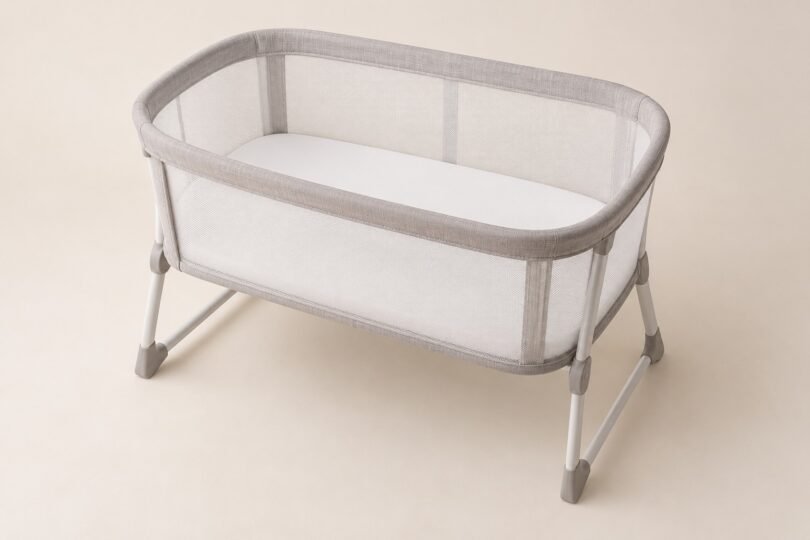

Do not add a wedge to a HALO bassinet. For routine infant sleep, use a firm, flat, level sleep surface and place your baby on their back. Putting a wedge above or beneath the mattress, propping up one end or adding a positioning pillow changes that sleep setup.
If you searched for a “bassinet wedge HALO” because your baby spits up, seems uncomfortable or will not settle, the useful next step is to discuss those concerns with your pediatrician and check the instructions for your exact BassiNest. A wedge is not a recommended reflux treatment or a substitute for the correct mattress.
Why a wedge is not a safe bassinet accessory
The American Academy of Pediatrics’ safe-sleep recommendations call for a firm, flat, noninclined surface. They specifically advise against putting wedges, pillows or similar items above or below the mattress to elevate an infant or create a slope. The recommendation applies even when an item is hidden under the mattress or sheet.
A claim that a wedge is “gentle,” “breathable” or “made for bassinets” does not change that guidance. The FDA warns against infant sleep positioners, including wedges intended to raise a baby’s head. Babies can move on these products and become trapped against the positioner or nearby surfaces. The warning applies whether or not the product makes a medical claim.
Do not treat a small angle as permission to modify a bassinet. Although some safety documents discuss an incline threshold, the home-sleep recommendation is still a flat, level surface, with the bassinet assembled and used as its manufacturer directs.
What HALO’s own instructions say
HALO provides separate instructions for different products through its official user-manual library. Match the model name and identifying label on your bassinet; “HALO bassinet” alone is not enough to identify the right pad, sheet or assembly procedure.
The Essentia and Premier manual explicitly says not to put anything in the BassiNest to elevate its mattress. It explains that elevation may let an infant slide into a position that affects breathing. It also requires a horizontal floor and warns against adding pillows, comforters or another mattress for padding.
The BassiNest Swivel Sleeper manual likewise addresses suffocation risks from extra padding and soft bedding. It requires the pad to be correctly positioned without pockets between the pad and mesh sides. If hardware is damaged or parts are missing, contact HALO for the correct replacement rather than substituting parts.
The 4.0 Signature and 4.0 Air manual repeats the instruction not to elevate the pad. It specifies using the mattress provided by HALO, keeping the bassinet on a flat, dry, level floor and securing the sleep surface to its base. The restriction on wedges is therefore not limited to an older BassiNest generation.
A bassinet’s height adjustment brings the sleep area to a suitable height beside the adult bed. It should not be confused with permission to raise one end of the mattress. If the assembled product appears tilted or unstable, stop using it while you check the exact manual and contact HALO.
What about reflux or a stuffy nose?
The AAP’s guidance for babies with reflux still recommends back sleeping. It explains that elevating the head of a baby’s sleep space does not effectively reduce gastroesophageal reflux and can create a dangerous sleeping position. Healthy babies sleeping on their backs are not shown to have a greater risk of serious or fatal choking than babies sleeping on their stomachs.
Ask your pediatrician about persistent symptoms and a feeding or treatment plan appropriate to your baby. This guide is general sleep-safety information, not an assessment of why an individual baby is uncomfortable. Do not use a retailer’s reflux claim to choose a wedge, inclined sleeper or positioning restraint.
The AAP also advises against mattress elevation for upper respiratory symptoms. A congested baby still needs the usual safe sleep surface; changing its angle is not a recommended solution.
What to buy instead: exact-fit essentials
Often, nothing needs adding to the bassinet. If the original pad is intact and you have the correct fitted sheet, a new accessory may not be necessary. If something needs replacing, identify the product first and then match the replacement.
A replacement sleep pad, only for the supported model
HALO’s DreamWeave BassiNest pad listing states compatibility with BassiNest models except the Bedside Sleeper and Twin. Its specifications are 30 by 18 by 1.3 inches. HALO says the core must stay inside its cover; an optional fitted sheet is separate from that required cover.
This is a manufacturer-made pad option with stated exceptions, not a wedge or an instruction to add another layer. Do not stack pads. Check the accessory instructions against your bassinet’s exact model before replacing the original. If the labeling or an older manual leaves compatibility unclear, ask HALO to confirm the replacement part before purchase. Do not use the listed dimensions to justify a different brand’s mattress.
A fitted sheet that matches the pad and bassinet
HALO’s BassiNest organic-cotton fitted sheet listing in Pebble specifies an envelope-style fit and 30-by-18-inch dimensions. The page lists Swivel Sleepers, Lite and Essential styles and explicitly excludes the Twin BassiNest and 2-in-1 Bedside BassiNest.
Those exclusions matter even though the products share the HALO name. Select the sheet for the exact model, follow its washing instructions and check the fit after laundering. Do not use a sheet that bunches up, pulls the pad out of shape or leaves loose fabric in the sleep area. A product labeled simply “universal bassinet sheet” is not enough information to confirm fit.
A short check before the next sleep
- Correct assembly: confirm the base, sleep area and any locking features are set up as the model’s manual requires.
- One appropriate sleep pad: no wedge, topper, pillow, folded towel or extra mattress above or below it.
- Bare sleep area: no toys, loose blankets, bumpers or positioning devices.
- Correct fit: the pad lies flat and any fitted sheet stays snug without creating gaps or distortion.
- Within the use limits: follow your model’s weight and developmental stop-use instructions. Reaching a developmental limit can mean stopping before the weight limit.
The CPSC’s safe-sleep guidance recommends a compliant crib, bassinet, play yard or bedside sleeper, with the baby placed on their back and the sleep area kept bare apart from a fitted sheet. It also advises checking for recalls. Look up the exact model and date information, especially when the product’s history is uncertain.
Common shopping claims to disregard
“Anti-roll,” “anti-reflux” and “helps prevent SIDS” are not reasons to add an accessory. The FDA says no baby product has been cleared or approved to prevent or reduce the risk of SIDS. A positive review about longer sleep cannot establish safety.
Nor does a product standard for infant support cushions turn a wedge into an approved sleep accessory. In its announcement of the infant-support-cushion standard, CPSC expressly tells caregivers not to use these cushions for sleep or naps and not to put them inside bassinets or other infant sleep products.
Bottom line: skip the HALO bassinet wedge. Keep the sleep surface flat and uncluttered, use only a correctly matched pad and fitted sheet, and take symptom questions to your pediatrician. The useful purchase is an appropriate replacement essential when needed, not an accessory that tilts or reshapes the sleep space.


