
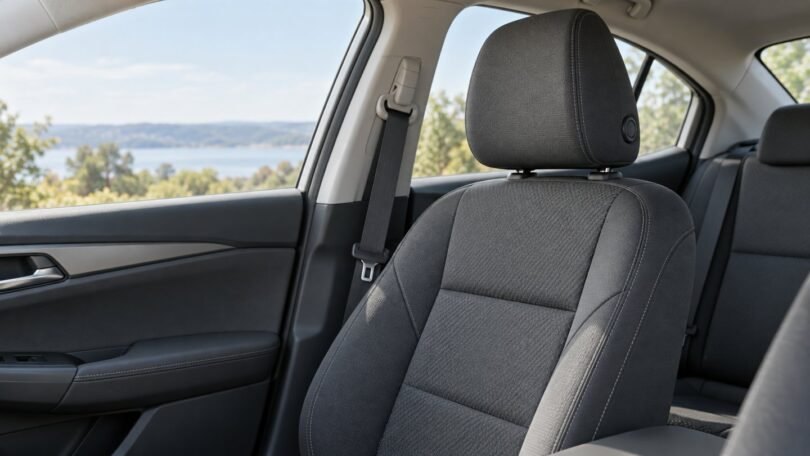

The right car seat neck support depends on who is riding. For a baby or child, start with the child restraint’s own headrest, inserts and installation instructions. Do not add a universal neck pillow, forehead strap or padded head positioner unless the car seat manufacturer specifically permits that accessory with that seat. For an adult, start by adjusting the vehicle seat and factory head restraint before considering a comfort cushion.
This guide explains those two situations separately, including what to check when a child’s head falls forward. It is based on manufacturer instructions and child-passenger-safety guidance, not hands-on testing or a ranking of aftermarket pillows.
Quick answer: what should you use?
- Newborn in a rear-facing seat: the correct recline setting and any original insert required by that seat’s manual.
- Toddler in a harnessed seat: the seat’s approved headrest and harness settings, with no improvised head-holding device.
- Child in a booster: a suitable booster and correct lap-and-shoulder-belt fit. A pillow cannot correct a poorly fitting belt.
- Adult driver or passenger: a properly positioned factory head restraint and an upright, comfortable seating position. Any accessory must comply with the vehicle’s instructions.
- Missing or damaged original padding: a replacement verified by the seat manufacturer for the exact model and production date.
NHTSA’s car seat glossary advises against aftermarket products unless the original seat manufacturer makes or allows them for its product. A seller’s claim that something is “universal” does not establish that permission.
Why a child car seat neck pillow needs a different safety test
A child restraint is a system. Its harness, shell, headrest and specified padding work together, so an extra cushion is more than a soft furnishing. It can change where a child sits or how the harness lies. A product that feels comfortable while parked may still be unsuitable for the restraint.
The American Academy of Pediatrics advises families to use additional products only when they came with the seat or are specifically approved by its manufacturer. It also warns against belt-positioning accessories that can interfere with belt fit. See its car seat information for families.
That is why this guide does not recommend an assortment of infant pillows, headbands or headrest-mounted side supports. “Crash tested,” without an identified seat combination and permission from that seat’s manufacturer, does not answer the compatibility question. Retail availability and customer ratings do not answer it either.
What to check if a baby’s head falls forward
If you notice a positioning problem during a journey, stop somewhere safe before adjusting the baby or the seat. Do not reach back or loosen the harness while driving. If a baby appears to have difficulty breathing, seek urgent medical assistance rather than trying to solve it with an accessory.
Once safely parked, work through the seat’s own instructions:
- Check the recline indicator. Use the level, bubble or reference line specified for your child’s size and the seat’s current mode. Do not copy the angle of a different seat.
- Check the original insert. Some inserts are required within particular size ranges; others must be removed as the child grows. The rules can differ for head and body pieces.
- Check the baby’s position and harness. Make sure the child is seated as directed and the straps are correctly routed and snug.
- Remove unapproved additions. An extra cushion behind the head may make the head position worse. Do not improvise with blankets or padding unless the exact seat instructions explicitly allow the arrangement.
- Get the installation checked. Persistent difficulty calls for help from the manufacturer and a certified child passenger safety technician.
Chicco’s newborn positioning guidance explains why the prescribed recline matters and distinguishes a head turned to the side from a head slumped forward. It also limits inserts to manufacturer-specified products for the particular seat. Those principles are useful, but your own model’s manual controls the actual settings.
Toddlers and older children: check the restraint stage
A sleeping child’s changing posture can prompt parents to shop for a neck support. Before doing that, confirm that the restraint still fits the child and is set up for the mode being used. Do not turn a child forward-facing early or move to a booster just to change the sleeping position.
NHTSA recommends keeping children rear-facing until they reach the manufacturer’s rear-facing height or weight limit, then using a forward-facing harness and tether within that seat’s limits. A booster is the next stage after the harnessed seat is outgrown. Its seat selection and installation guide includes inspection help.
With a booster, look at the belt rather than trying to hold the head in one place. The shoulder belt should cross the chest and shoulder; the lap belt should sit low across the upper thighs. A child needs to remain properly seated for the whole ride, including while asleep. If that is not happening, ask a technician about an appropriate restraint and fit. Do not put the shoulder belt behind the back or under an arm.
How to buy the correct replacement head support
Ordering the original replacement part is a different task from buying a universal pillow. Before contacting customer support, photograph the car seat’s model label and note the date of manufacture. Describe exactly what is missing: the removable infant head pad, body insert, fabric cover, adjustable headrest or another component.
Ask the manufacturer to identify the correct part number and confirm whether it is required or optional for your child’s size and current seating mode. A shared brand name is not enough; parts from two models may look alike without being interchangeable.
For example, Britax’s warranty and support guidance says non-Britax accessories are not approved and directs owners to the user guide or customer service. Chicco maintains a model-specific manual library. Use the equivalent support channel for your brand rather than relying on a marketplace seller’s compatibility list.
No affiliate purchase link is included for a child support: the reader’s exact seat, component and required approval are unknown. A broad product link could encourage the wrong combination.
Adult car neck support: adjust the seat first
An adult comfort pillow and a vehicle head restraint serve different purposes. The head restraint is part of the vehicle’s crash-protection system. IIHS explains that both its height and its distance behind the head matter in head-restraint evaluation.
While parked, use the owner’s manual to adjust the seatback, seat position and head restraint. Check that you can see clearly, reach the controls and turn your head comfortably without leaning forward. A thick cushion that changes your posture is not an automatic improvement.
Read any restrictions before attaching straps or clamps. For example, this Honda head-restraint guide warns against hanging items from the restraint or its legs. That illustrates why “fits most cars” is insufficient: instructions vary by vehicle.
Do not remove or reverse a factory restraint to accommodate a pillow, obstruct a seat-mounted airbag, or use a support that restricts the driver’s movement. An accessory’s memory foam, washable cover or adjustable strap describes convenience, not proven injury protection. Persistent neck pain deserves advice from a qualified healthcare professional; a shopping guide cannot diagnose its cause.
Questions parents often ask
Can a baby keep sleeping in the car seat after the journey?
Move a sleeping baby to an appropriate firm, flat sleep surface when you reach your destination. The AAP’s rear-facing seat guidance explains that car seats are intended for travel and describes breathing concerns when an infant’s head flops forward. A neck pillow does not turn a car seat into a safe sleep space.
What about a child with additional positioning needs?
Involve the child’s healthcare team and a technician trained in special-needs transportation. The AAP’s family guide points to technicians with this additional training. Individual needs may require a different restraint or a prescribed transport plan, rather than an off-the-shelf support.
What is the best purchase?
For a child, it may be no accessory at all: a correct adjustment, installation check or manufacturer-verified replacement is the useful next step. For an adult, identify the vehicle’s restrictions before shopping. Choose based on the exact seating situation, not a claim that one cushion suits every passenger.
Image note: Original AI-generated editorial illustration; generic objects shown, not branded product photography.

