


The best CD case depends on what you want to keep with the disc. For replacing a cracked album case while retaining its booklet and back artwork, start with the Maxtek standard jewel cases below. Choose Verbatim slim cases when individual disc protection matters more than a full-width spine. The Amazon Basics binder is the space-saving option for a large working collection of loose discs.
Those are three different jobs. A binder’s advertised capacity counts discs, while a pack of jewel cases counts individual enclosures. Neither tells you how much room remains for booklets, unusual packaging or future additions. Decide what you are storing before comparing pack sizes.
Three CD cases for different collections
| Product and exact version | Best fit | Main compromise |
|---|---|---|
| Maxtek 10.4 mm standard jewel cases, black trays, 25 pack | Replacing conventional single-disc album cases | More shelf space than slim cases |
| Verbatim 94178 assorted-color slim cases, 50 pack | Individually storing and color-coding loose discs | Less room for original album packaging |
| Amazon Basics black 400-capacity binder, one binder | Consolidating a large everyday-use collection | Discs sit in sleeves and original cases need separate storage |
Maxtek standard jewel cases for replacing broken album packaging
The Maxtek 10.4 mm single-disc case with an assembled black tray is the most straightforward choice here when an ordinary music CD needs a new enclosure. This exact package contains 25 cases, with one disc hub per case and clips for standard inserts. The product description also identifies a removable tray for placing back artwork.
Keeping the booklet, tray card and disc together makes sense if you browse albums by their spines or want the collection to retain its familiar presentation. The black tray matches many conventional releases, although it will conceal artwork intended to show through a transparent tray. Choose that detail deliberately.
Before ordering: compare one damaged case with the replacement format. A standard single-disc case is not a replacement for a double-CD tray, a thick multi-disc box, a cardboard digipak or a proprietary game case. Retain any unusual original components until you know the replacement fits.
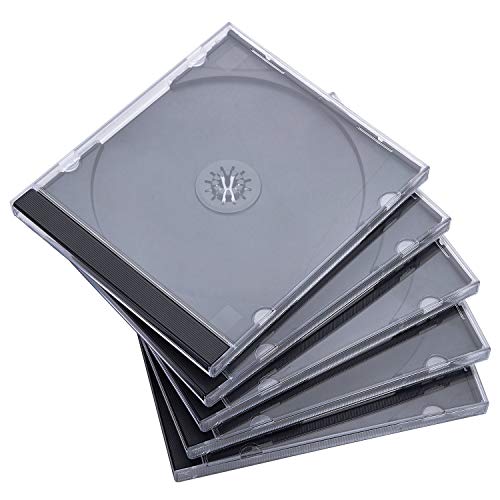
Maxtek Standard Single CD Jewel Cases, 10.4 mm, Clear with Black Tray, 25 Pack
As an Amazon Associate we earn from qualifying purchases.
Verbatim slim cases for a smaller individual-disc footprint
The Verbatim 94178 assorted-color 50 pack suits discs that need separate cases without full album packaging. Its Amazon listing specifies a 0.21-inch profile, and Verbatim identifies five colors: blue, green, orange, purple and pink. You can use those colors to distinguish projects, music categories or different people’s discs.
The practical appeal is simple: you can hand someone one disc without removing it from a shared binder. Slim cases also reduce the thickness of a row of individually housed discs. They are a sensible choice for home-recorded discs, provided your labeling method fits the available insert space.
Before ordering: do not assume a standard rear tray card or thick booklet transfers into a slim case. If preserving an album’s complete printed package is the priority, the standard Maxtek format is the better match.

Amazon Basics 400-capacity binder for consolidating loose discs
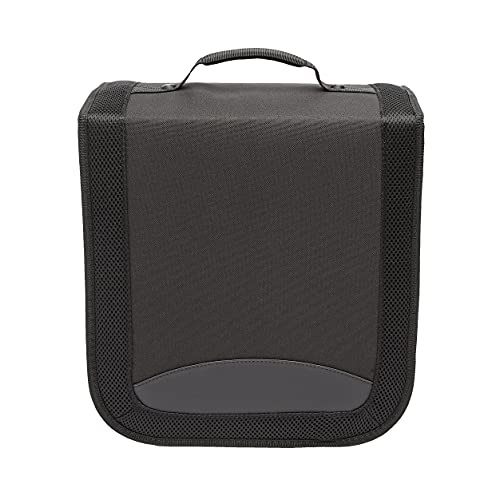
The Amazon Basics 400-capacity black binder is for buyers who want many discs in one zippered organizer. The manufacturer’s listing specifies a handle, fabric-backed sleeves and four discs per side of each page. Its stated dimensions are 12.2 by 11.7 by 6.6 inches, so measure the intended shelf or drawer rather than treating it as a small travel wallet.
This format makes sense for an everyday collection where rapid browsing and fewer separate boxes are useful. Number the pockets and keep a simple index if titles are difficult to read through the sleeves. Leave a little organizational room between categories instead of filling every pocket immediately.
Before ordering: 400-capacity means loose discs, not 400 jewel cases. Keeping booklets beside discs may use space you expected to reserve for more music. Choose individual cases for discs you want stored without their playing surfaces contacting sleeve material.
How to choose the right case format
Separate album preservation from everyday convenience
Start by dividing the collection into complete albums, loose playable discs and irreplaceable recordings or data. Complete albums benefit from keeping their identifying artwork together. Loose discs may be easier to use in a binder. Irreplaceable content deserves a preservation plan beyond the container.
The National Archives recommends individual plastic jewel cases stored upright, with polypropylene preferred, for optical-disc preservation. That is a storage principle, not an archival certification for any product on this shortlist. Its guidance also recognizes the need to copy or reformat vulnerable content. A new case cannot recover a failing disc or replace a backup.
Measure the shelf and count usable spaces
For individual cases, compare the case thickness with the width of the shelf section you can actually use. Allow room to grip the cases rather than wedging them tightly together. For a binder, check the closed dimensions, the space needed to open it and whether you can turn the pages without pressing them against the shelf above.
Count the items that need housing now, then decide whether you want spare cases for replacements or room for another batch of discs. Buying a larger pack is only useful when the format is correct. Twenty-five suitable cases are more helpful than fifty that cannot accommodate your inserts.
Check the hub, hinge and inserts before moving everything
Inspect a few empty cases on arrival. Look for cracked corners, broken hinge pins and missing hub teeth. Open and close each sample without a disc, then try one ordinary disc before transferring valuable albums. Check that the hub holds it securely and releases it without having to bend the disc.
For a binder, inspect the sleeve openings and seams for rough edges or debris. Do not force two discs into a pocket intended for one. Stop loading if pages bunch up or the zipper requires pressure to close. Capacity labels should never override the way the organizer actually closes around your collection.
Handling habits that help a case do its job
Keep discs off desks while swapping cases, and handle them by the edge and center opening. The National Archives advises releasing the hub while supporting the disc rather than flexing it upward. If cleaning is needed, its guidance calls for gentle straight strokes from the center outward, not circular wiping. Let a cleaned disc dry before putting it away.
Place cases somewhere you can reach them without repeatedly rearranging tall stacks. Use a consistent naming scheme on case inserts or a binder index. If you keep original artwork separately, give it the same identifier as the disc so that the connection is not lost during the next reorganization.
Common CD case questions
Can these cases hold DVDs too?
All three listed products are sold for CDs and DVDs. That refers to storing the discs. It does not mean a DVD’s tall printed cover fits inside a CD jewel case, or that a binder preserves its original packaging.
Should I throw away the original cases after buying a binder?
Keep them until you are certain you prefer the new arrangement. Complete packaging may matter to you later, particularly for collectible releases. A reversible first step is to move only a small everyday-use selection and see whether the binder makes those discs easier to find.
Which choice is the best starting point?
Pick Maxtek for conventional album-case replacements, Verbatim for compact individual storage, and Amazon Basics for consolidating loose discs. The right answer is the format that preserves what matters in your collection while making it easier to use.
Image note: Relevant existing category illustration retained.


