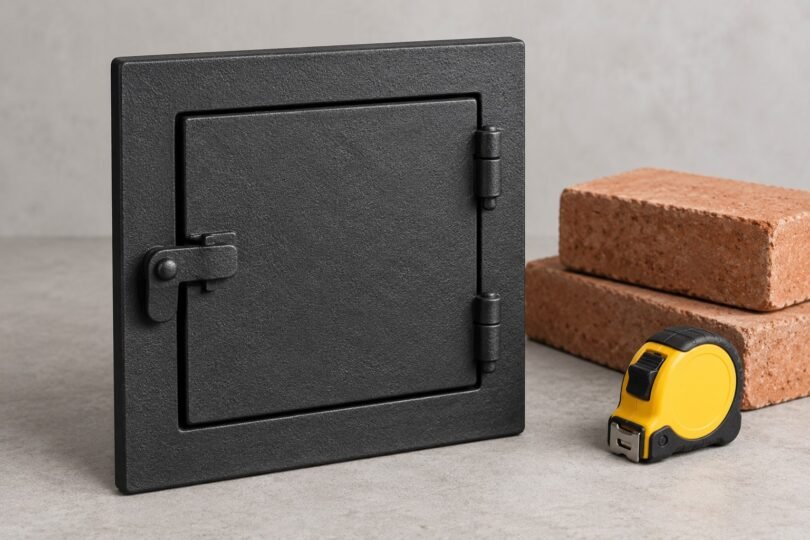

Chimney cleanout door sizes usually describe one part of the assembly, not every dimension needed for replacement. An 8-by-8-inch label might refer to a door opening or a nominal size, while the surrounding frame is larger. Before ordering, establish the required masonry opening, the usable access opening and the overall frame dimensions for the exact model.
For an existing masonry chimney, the right replacement is the door assembly that fits the opening, closes securely and is suitable for that location and chimney system. A larger frame cannot compensate for damaged masonry or an unsuitable installation. If the opening or old frame is deteriorating, arrange an inspection before selecting the replacement.
The four measurements that matter
1. Masonry or rough opening
This is the opening in the wall that receives the assembly. Its dimensions must match the manufacturer’s installation requirements, including any required fitting allowance. An old frame can hide the edges, so a measurement taken across the visible door may not reveal the true opening. Do not remove embedded masonry or force out a damaged frame just to obtain a measurement.
2. Clear access opening
This is the usable passage after the door is open. The frame and hinge arrangement can reduce the space available for inspection and removal of debris. Ask whether a listed “door opening” is this clear passage or the required hole in the masonry. Those descriptions are sometimes used inconsistently in online listings.
3. Door panel and overall frame
The movable panel is different from the full frame around it. Record both when comparing an existing assembly with a replacement. The frame must fit the available wall surface without clashing with adjacent trim, pipework or another opening. Its overlap and installation depth must follow the product’s instructions, rather than an assumed universal allowance.
4. Depth and opening clearance
A door can match the front measurements yet still be unsuitable because its frame projects too far into the opening or its hinge cannot swing freely. Check the required depth, hinge side, latch clearance and space for the person servicing the chimney. A closet, shelf or appliance placed in front can make a correctly sized door impractical to access.
Verified sizes and products to compare
The following examples show why exact dimensions and manufacturer confirmation matter more than a long list of supposedly interchangeable doors. Use the linked manufacturer information to narrow the choice, then obtain the installation drawing before ordering.
US Stove COD 8: an 8-by-8-inch access opening
US Stove’s COD 8 cleanout door is a cast-iron door-and-frame assembly intended for masonry chimneys, including replacement and new construction. The manufacturer specifically describes the door opening as 8 by 8 inches and lists cast-iron latches.
The same page includes an additional-information dimensions field of 11 by 11 by 4 inches. It does not clearly identify those numbers as the installation opening or provide a labeled frame drawing. Do not translate that field into a required hole size. Ask US Stove or the supplying dealer for the frame outside dimensions, insertion dimensions and fitting instructions.
HY-C Liberty Foundry COD88: clear frame dimensions, conflicting fit text
The Liberty Foundry COD88 page identifies heavy-duty cast iron, a hinged door and a single-bolt closure for indoor or outdoor masonry cleanouts. It gives a frame size of 10½ by 10½ inches and a door-panel size of 8½ by 8½ inches.
Confirm the opening before buying: the page’s narrative says the assembly fits an 8-by-8-inch wall opening, but its feature list says 8½ by 8½ inches. Because those statements conflict, neither should be treated as a guaranteed installation dimension. Request written confirmation for the supplied COD88 version. The page’s retail and shipping measurements describe the packaged product, not the masonry cutout.
South Atlantic LCD series: square and rectangular openings
South Atlantic’s fireplace-products page identifies three cast-iron cleanout models by door opening:
- LCD88: 8 by 8 inches
- LCD810: 8 by 10 inches
- LCD812: 8 by 12 inches
The manufacturer does not provide overall frame dimensions or a detailed closure description in that listing. Request those details and the required masonry opening rather than assuming the named opening is the rough opening. Its carton quantities are trade packaging information; confirm whether your quotation is for one complete assembly or a carton.
A safe measuring checklist for an existing door
Take measurements only when the connected fireplace or appliance is off and the system is fully cool. If the door is stuck, loose, heavily corroded or surrounded by cracked masonry, leave assessment to a qualified chimney professional. Do not pry, chisel or enlarge the opening to make a chosen product fit.
- Record the identity. Photograph the existing door, any cast-in name or part number, and the surrounding wall.
- Separate the dimensions. Note visible frame width and height, door-panel dimensions, and the clear opening if it can be safely observed.
- Check variation. Measure accessible widths and heights at more than one point. Record unevenness rather than rounding to the nearest catalog size.
- Document the surroundings. Include hinge direction, available swing, indoor or outdoor location, wall material and the appliance or fireplace served.
- Ask for a fit decision. Give the photographs and labeled measurements to the manufacturer or installer and request the correct assembly and installation requirements.
If the old frame hides the rough opening, write “not yet verified” beside that measurement. This is more useful than substituting the visible panel size and discovering the mismatch after delivery.
Material, closure and application
Cast iron is used in the verified examples above, but material alone does not establish suitability. Compare the entire assembly: frame condition, hinge movement, latch engagement and the way the closed door seats. A replacement leaf is not automatically compatible with a different manufacturer’s existing frame, even when both carry the same nominal size.
For a gasketed design, confirm that the specified gasket and replacement parts are available. Do not add household weatherstripping, expanding foam or an improvised seal. Ask the manufacturer or chimney professional which installation and sealing materials are appropriate for the particular assembly and service conditions.
A masonry cleanout door is also different from an ash-dump door in a fireplace floor, a stove loading door, a smoke-chamber access product or a panel in a factory-built chimney. South Atlantic lists its ash dumps separately from its cleanout doors. Do not substitute a generic plumbing or drywall access panel, or modify a listed factory-built system based only on matching dimensions.
What does the building code require?
There is no universal cleanout-door size that proves every installation compliant. The applicable jurisdiction, adopted code edition, local amendments, appliance instructions and chimney construction all matter. For example, Section R1003.17 of the 2018 International Residential Code addresses masonry-chimney cleanout openings, including their location, a minimum opening height of 6 inches and a noncombustible cover. That is an edition-specific example, not a statement that the 2018 code governs your home.
Ask the local building department or qualified installer what applies before changing the opening or cleanout location. A product advertised as 8 by 8 inches does not independently establish correct placement, access, construction or compliance.
When a replacement door is only part of the problem
The Chimney Safety Institute of America’s masonry-inspection guidance calls for checking that cleanout doors close securely. It also notes that debris found in the cleanout can reveal information about the chimney’s interior condition. A new door should not be used to conceal loose material, persistent water entry or a surrounding masonry defect.
CSIA’s homeowner guidance recommends annual inspection of chimneys, fireplaces and vents, with cleaning and repairs as needed. A visual check of the little access door is not a substitute for that inspection. If smoke leaks around it, damage is visible or it will not close securely, stop using the connected appliance until the problem has been assessed.
Before you place the order
Get a written specification covering the exact model, required masonry opening, clear access opening, outer frame dimensions, depth, closure type, intended application and package contents. For the COD88, resolve the manufacturer’s conflicting opening measurements first. For any door lacking a labeled drawing, request one. Matching these details to a professionally assessed opening is the most reliable way to avoid an expensive, unsuitable replacement.