
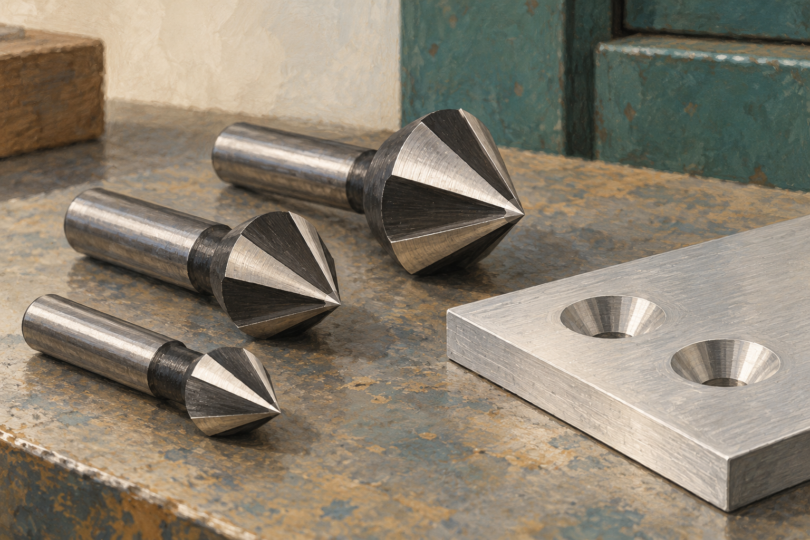

For aluminum, choose a countersink whose manufacturer lists the material, then match its included angle and cutting range to the actual fastener or drawing. A tool advertised as chatter-free cannot compensate for the wrong angle, an unsupported workpiece or an unsuitable cutting diameter.
Three useful comparisons are the Champion CSK18 82° zero-flute countersink, the RUKO 102154RO 90° three-edge set, and the RUKO 102312RO 90° cross-hole set. The cross-hole set has an important restriction: RUKO does not recommend it for full countersinking. That makes it a different purchase from a general screw-seat cutter.
Research checked October 4, 2026, using manufacturer specifications, application guidance and CCOHS machinery-safety guidance. We have not measured chatter, tool life or hole quality. Prices and availability are not verified; no universal spindle speed or feed rate is supplied.
Three documented aluminum options
| Tool | Geometry and material | Published sizes | Best reason to compare |
|---|---|---|---|
| Champion CSK18 | 82°, pilotless zero-flute, HSS | 3/16–17/32-inch cutting range; 1/4-inch shank | An 82° job using a portable drill or drill press |
| RUKO 102154RO | 90°, three cutting edges, uncoated HSS | 6.3, 10.4, 16.5, 20.5 and 25 mm | Several 90° countersink sizes in one set |
| RUKO 102312RO | 90°, cross-hole, one listed cutting edge, uncoated HSS | 2–5, 5–10, 10–15 and 15–20 mm ranges | Deburring, with a manufacturer restriction against full countersinking |
Champion CSK18: an 82° zero-flute option
Champion’s CSK range explicitly lists aluminum and use in portable power drills or drill presses. The CSK18 is pilotless, with an 82° cutting angle, a 3/16–17/32-inch cutting range, a 9/16-inch body and a 1/4-inch shank. It is made from high-speed steel.
The body diameter and usable cutting range are separate specifications. Shop using the range that covers the required recess, then verify that the shank fits your chuck. The family includes other sizes and shank diameters, so copying a CSK18 specification onto every CSK listing would be misleading.
Champion describes the design as a single cutting edge intended to produce a chatterless finish. Treat that as a manufacturer claim, not a result we have independently verified. It is a sensible comparison when the drawing actually calls for 82°, rather than a substitute for a 90° or 100° tool.
RUKO 102154RO: a 90° three-edge set
The 102154RO set contains five uncoated HSS, DIN 335 type C countersinks with three cutting edges. RUKO lists aluminum as a main application. Its diameters are 6.3, 10.4, 16.5, 20.5 and 25 mm.
Compare this set if your work calls for 90° recesses across several sizes. The manufacturer describes wide chip flutes and geometry intended to reduce material welding and cutting forces. Those design features are more useful to investigate than choosing solely by the largest number of pieces in a case.
Limit: the product page’s percentage improvements in time, force and tool life come from its own tests on specified structural steel. They are not measured aluminum performance and are not used as a ranking here. If you need only one diameter, compare an individually specified tool before paying for the set.
RUKO 102312RO: respect the cross-hole limitation
The 102312RO set is uncoated HSS with a 90° sinking angle and right-hand cutting direction. RUKO gives four working ranges: 2–5, 5–10, 10–15 and 15–20 mm. Aluminum is a listed main application.
The cross-hole design routes chips through the opening. However, the exact product description says it is not recommended for full countersinking. Use that restriction when deciding whether you need a deburring tool or a cutter to produce a complete screw seat. Do not generalize from the suitability of another brand’s zero-flute tool.
This set is worth considering for edge cleanup within its documented range. For a specified full-depth recess, ask RUKO to identify the appropriate product instead of assuming every conical tool can perform the same operation.
Start with the angle on the drawing
RUKO’s geometry guide distinguishes countersinking a fastener head from removing a burr. It lists 82° for U.S.-standard countersunk screws and 90° for other countersunk screws, alongside several additional angles for different applications.
Those categories are useful orientation, not permission to infer your fastener’s geometry from the units on its package. Check the manufacturer’s drawing, included head angle and required recess diameter. A hole may appear flush while giving the wrong contact pattern. For aircraft, vehicles, load-bearing joints or other controlled work, use the specified process and acceptance criteria.
Five checks before ordering
- Operation: identify whether you are breaking a sharp edge, machining a full screw seat or making a flat-bottomed counterbore. Those are different outcomes.
- Material: identify the aluminum alloy, temper and thickness if known. Give that information to the tooling supplier rather than asking for settings for “metal.”
- Range: distinguish starting-hole diameter, finished countersink diameter, tool body diameter and shank size. An oversized body is not a dimensional inspection method.
- Machine: confirm the tool is suitable for your handheld drill, drill press or machine tool. A hex shank by itself does not establish permission to use impact mode.
- Remaining section: confirm that the specified recess can be produced without leaving an unacceptable thin edge or breaking through the part. Ask the designer when the drawing is incomplete.
Speed, lubrication and chatter
RUKO’s operating guidance identifies excessive speed, uneven feed, unsuitable geometry and dull edges as common causes of poor results. It recommends matching settings to material and diameter, secure tool clamping and appropriate cooling or lubrication.
There is no defensible one-RPM answer for every tool in this comparison. Obtain the exact manufacturer’s starting parameters for your cutter, alloy and setup, and follow its lubricant guidance. Do not copy a drilling speed, another material’s feed or a generic internet number onto the job.
Where the work permits it, qualify the setup on a representative offcut and inspect the finished recess against the drawing. If chatter appears, stop to check rigidity, alignment, cutting-edge condition and parameters. Increasing pressure without diagnosing the cause is not a reliable remedy.
Safe workholding matters
CCOHS drill-press guidance calls for securing work with a clamp or drill vise and wearing appropriate eye protection. It prohibits gloves, rings, watches and bracelets around the operating drill press. Keep hair and loose clothing away from rotating parts, and stop the machine before removing chips or making adjustments. Follow your machine’s complete manual as well.
Frequently asked questions
Is zero-flute always best for aluminum?
No. These sources support specific products for specific tasks, not a universal flute-count winner. The RUKO cross-hole restriction shows why model-level instructions matter.
Do I need cobalt or carbide?
Not automatically: the compared HSS products explicitly list aluminum. Discuss production volume, rigidity and finish requirements with the manufacturer before assuming a more expensive tool material is necessary.
Can one countersink fit every screw?
It can cover a range of diameters only within its published geometry and capacity. Different included angles still require matching tooling.
Image note: AI-generated generic editorial illustration; cutter geometry is illustrative and does not establish a product specification, angle or machining procedure.


