


The right cross bars for a Kia Niro depend on its model year, roof-rail design and powertrain, plus the cargo carrier you plan to use. For a U.S. 2017–2026 Niro with the appropriate factory rails, the genuine Kia G5F21AC000 kit and ERKUL’s Niro-specific Skybar V2 are identifiable options worth checking. Do not assume those kits transfer to the redesigned 2023-and-later Niro.
This guide compares documented products and the fit checks that matter before ordering. It is based on manufacturer information and matching listings, rather than installation tests, highway-noise measurements or an assertion that one rack fits every Niro.
Crossbar options at a glance
| Option | Documented application | What distinguishes it | Main check before ordering |
|---|---|---|---|
| Genuine Kia G5F21AC000 | Niro application with factory roof rails; verify year and powertrain by VIN | OEM part-number route and Kia’s 165-pound evenly distributed accessory limit | Exact vehicle fit and supplied installation instructions |
| ERKUL Skybar V2, silver or black | Manufacturer’s Niro 2016–2026 flush-rail family | Aluminum crossbars, locks and two verified color variants | Correct Skybar V2 version, rail profile and carrier fit |
| OMAC U015703, black | Manufacturer’s first-generation Niro 2017–2026 flush-rail application | Two-piece aluminum set; stated 165-pound capacity | Manufacturer confirmation of exact current kit and vehicle |
“Flush rails” sit close to the roof without a continuous open gap beneath them. Raised rails, fixed mounting points and a bare roof use different attachments. A generic adjustable bar that spans the roof is not enough; its feet and clamps must match the actual mounting arrangement.
Genuine Kia G5F21AC000: start with a VIN-based fit check
Kia’s G5F21AC000 accessory listing specifies factory-installed roof rails and an evenly distributed 165-pound load limit. The listing identifies Niro, Niro EV and Niro PHEV applications; the final choice should still be confirmed against your VIN and market.
This is a useful starting point if you want the dealer to establish the correct original-equipment part. Keep the part number, fitting instructions and any confirmed supersession together. Do not order a Sorento, Sportage or Soul kit because its photograph resembles a Niro rack.
Ask what is included in the particular package, whether the kit is new and complete, and how missing clamps, pads or keys are replaced. If buying used, a low price does not compensate for missing safety-critical mounting hardware. An exact Amazon mapping for this OEM kit was not established here, so the manufacturer reference is provided without a purchase card.
ERKUL Skybar V2: two color choices for the earlier flush-rail fit
ERKUL’s Niro product page contains several crossbar designs, so use its selectors carefully. The two listings below are the Skybar V2 for the 2016–2026 Niro flush-rail application. They are the silver and black versions of the same family, not two separate performance recommendations.
The verified silver Amazon listing identifies Skybar V2 and manufacturer part number SKYV2170618G. The black listing identifies Skybar V2 and SKYV2170618S. Both list front and rear bars, mounting hardware, keys and instructions. The manufacturer page separately identifies the corresponding silver and black Skybar V2 variants.
Resolve the capacity discrepancy before loading: ERKUL’s current comparison table lists Skybar V2 at 165 pounds, while the matching Amazon headlines advertise 220 pounds. Do not use the higher marketplace figure as your working limit. Ask ERKUL to confirm the rating for the exact kit supplied, and follow the lower applicable rating along with the vehicle and carrier limits.
Consider this option when that rail-specific fit is confirmed and you prefer an aftermarket kit. The aluminum construction and locks are documented features; this guide has not measured durability, resistance to theft or wind noise. Treat a lock as a deterrent rather than a guarantee that the bars or cargo cannot be stolen.
ERKUL’s listing uses a 2016–2026 range, while the U.S. first-generation shopping context commonly begins with 2017. Confirm the actual model year, country and roof details rather than interpreting the date range as universal worldwide fit. Also distinguish standard Skybar V2 from the “Heavy Duty” and newer-generation options on the same marketplace page.
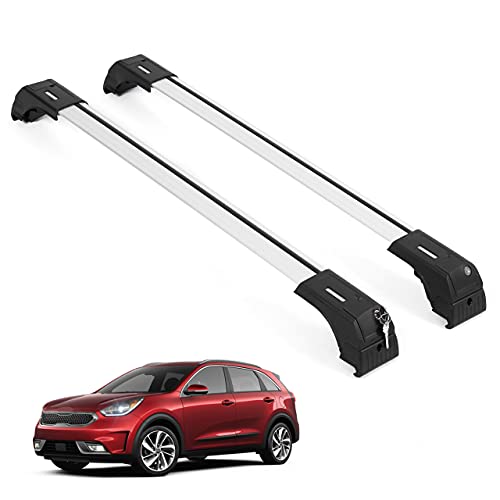
ERKUL Skybar V2 SKYV2170618G, Kia Niro 2016-2026 Flush Rails, Silver, 2 Bars
As an Amazon Associate we earn from qualifying purchases.
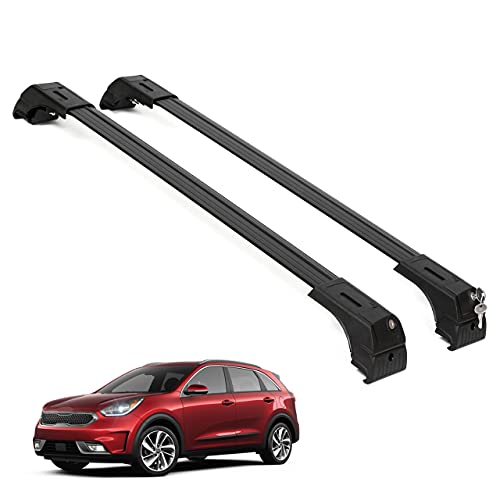
OMAC U015703: verify the current kit directly
OMAC’s black first-generation Niro crossbar page identifies SKU U015703, two aluminum pieces, flush-rail mounting and a stated 165-pound capacity for its 2017–2026 application. Those specifics are more useful than a broad “fits Kia” description.
Earlier Amazon identifiers from the original article could not be independently verified as the current U015703 kit. There is therefore no Amazon card for it here. If considering OMAC, ask the manufacturer to match your year, powertrain, rail profile and intended carrier to the exact supplied SKU. Do not infer compatibility from the years embedded in the web address alone.
Why 2023-and-later Niros need a separate lookup
Kia identifies the 2023 Niro as a new second generation, offered as HEV, PHEV and EV. That change is enough reason to reject an unsupported assumption that an earlier kit will fit. A car registered in one year can also have a different model year, so use the vehicle documentation.
For a newer Niro, choose the precise vehicle in Kia’s accessory catalog or a rack manufacturer’s fit tool, then verify the result against the roof in front of you. Some product pages group multiple years, mount styles and powertrains. Make sure the selected variant, not just the headline, names the correct application.
Understand the lowest load limit
A crossbar rating is only one limit in the system. The vehicle roof, rails, feet, bars and cargo attachment can each impose restrictions. Follow every relevant instruction and the lowest applicable limit. A bar advertised at 220 pounds cannot increase a lower vehicle or carrier rating.
For example, the 2026 U.S. Niro EV manual lists a 220-pound evenly distributed roof-rack limit, while Kia’s G5F21AC000 accessory page lists 165 pounds. Those figures describe different parts of the system. They are not interchangeable cargo allowances, and the manual for another Niro must be checked separately.
Account for the rack and carrier weights in the limits that include them. A roof box, its mounting hardware and the contents all contribute to the load on the roof. Check how each manufacturer defines its rating rather than subtracting weights from an unexplained headline number. Never double a set’s stated capacity because it has two bars.
Do not infer rooftop-tent suitability from a driving-load rating. Parked loads, occupants and tent attachments need separate explicit approval for the vehicle and complete rack system. If that documentation is missing, do not use an arithmetic multiplier or a seller’s generic claim as permission.
Match the carrier as well as the car
- Bar spacing: A box, bike rack or kayak carrier usually specifies an acceptable distance between bars. The crossbars must also remain within the vehicle’s approved mounting positions.
- Clamp clearance: Confirm that the carrier’s clamps clear the roof, glass and trim and fit the bar’s width and thickness.
- Track hardware: If using a T-track attachment, verify the track and bolt dimensions. The presence of a channel does not establish compatibility with every accessory.
- Hatch and sunroof: Check the position of a long box or carrier against the tailgate’s opening path. Follow the vehicle instructions concerning the sunroof.
- Total height: Measure the loaded vehicle before approaching garages, car parks, drive-throughs or other overhead restrictions.
Installation and pre-trip checks
Use the instructions for the exact kit. Identify the front and rear bars, correct feet and pads, required mounting positions and fastener torque. Do not substitute bolts, bend clamps, remove structural parts or tighten beyond the specified torque to make an incorrect kit fit. Have a qualified installer help if the instructions are incomplete or the fit is uncertain.
Before loading, inspect the rails, pads and fasteners for damage and verify that the rack is secure as instructed. Secure the carrier and cargo with the required attachments. Bar locks do not secure everything placed on the roof, and a cargo strap is not a remedy for loose rack feet.
Kia warns that roof loads raise the center of gravity and can affect handling. Its Niro EV guidance calls for cautious driving, evenly distributed loads and frequent checks that cargo remains fastened. It also says not to operate the sunroof while carrying roof cargo. Follow the speed limits and recheck intervals in the rack and carrier manuals as well.
Frequently asked questions
Will HEV, PHEV and EV use the same bars?
Sometimes a manufacturer lists several powertrains, but do not assume it. Verify your exact year, roof equipment and vehicle application. A seller’s broad family name is not enough.
Can I install flush-rail bars on a bare roof?
Not unless the manufacturer explicitly supplies and approves a complete system for that mounting arrangement. Flush-rail clamps need the compatible rails they were designed to grip.
Which option should I choose?
Start with a VIN-confirmed OEM kit if you want the Kia parts route. Compare ERKUL Skybar V2 only after the earlier-generation flush-rail fit and carrier requirements are confirmed. For newer Niros or uncertain roofs, resolve fit first rather than selecting by price, color or advertised capacity.
Image note: AI-generated editorial category illustration; not a photograph of a named or tested product. Generic roof-rack crossbar illustration; not a Kia Niro part, compatibility demonstration or installation guide.


