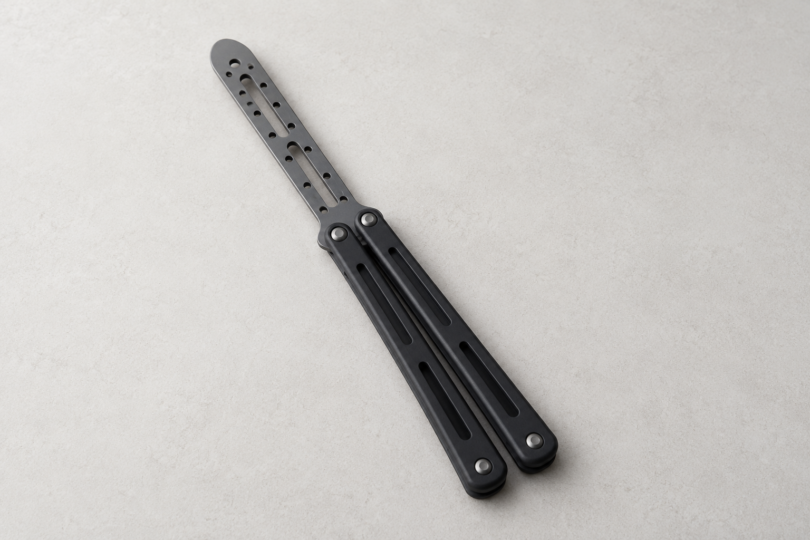

A curved butterfly knife trainer should be a purpose-built, blunt practice device with no cutting edge and a rounded tip. For an adult buyer, those details matter more than the finish, game-inspired styling or number of items in a bundle.
No exact curved model is recommended here: a curved trainer with a sufficiently clear manufacturer specification could not be verified. Use the checks below to assess a listing, or compare the clearly documented non-curved trainers linked later in this guide.
What to check before buying a curved trainer
“Curved” can describe the handles, the practice insert or simply the product’s appearance. It does not establish how the device is built. A listing should identify the manufacturer and exact model and explicitly confirm that the selected version is a non-cutting trainer.
- Practice-only construction: look for an explicit statement that the insert has no cutting edge, plus a clearly rounded end. A photograph alone is insufficient.
- Exact selected variant: check the title, option selector, specifications and basket description for the same model. Do not rely on reviews pooled across different products.
- Useful dimensions: ask for open length, closed length, handle thickness and assembled weight. Overall length alone says little about whether the handles will fit your hand comfortably.
- Clear hardware information: identify the pivot system, fasteners and any latch. A maker that supplies model-specific care instructions and replacement parts is easier to evaluate.
- Return terms: check how incorrect variants, missing hardware, binding pivots and damaged finishes are handled before ordering.
If the seller cannot identify the trainer or confirm its non-cutting construction, skip that listing. Generic claims such as “safe,” “premium” or “beginner friendly” do not answer those questions.
Fit and construction matter more than the curved silhouette
Handle shape and clearance
Compare the handle profile with something you can already hold comfortably. Ask whether the dimensions include a latch or projecting hardware. Look for clear photographs of the pivot area and the closed device, where a decorative shape can hide tight clearances or protruding edges.
A pronounced curve is not a quality grade. Choose a shape because it fits comfortably and has documented construction, rather than assuming a more dramatic outline makes practice easier.
Material and weight
Plastic and metal trainers can feel very different. Compare the actual assembled weight instead of inferring it from the material name. For a first purchase, a manageable weight and comfortable edges are more useful criteria than a claim that the trainer feels “realistic.”
Pivots, fasteners and maintenance
Washers and bearings are construction details, not a complete verdict on quality. Ask whether the maker provides an inspection guide, identifies replacement fasteners and explains what requires service. Do not buy a device that needs improvised adjustments just to arrive in usable condition.
Two documented practice-only references
These are non-curved alternatives for comparing specifications. Neither is presented as an exact substitute for a curved design.
Squid Industries Squiddy-B: lightweight plastic reference
The official Squiddy-B page identifies an acetal trainer with no sharp edges. Listed specifications are 2.6 ounces, 10 inches open and 5.75 inches closed. It uses phosphorus-bronze washers, latchless channel handles and O-rings intended to reduce noise.
This is a useful starting point if low weight is your priority. The maker’s noise description is not a measured comparison with other products. Inspect a plastic trainer for cracks or damaged hardware just as carefully as a metal one.
Kershaw Lucha – Trainer 5150TR: heavier metal reference
Kershaw explicitly describes the Lucha – Trainer as having a blunt, non-cutting training insert and rounded tip. Its specifications list stainless-steel handles, dual KVT ball-bearing pivots, a latch, a 10.25-inch open length and a weight of 6 ounces.
The manufacturer product page identifies the trainer as 5150TR. Match that full code when checking a seller’s selected variant. Its substantially greater listed weight is a reason to consider hand comfort carefully.
Inspect it before recreational practice
This guide is for adults using a purpose-built trainer in a controlled private space. Blunt construction still leaves moving handles, pinch points and the possibility of impact injuries.
- Match the received model and variant to the order and the manufacturer’s documentation.
- Visually inspect the rounded insert, handle surfaces and fasteners. Do not run a finger along an uncertain edge to test it.
- Stop if there are cracks, burrs, missing parts, loose hardware or unexpected binding. Ask the seller or maker for an inspection or return rather than forcing the mechanism.
- Keep other people, pets, fragile objects and exposed feet clear of the practice area. Keep the device away from children when stored.
- Use only the maker’s model-specific care instructions. Leave the training insert and hardware in their intended configuration.
Before ordering, carrying or travelling with a trainer, check the applicable local rules and the venue or transport provider’s current policy. A seller’s broad travel or legality claim is not a substitute for those checks.
Frequently asked questions
Is a trainer with a curved handle automatically non-cutting?
No. Handle shape does not establish the insert’s construction. Verify the exact selected model through the maker’s description, including its non-cutting edge and rounded tip.
Should an adult beginner choose plastic or metal?
Compare weight, dimensions, comfortable edges and support information. The two documented references above illustrate the weight difference; they do not establish one material as the right choice for everyone.
What if the listing has no model number?
Ask for a manufacturer reference and confirmation of the supplied variant. If the answers remain unclear, choose a better-documented trainer rather than treating a low price or high rating as proof of suitability.
Bottom line
For a curved butterfly trainer, buy only after the exact non-cutting construction, fit and support are clear. If the curved appearance is optional, a documented practice-only model gives you a firmer basis for comparing dimensions and materials.