
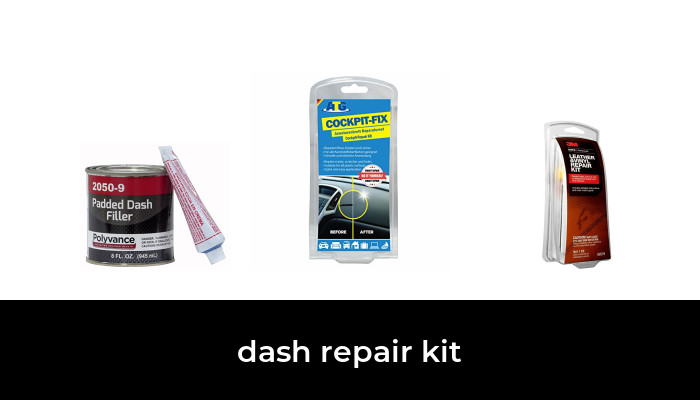

A dash repair kit is worth considering for a small cosmetic defect in otherwise sound material. It is a much less convincing purchase when the dashboard is brittle across a wide area, lifting away from its backing, or damaged around an airbag. First identify the surface and the damage; then choose the repair chemistry, tools and finish. A kit sold for leather upholstery is not automatically suitable for every hard-plastic dashboard.
The useful choices below cover three different jobs: filling a padded dash, repairing small vinyl surface damage with a separately heated tool, and buying a kit with its own electric heat tool. These are specification-based comparisons, not hands-on test results or a promise of an invisible repair.
Before buying: rule out airbag-related damage
Do not fill, glue, cover or refinish an airbag cover, deployment seam or damaged restraint-system component as a cosmetic DIY repair. Have a qualified repairer identify the affected part and the vehicle manufacturer’s repair procedure. A crack near a deployment area is a reason to stop, not to use stronger adhesive. Ford’s airbag deployment guidance explains why objects must not obstruct an airbag and warns against modifying the restraint system. Check the equivalent guidance for your exact vehicle.
Also distinguish the dashboard skin from the instrument cluster. A filler will not repair faulty gauges, damaged wiring or broken mounting brackets. Button-label decals can replace worn markings but do not restore the dashboard’s surface or an electrical switch.
Dash repair products to compare
Polyvance 2050-9 Padded Dash Filler: for a padded-dash restoration
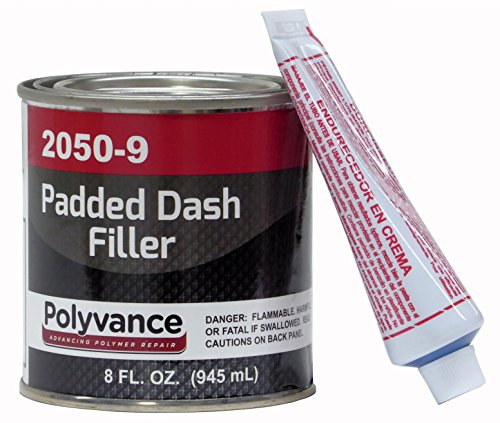
Polyvance 2050-9 Padded Dash Filler, 8 fl oz Can and Cream Hardener, 1 Set
As an Amazon Associate we earn from qualifying purchases.
Polyvance’s 2050-9 product specification identifies an 8-fluid-ounce can plus cream hardener. The polyester formulation is intended to adhere to vinyl and other plastic substrates, with flexibility for temperature-related movement. It can be shaped, sanded and feathered into the surrounding surface.
Choose it for: a repairable padded dashboard where filling and shaping are part of a larger refinishing job. Know the limit: this is filler and hardener, not a complete color-and-texture restoration kit. Budget for the compatible preparation and finishing materials specified for the job. Filling a crack cannot make widespread degraded material sound again.
Permatex 80902: for small vinyl damage and a separate heat source

The 80902 kit includes seven color compounds, clear adhesive and filler, grain papers, a spatula and a heat-transfer tool. Permatex includes soft-surface dashboards among its applications. The supplied transfer tool is heated using a separate heat source as directed in the instructions; it is not the plug-in tool supplied with the Ultra kit below.
Choose it for: localized cosmetic damage in a compatible soft vinyl surface when you are prepared to practice the color and texture match first. Know the limit: heat control and careful blending are part of the process. Do not apply a household iron directly to the dashboard. Follow the current kit instructions rather than assuming that any generic online heat-setting method applies.
Permatex 81781 Ultra: for an included electric heat tool

The 81781 Ultra system adds a plug-in heat tool and dashboard hardening powder to its seven color compounds, adhesive/filler, grain papers and metal spatula. That makes the tool package the main reason to compare it with 80902.
Choose it for: a compatible localized repair where you want the kit’s dedicated heat tool. Know the limit: the powder does not establish compatibility with every dashboard plastic. An included tool also does not remove the need for a practice repair, careful heating or a realistic assessment of the damaged substrate.
How to decide whether a kit is enough
- Check what the dashboard is made from. Identify whether you are repairing a flexible skin, padded vinyl, leather covering or rigid molded trim. Look for written compatibility with that material rather than relying on the word “dash” in a listing.
- Look beyond the visible crack. If surrounding material is lifting, crumbling or cracked in many places, get an assessment of re-covering or replacement before buying several small repair kits.
- Separate shape, color and texture. Filling a depression, matching a faded color and recreating a grain pattern are different tasks. A filled patch can still be visible because its sheen or texture differs.
- Compare the complete job cost. Include preparation supplies, finishing materials, protective equipment and any removal or professional work. The cheapest box can become poor value if it cannot address the actual damage.
Preparation and finish expectations
Use the product’s own cleaning, mixing, curing and ventilation directions. Dashboard dressings and contamination should be addressed with an approved preparation process; do not improvise aggressive solvents on an unknown surface. Protect nearby trim and electronics. Read the label and safety data before working with chemicals or heat.
Make a practice repair and color sample before touching a prominent area. Check the cured sample under the light in which the dashboard is normally seen. Work only on an identified, suitable cosmetic area and allow the specified cure before use. A tidy patch is a reasonable goal; a factory-identical appearance or permanent cure for a failing dashboard is not a sensible guarantee.
Common questions
Will leather repair compound fix a hard-plastic dash?
Not necessarily. “Leather and vinyl” describes the intended surface family, not every automotive plastic. Confirm the particular substrate with the maker. If the part is structural or part of the restraint system, a cosmetic compound is the wrong repair route.
Can a dash cover solve the problem instead?
A correctly designed cover may conceal cosmetic damage, but it does not repair the substrate. Check exact vehicle fit, defroster and sensor openings, and all airbag restrictions before considering one. Do not place an unapproved cover over an airbag deployment area.
Which kit is the sensible starting point?
For a suitable padded-dash restoration, compare Polyvance 2050-9 with the full refinishing process in mind. For a small compatible vinyl defect, compare Permatex 80902 and 81781 according to the heat tool you need. If material condition or airbag involvement is uncertain, identify the part and approved repair before buying.
Image note: Relevant existing topic illustration retained; not a representation of exact current card contents.


