
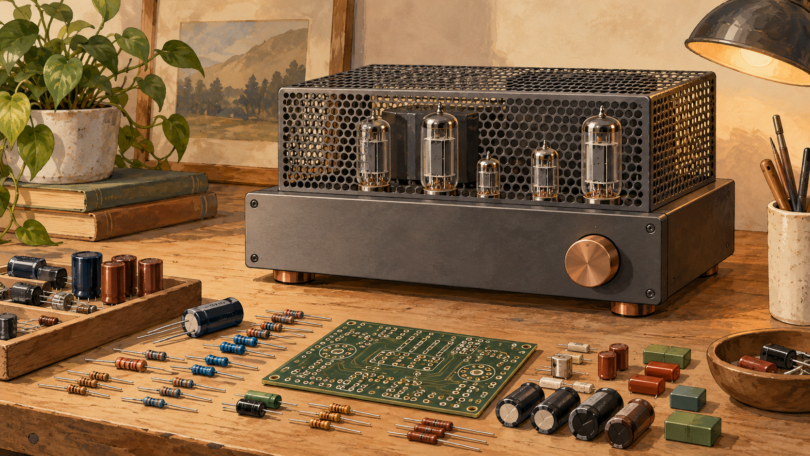

A DIY tube amplifier kit can mean a stereo power amp, a guitar amp head, or a small preamp board. Those are different purchases. For home listening, start with the Elekit TU-8400 or Bottlehead Stereomour II. For a guitar project, consider the MOD 102. The right choice depends on what you want to drive, your electrical experience, and exactly what the kit includes.
Read this before choosing a tube-amp kit
Tube amplifiers contain potentially lethal voltages. Their capacitors can retain a dangerous charge after the amplifier is switched off and unplugged. A low output-wattage rating does not make the internal circuitry safe. The MOD 102 manual’s safety section explicitly warns that dangerous voltage can remain even after a long period unplugged.
These are projects for people with appropriate electrical knowledge, safe working practices, and suitable test equipment. Soldering experience alone is insufficient. If you lack high-voltage experience, arrange qualified supervision or professional assembly and inspection, or choose an assembled amplifier. Follow the exact manufacturer documentation; this buying guide is not an assembly or servicing procedure.
Know which kind of “tube amplifier” you are buying
- Speaker power-amplifier kit: provides amplified output for passive speakers. A stereo model has two audio channels. Check speaker impedance and power requirements.
- Guitar amplifier kit: is designed for an instrument and a suitable guitar speaker cabinet. A mono guitar head is not a substitute for a two-channel hi-fi amplifier.
- Preamp or buffer kit: normally feeds another amplifier or powered speakers. A line-level output does not directly power passive speakers. A headphone output, if present, is another separate function.
- Hybrid amplifier: combines tube and solid-state circuitry. “Tube” in a listing does not establish that the speaker-output stage uses tubes.
- Assembled amplifier: may arrive with tubes that need fitting, but that does not make it a solder-together kit.
For low-voltage preamp or hybrid boards, verify the circuit’s internal voltages and the required supply. A “12V” input label alone does not prove that every part of the board operates at 12V, and AC and DC supplies are not interchangeable.
Three genuine tube-amplifier kits to consider
Elekit TU-8400: flexible stereo power-amp project
The Elekit TU-8400 is a single-ended stereo power-amplifier kit with automatic bias adjustment and support for several specified output-tube families. It also has a headphone output. Elekit describes it as intended primarily for use with a preamp, while its second input includes an op-amp preamplifier for lower-output sources.
Important specification: Elekit lists 8 watts per channel with EL34 tubes in ultralinear mode into 8 ohms at 10% total harmonic distortion. That test condition matters: do not compare it directly with another amplifier’s power rating measured at much lower distortion.
Before ordering: tubes are excluded from the standard kit. Confirm the seller’s tube bundle, English instructions, and mains-voltage version. The manufacturer’s web specification lists 100V, while its export leaflet describes other regional versions. Choose this model for its documented configuration options, provided you can budget for the complete, correctly specified build.
Bottlehead Stereomour II: for an efficient-speaker system
The Bottlehead Stereomour II is a single-ended 2A3 stereo integrated-amplifier kit rated by its maker at 3.5 watts per channel. Volume and input-selection controls mean a separate line preamp is not required for ordinary line-level sources.
Its practical appeal is a defined system role: low-power amplification for suitably efficient speakers. Discuss your exact speakers, room size, listening distance, and preferred volume with Bottlehead before ordering. Do not assume a nominal impedance figure alone makes a speaker a good match.
Before ordering: Bottlehead lists tubes, the chassis, electronic parts, and an unfinished wood base among the kit contents. Allow for tools, solder, and finishing materials. The full assembly manual is supplied with a kit purchase, and the company provides a support forum. Choose it when your speakers suit its modest output and you want this particular integrated-amp format.
MOD 102: a guitar-amp head, not a stereo hi-fi kit
The MOD 102 is a single-channel tube guitar-amplifier kit. Its manufacturer specifies 5 watts into 8 ohms, with bass, treble, and volume controls. The kit includes an EL84 output tube, a 12AX7, transformers, and a pre-punched steel chassis; construction uses point-to-point wiring on terminal strips.
Before ordering: plan for a suitable separate speaker cabinet. The manual recommends an 8-ohm cabinet with at least 10 watts of power handling. This is the original MOD 102, not the separately specified MOD 102+.
The public manual lets you review the parts list, required equipment, and scope before buying. That is useful for judging whether you and a qualified supervisor can undertake the project. Choose it for guitar practice or a dedicated guitar build; its modest output rating does not reduce the high-voltage precautions.
What to confirm before paying
Ask for an itemized kit description rather than relying on a finished-amplifier photograph. Check whether the price includes tubes, transformers, chassis, protective covers, power cord, and the correct manual. Add any necessary speaker cabinet, tools, shipping, and professional help to your budget.
Confirm the exact model suffix and regional supply rating, replacement-part availability, and who handles construction problems. Read the return policy before soldering: an untouched kit and a partly assembled kit may be treated differently.
Finally, choose around the finished system. The TU-8400 suits buyers seeking configuration flexibility; the Stereomour II suits an efficient-speaker setup; the MOD 102 serves a guitar project. If building is not your goal, a properly assembled amplifier with service support may be the more practical purchase.

