
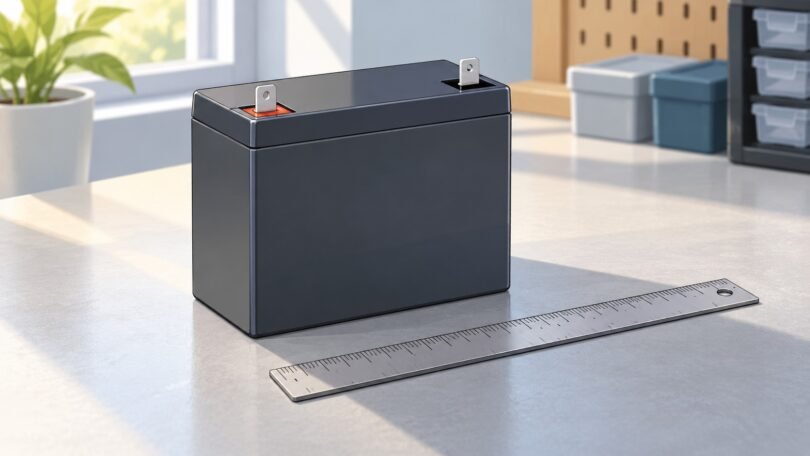

The right replacement for a DJW6-7 6V 7Ah battery must match more than the voltage printed on its case. Confirm the battery chemistry, case dimensions, terminal width, positive/negative terminal layout and the equipment’s charging requirements. A battery advertised as “6V 7Ah” is not automatically a drop-in replacement.
Leoch’s current DJW catalog lists the model as DJW6-7.0. If your existing label says DJW6-7, use that label together with the equipment manual and measurements to establish the correct replacement. This guide explains the specifications and buying checks; it does not claim a hands-on runtime comparison.
DJW6-7.0 specifications to check
The Leoch DJW product catalog describes the range as AGM valve-regulated sealed lead-acid batteries. Its DJW6-7.0 entry specifies:
- Nominal voltage: 6V
- Rated capacity: 7Ah at a 20-hour discharge rate to 1.75V per cell
- Case length and width: 150 × 34mm
- Case height: 94mm
- Total height: 100mm, including terminals
- Terminal options: T1/T2
Use these numbers as an identification starting point. Check the exact battery offered: replacement brands can have different dimensions, and some listings give only the height of the plastic case. The equipment also needs room for the connected leads and their insulation. A retaining bracket that almost closes is a reason to recheck fit, not to force it.
Terminal size and polarity are separate checks
Common small SLA battery tabs are described as F1 or F2. F1 is approximately 4.75mm wide, while F2 is approximately 6.35mm wide; Power-Sonic’s terminal drawings show these two sizes. Leoch uses T1/T2 terminology, so compare the actual terminal drawing and width rather than rely only on a seller’s shorthand.
Record which terminal is positive and which is negative, using the markings on the battery and the equipment instructions. Compare their locations with the replacement in the same orientation. Do not assume a rotated photograph proves that the layout matches, or rely on wire color alone. The leads must reach naturally without being stretched, pinched or rerouted across exposed terminals.
Do not force a small connector onto a larger tab, leave an oversized connector loose, or file a terminal to make it fit. If the original assembly uses a special plug, fuse, thermal protector or enclosed harness, order the equipment-approved assembly or obtain professional advice. A bare battery does not automatically include those parts.
What the 7Ah capacity rating actually means
The Leoch DJW6-7.0 datasheet, revision dated November 8, 2024, hosted by Engitech Power, rates capacity at 25°C. Its 20-hour, 1.75V-per-cell discharge point is 0.350A. Multiplying 0.350A by 20 hours gives 7Ah; it does not mean the battery will deliver 7A for one hour. At the same endpoint, the sheet’s one-hour discharge figure is 4.06A.
Your equipment’s cutoff voltage, load, battery age and temperature affect runtime. A simple capacity-divided-by-current calculation is therefore only a rough starting point, especially for motors or other changing loads. Likewise, nominal voltage multiplied by capacity gives 42Wh, not a promise of 42Wh usable energy at every load.
If runtime is important, ask for discharge data at your actual load and cutoff conditions. Compare two batteries using the same test basis. A capacity number without its discharge period and endpoint is insufficient for a meaningful comparison.
Replacement options and their trade-offs
An exact Leoch replacement
An original DJW6-7.0 with the correct terminal option is the clearest starting point when the equipment specifies it. Confirm the supplier’s exact part, current specification sheet and terminal layout. A photograph of a Leoch battery does not establish that the seller will supply that brand; some listings describe compatible replacements under the original model name.
Raion Power RG0670T1
Raion’s own DJW6-7.0 replacement page identifies its RG0670T1 as a 6V 7Ah battery with T1 terminals and lists dimensions of 5.94 × 1.34 × 3.7 inches. It says existing cables and hardware must be reused. Confirm total terminal height and your equipment’s approval before ordering; a manufacturer’s replacement claim should still be checked against your particular installation.
Mighty Max ML7-6, F1, one battery
The verified listing below is the one-pack ML7-6 with F1 terminals. It supplies the battery only, without a wiring harness or mounting accessories. Its listed dimensions are 5.94 × 1.42 × 3.94 inches, so the advertised width is about 36mm rather than Leoch’s 34mm. That difference can matter in a close-fitting compartment.

Mighty Max ML7-6 6V 7Ah SLA AGM Battery, F1 Terminals, 1 Pack
As an Amazon Associate we earn from qualifying purchases.
Consider this option only after confirming compartment clearance, terminal fit, polarity and charging compatibility. The shared voltage and capacity are useful screening criteria, not a universal compatibility guarantee.
Charging: use the matching specification and approved charger
For the November 2024 Leoch sheet linked above, standby charging is 2.25–2.30V per cell at 25°C, or 6.75–6.90V for the three-cell battery. Cycle charging is 2.35–2.45V per cell, or 7.05–7.35V. Maximum charging current is 0.3C, equivalent to 2.1A using the 7Ah rating. The sheet also specifies temperature compensation. These figures describe that revision at 25°C, not universal settings for every replacement or older label.
Standby and cyclic use are different charging situations. Use the equipment-approved charger and the specification for the battery actually installed. If the original label, replacement datasheet and charger documentation disagree, ask the equipment or battery manufacturer to resolve the difference. Do not select a charger solely because its connector fits or its product title includes “6V.”
A lithium replacement also needs explicit equipment and charger compatibility; Power-Sonic explains why charging profiles differ by chemistry. Similar nominal voltage is not enough to establish suitable charging, protection or behavior under load. Do not change chemistry as an improvised upgrade.
Safe handling and signs to stop
Sealed lead-acid batteries contain lead and sulfuric acid, and a short circuit can release substantial current. Leoch’s installation and operation guide warns against short circuits, opening the case, heat, sparks and flames. Follow the equipment’s shutdown and replacement procedure. Have a qualified technician handle equipment that is not designed for user battery replacement.
Keep tools and jewelry away from exposed terminals, use appropriate eye and hand protection, and provide the ventilation required by the equipment manufacturer. Do not use or charge a cracked, leaking, swollen or abnormally hot battery. Keep it away from children and obtain safe handling guidance from the supplier or recycling service. Do not open the case to add water or acid, bridge the terminals to “test” it, or attempt a homemade revival procedure.
Recycle the old battery and make the final fit check
The EPA’s household battery guidance says rechargeable batteries, including small sealed lead-acid types, should go to a suitable battery recycler, participating take-back retailer or household hazardous-waste program rather than household trash or curbside recycling. Confirm the location accepts this chemistry. Protect the terminals against contact during handling and follow the receiving facility’s transport instructions, especially for a damaged battery.
Before buying, make one final comparison: 6V, approved sealed lead-acid/AGM type, suitable rated capacity, all case and terminal dimensions, correct tab width, matching polarity, required harness and compatible charger. If any of those details is missing, resolve it before checkout. That is a more reliable way to choose a DJW6-7 replacement than a long list of superficially similar batteries.


