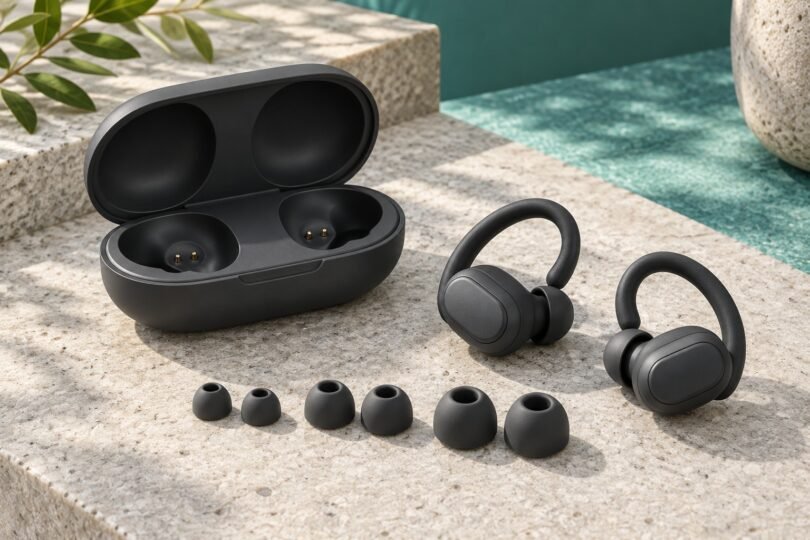

Earbuds that stay in place usually solve two problems: they hold the earpiece securely, and they fit your ear without uncomfortable pressure. For workouts, start with an ear-hook design such as the Beats Powerbeats Pro 2 or soundcore Sport X20. For a smaller in-ear design, consider the wingtip-equipped Powerbeats Fit. If you dislike silicone tips inside your ear canal, the open-ear Shokz OpenFit 2 takes a different approach.
No model can guarantee a secure fit for every ear. These choices are based on their documented construction and features, with the trade-offs explained below. Your own fit check and the seller’s return policy matter more than a universal ranking.
Choose the retention style before the brand
- Ear hooks: a loop rests around the outer ear, giving the earbud another support point. This is worth trying when ordinary tip-only earbuds keep dropping out. Check whether the hook competes with your glasses or helmet straps.
- Wingtips: a flexible fin tucks into an outer-ear fold. This keeps the design relatively compact, but the wing must match your ear’s shape. A fin that creates a sore spot is not a successful fit.
- Open-ear hooks: the speaker sits beside the ear canal rather than sealing it. These can suit people who dislike inserted tips, although they do not provide the same passive isolation as a sealed earbud.
A hook can prevent a bud from dropping to the floor while the silicone tip still loses its seal. Judge retention and sound stability separately: if bass changes whenever you turn your head, try another tip size or a different design.
Beats Powerbeats Pro 2: ear hooks with a broad tip-size range
The Powerbeats Pro 2 combines flexible nickel-titanium ear hooks with five silicone-tip sizes: XS, S, M, L and XL. That makes it a sensible starting point for someone who wants external support plus more adjustment at the ear canal. It is the second-generation model, so check that the listing actually says “Pro 2.”
Beats specifies IPX4 sweat and water resistance for the earbuds. The charging case is not sweat- or water-resistant, despite supporting both USB-C and Qi wireless charging. Dry the earbuds before putting them away. The standard package does not include a charging cable or power adapter.
Active noise cancellation and Transparency mode give it uses beyond exercise, while physical controls include a volume rocker on each earbud. The buying trade-off is the hook itself: try it with your everyday eyewear, and make sure the combination does not pinch. Additional retention is useful only if you can comfortably wear it for your whole session.

Beats Powerbeats Pro 2 wireless earbuds, Jet Black
As an Amazon Associate we earn from qualifying purchases.
soundcore Sport X20: adjustable hooks for fine-tuning position
The soundcore Sport X20, model A3968, uses hooks that extend up to 4 mm and rotate up to 30 degrees. Those adjustments are useful if a fixed hook leaves the speaker sitting at the wrong angle. Change the hook position gently, then choose the ear tips that produce a comfortable seal.
The earbuds have an IP68 rating and soundcore’s SweatGuard design. Do not transfer that rating to the charging case. The manufacturer’s comparison specifications list no wireless charging, so this is a different case arrangement from the Powerbeats Pro 2.
Sport X20 includes active noise cancellation and physical buttons. It is a practical candidate when adjustable retention is your priority. It still places a silicone tip in the ear canal, however, so it is not the natural alternative if your main complaint is disliking that sensation. Also check the exact name: Sport X10 and Sport X20 are different products.

Powerbeats Fit: flexible wingtips without an over-ear loop
The Powerbeats Fit has a flexible wingtip that tucks into the upper part of the ear. Four included tip sizes, XS through L, let you adjust the acoustic seal separately. This is a useful design to try when glasses make a wraparound hook awkward.
Beats describes Powerbeats Fit as the successor to Beats Fit Pro, with redesigned wingtips and a smaller case. The names are easy to confuse, but the case difference matters: both Powerbeats Fit earbuds and their case carry an IPX4 rating. Charging is through USB-C. There is no Qi wireless charging, and the cable and power adapter are sold separately.
It also offers active noise cancellation and Transparency mode. The main fit question is whether the wing rests comfortably in your ear fold. It should not need to be jammed into place. Use the supported fit test for the seal, then check comfort during ordinary movement; an app result alone cannot establish long-session comfort.
Shokz OpenFit 2: an open-ear option without sealing tips
The Shokz OpenFit 2 uses an ear hook with a speaker positioned outside the ear canal. Unlike the sealed choices above, it does not depend on an inserted silicone tip. Consider it if canal pressure is the reason you keep taking earbuds out.
The OpenFit 2 earbuds are rated IP55; the charging case is not waterproof. The standard OpenFit 2 case charges by USB-C. The similarly named OpenFit 2+ adds wireless charging and Dolby Audio, so a “2 Series” description is not enough to identify the case you are buying. The card below is the black OpenFit 2 with USB-C charging, in a bundle that includes a carrying bag.
Physical buttons help you make deliberate adjustments without relying entirely on touch gestures. Open-ear construction leaves more environmental sound audible, but it is not a guarantee of traffic awareness. Check the hook with glasses, and do not expect a sealed-earbud experience in a noisy gym or on public transport.

Check the fit before committing to a pair
- Start with clean, dry earbuds. Follow that model’s cleaning instructions and inspect tips for damage or poor attachment.
- Try different sizes on each side. Your left and right ears may need different tips. Soundcore explicitly recommends this approach when one Sport X20 earbud feels less stable than the other.
- Adjust one thing at a time. Change the tip, rotation or hook position, then reassess. Otherwise it is hard to know what helped.
- Try everyday movements indoors. Talk, look over each shoulder, walk and bend down. Check for slipping, changing sound or a pressure point before relying on the fit outside.
- Wear your usual accessories. Sunglasses, glasses and a hat may change how a hook sits. Test the combination you actually plan to use.
- Check the charging fit. If you add compatible aftermarket tips, confirm the earbuds still seat properly, the lid closes and both sides charge. A larger tip is not automatically a better fit.
If the shell or wing hurts despite reasonable adjustments, choose a different shape. Do not keep forcing a design to work simply because it feels difficult to dislodge.
Returns, water resistance and listening safety
Before ordering, check whether that seller accepts opened-earbud returns for fit problems, the deadline, and any return-shipping or restocking costs. As one concrete example, Apple’s U.S. policy gives 14 calendar days from receipt for direct purchases and requires the included accessories and documentation. An Amazon or other retailer purchase follows that seller’s policy instead. Keep the packaging until you have made a decision.
Water resistance does not make every earbud suitable for swimming, showering or charging while wet. Use the model’s care instructions and keep the charging contacts dry. Charging-case protection must be checked separately from the earbuds’ rating.
For hearing safety, the World Health Organization recommends keeping volume down, taking listening breaks and using sound-exposure monitoring when available. A secure seal can reduce the temptation to overpower background noise. Persistent ringing or difficulty hearing warrants a hearing check. Outdoors, lower the volume or pause playback when you need your full attention.
Which design should you try first?
Choose a hook if your main problem is losing the entire earbud during movement. Choose a wingtip if you want a smaller design and your outer-ear shape accommodates it comfortably. Choose an open-ear hook if avoiding an inserted tip is the priority. The best outcome is a pair that stays comfortable and stable without repeated adjustments, backed by a return option if it does not fit your ears.