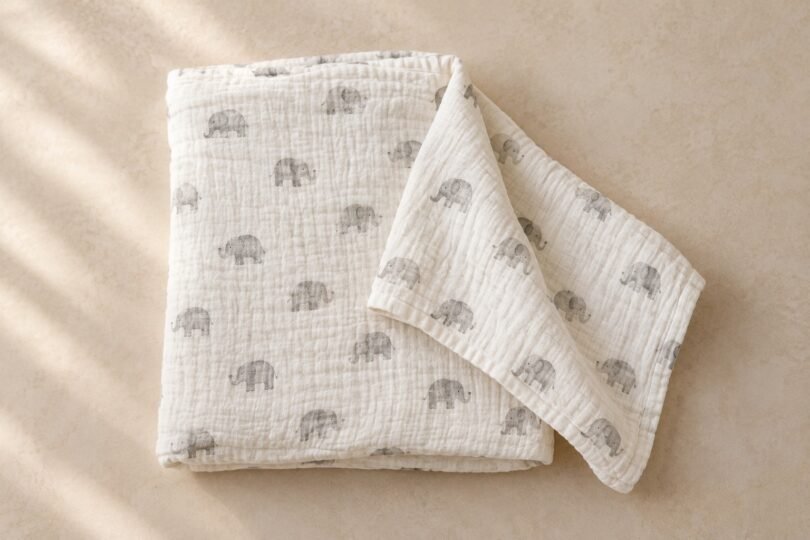

An elephant swaddle can mean a square blanket with an elephant print, a fitted garment that holds a newborn’s arms, or even a sleep sack sold under a loosely worded listing. Those are different products. Choose the construction and fit first, then the pattern. Elephant artwork does not tell you the fabric, thickness, age range or whether the item is appropriate for your baby’s current stage.
The most important starting point is that swaddling does not prevent sudden infant death syndrome (SIDS), and no swaddle guarantees longer sleep. The American Academy of Pediatrics’ safe-sleep guidance should take priority over reassuring product names or promises.
Choose the right type of elephant-print product
- Loose swaddling blanket: a thin fabric square that a caregiver folds and tucks. It has no built-in fit system. Its dimensions describe the cloth, not the size of baby it safely fits. If it comes undone, it becomes loose bedding.
- Wearable swaddle: a fitted garment with a zipper, wrap panels or another closure. Depending on its design, it can contain the arms or compress the body. Check the exact model’s instructions and size limits; the word “sack” does not make it an arms-free product.
- Arms-free sleep sack: a wearable blanket that allows free movement rather than swaddling. It still needs to fit correctly at the neck and arm openings. It is a different purchase from an arm-restraining newborn swaddle.
The AAP advises stopping both blanket swaddling and wearable products that compress the arms, chest and body when a baby shows signs of trying to roll. Simply leaving the hands outside a tight wrap does not establish that the product is suitable. See the AAP’s swaddling guidance and the instructions for the actual garment.
Safety checks that come before the elephant pattern
For every sleep, place your baby on their back on a firm, flat, non-inclined surface in an appropriate crib, bassinet or play yard. Use your baby’s own separate infant sleep space; do not share an adult bed or use a lounger or reflux wedge for infant sleep. Keep the sleep space empty except for its properly fitted sheet. Do not add pillows, stuffed elephants, loveys, bumpers, loose blankets or sleep positioners. A swaddle is not a mattress cover, and a fabric square is not a fitted crib sheet. The CPSC’s safe-sleep guidance also warns against weighted swaddles and weighted blankets.
Stop swaddling at the first signs of attempting to roll, even if a package’s age range has not ended. Do not wait for a completed roll or a particular birthday. Babies develop at different rates. Once this milestone appears, do not extend arm-restraining swaddling through a gradual transition. Choose suitable non-swaddling sleep clothing and ask your pediatrician if you are unsure what to use.
The wrap must not restrict breathing or hold the legs straight and tightly together. Leave room for the hips and knees to bend and move. Ask a pediatrician or another qualified clinician to demonstrate fit if you are uncertain, especially when your baby has medical or hip concerns. Never use extra straps, weights or positioning devices to keep a baby still.
Elephant-print examples and the differences to check
These examples illustrate why the product name and specifications matter more than a search-result photograph. They are not interchangeable recommendations for every baby. Follow the supplied instructions and check the current label before use.
SwaddleDesigns Marquisette: a lightweight fabric square
The Marquisette Swaddle Blanket, Elephant & Chickies, Pastel Blue, model SD-458PB, is described by SwaddleDesigns as 100% cotton marquisette measuring 46 by 46 inches. The manufacturer lists machine washing and drying and a sewn-in instructional label.
This is a loose blanket, so there is no zipper or adjustable wrap panel to check. The relevant question is whether the caregiver can use it correctly without excess or unsecured fabric. Its large square dimensions are not permission to continue swaddling an older or rolling baby. Do not assume another color or a similarly named multipack has identical contents.
SwaddleDesigns Ultimate: a different cotton construction
The Ultimate Swaddle Blanket, Sterling Deco Elephants on Sunwashed Pink, model SD-352SP, is a cotton flannel blanket. Its product page lists a 42-by-42-inch square and an instructional label sewn to the edge.
The smaller dimensions and flannel construction distinguish it from the Marquisette example. Neither listing’s blanket measurements provide a wearable garment’s weight-based fit range. If you want a zip-up product, neither of these squares supplies that feature. Choose a fabric appropriate to the actual sleep environment rather than assuming that every cotton elephant blanket has the same warmth.
SwaddleMe Elephant Skies: verify the fabric label
The SwaddleMe by Ingenuity Pod, Elephant Skies, model 58950, is a one-pack newborn wearable swaddle with a two-way zipper. Kids2 lists 0–2 months, 5–12 pounds and up to 26 inches, for babies who are not showing signs of rolling. Those are this model’s limits, not a universal swaddling timetable.
There is an important specification conflict: the page’s description gives 93% cotton and 7% spandex, while its materials field gives 97% cotton and 3% spandex. Confirm the composition on the actual garment label or with Kids2 before buying if that detail matters to you. Do not treat a retailer’s generic “cotton” description as resolving the difference. Its zip-up construction also does not make it an arms-free sleep sack.
Read fit information before choosing a size
For a wearable product, compare your baby’s current measurements with every applicable manufacturer limit: minimum and maximum weight, length, age guidance and developmental restrictions. Being inside one range is insufficient if another is exceeded. Do not buy a larger size for extra growing room when it fails the fit instructions.
Check the neckline and arm openings as directed so the garment cannot ride over the face. The AAP’s safe-sleep checklist specifically says wearable blankets should be the correct size and should not cover the head. If the exact model lacks usable sizing information, ask the manufacturer rather than copying measurements from a different elephant-print listing.
Consider warmth, fabric and everyday care
A “breathable” label is not a guarantee against overheating. Consider the garment, clothing underneath and room conditions together. If a product has a TOG rating, use that exact manufacturer’s clothing and temperature guidance; do not interpret one number as suitable for every season or household.
The AAP generally recommends no more than one additional clothing layer compared with what an adult would wear comfortably. Sweating or a hot chest can signal overheating. Keep the head uncovered indoors during ordinary home sleep. Discuss temperature or health concerns with your pediatrician rather than adding thick layers to make a baby sleep longer.
For practical comparison, read the washing instructions before ordering. Check whether drying requires a low setting, whether fasteners need closing, and whether the item must be washed separately. Follow the actual care label. After laundering, inspect seams, fabric and closures, and stop using an item that is damaged or no longer fits as instructed.
A short checklist before checkout
- Match the exact model, print, size and pack quantity across the title, selected options and product description.
- Identify whether you are buying a loose blanket, an arm-restraining swaddle or a freely moving wearable blanket.
- Read the manufacturer’s instructions and current fit chart, including any earlier stop-use conditions.
- Check the product name and model against CPSC recalls. A seller’s listing remaining online is not proof that a product is appropriate.
- Keep the label, instructions and purchase information. If the item received differs from the ordered version, resolve that before using it.
Common questions
Does an elephant lovey count as a swaddle?
No. A small comfort blanket with a stuffed head is a different product. Keep loveys and stuffed toys out of an infant’s sleep space, including when they are part of a matching gift set.
How many should I buy?
Start with the correct type and a manageable laundry rotation. A large multipack offers little value if the fit or construction is wrong. For a gift, ask which exact product the parents use and include a gift receipt.
What should replace a swaddle when rolling starts?
Use appropriately fitted, non-weighted sleep clothing or an arms-free wearable blanket that does not restrict movement. Continue placing your baby on their back for sleep. For a baby with a medical condition or an unclear fit, ask the pediatrician about the appropriate next step.