
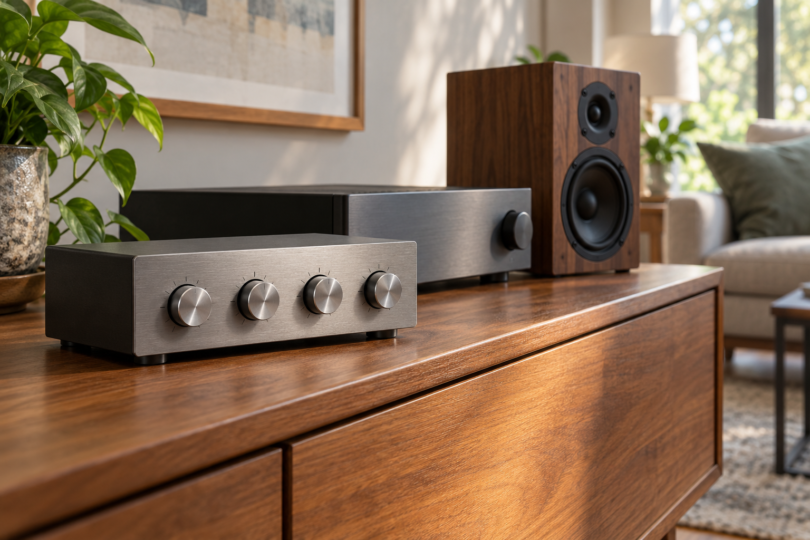

The best equalizer for a home stereo is the one that fits both your connections and the adjustments you want to make. Schiit Loki Mini+ is our straightforward choice for an RCA system, Schiit Lokius adds more bands and XLR connections, and dbx 231s is the rack option for separate left- and right-channel graphic control. Start with the signal path before choosing the number of knobs.
This is a feature-based shortlist drawn from manufacturer documentation and exact product listings. We have not listened to, measured or compared these units in a test system. The recommendations describe useful matches, without promising a particular sound or ranking measured audio quality.
Three equalizers for different stereo setups
| Equalizer | Best fit in this shortlist | Controls and connections | Main trade-off |
|---|---|---|---|
| Schiit Loki Mini+ | Simple tone shaping in an RCA system | Four bands; RCA input and output | Fixed-frequency tone controls; no separate left/right adjustment |
| Schiit Lokius | More analog tone controls or XLR equipment | Six bands; RCA and XLR inputs and outputs | Needs space away from transformer-equipped components |
| dbx 231s | A rack system needing channel-by-channel graphic EQ | Two 31-band channels; XLR and ¼-inch TRS | Large rack format; RCA systems need compatible cabling |
1. Schiit Loki Mini+: best for simple RCA tone control
The Loki Mini+ is a compact four-band unit with controls centered at 20 Hz, 400 Hz, 2 kHz and 8 kHz. Its RCA connections make it the first option here for a simple analog chain. The 5 × 3.5 × 1.25-inch chassis also suits a setup where a full-width rack component would be awkward.
Choose it when you want a few physical controls for broad tonal preferences. Its frequencies are fixed, and Schiit describes a variable-width response as the controls are turned. It is not a parametric equalizer with independently adjustable frequency and bandwidth. The same four controls affect the stereo signal, so choose the dbx below if independent channel adjustment is essential.
The selected listing is the silver Loki Mini+ with a USA power adapter intended for 115 V mains. Check the power version when buying in another region. Schiit’s manual recommends using the powered-on bypass switch for comparison; simply switching the unit off can cause distortion with some sources.

Schiit Loki Mini+ 4-Band Equalizer, Silver
As an Amazon Associate we earn from qualifying purchases.
2. Schiit Lokius: best for six bands and XLR connections
The Lokius is the more flexible Schiit option when your stereo uses balanced XLR cables or you want extra tone controls. Its six centers are 20 Hz, 120 Hz, 400 Hz, 2 kHz, 6 kHz and 16 kHz. It provides both RCA and XLR inputs and outputs. These are useful connection and control differences; they do not establish that it will sound better in your system.
It remains a hands-on tone-control unit rather than a surgical parametric processor. Placement matters: the Lokius manual warns that its inductors can pick up hum from nearby transformers. Leave room to separate it from other components instead of assuming it belongs directly on top of an amplifier.
Choose Lokius for the added connections and bands, provided you can accommodate the placement requirement. The selected listing is black and supplies a 110–120 V US adapter, not a 220–240 V version. Use its powered bypass switch when comparing settings.

3. dbx 231s: best for separate-channel graphic control
The dbx 231s gives each channel its own 31-band graphic equalizer. Its fixed one-third-octave bands offer far more adjustment points than the two knob-based options above, with selectable ±6 or ±12 dB slider ranges. Choose it when you specifically want to adjust the two channels separately and are comfortable managing many sliders.
The trade-off is integration. It is a 19-inch-wide, 3.5-inch-high rack component with XLR and ¼-inch TRS audio connections. Its manufacturer manual, supplied with the listing allows balanced or unbalanced line-level use with appropriate cables. An RCA system therefore needs a deliberate cable and level plan. This is not a direct speaker-wire accessory.
Verify 231s, 31-band, Dual Channel before ordering: the product family also contains different band counts and channel arrangements. The selected listing is model 231s. Its EQ bypass does not mean every front-panel function is removed from the path; the manual describes it as bypassing the graphic equalizer section.

Check your signal path before you buy
Find an accessible analog connection
Schiit documents two placements: between a single source and a preamp, or between a preamp and power amplifier. The second lets one equalizer serve multiple sources selected by the preamp. Check your own equipment manuals for a usable connection point; an integrated amplifier with no accessible path may not accommodate the arrangement you have in mind.
These choices use analog audio connections. If your source and amplifier communicate only through a digital connection, work out the complete conversion and connection path before ordering. Do not assume an adapter changes the type of signal, and do not connect speaker outputs to an equalizer’s line inputs.
Choose the adjustment style you will actually use
Four or six shared tone controls are appealing when you want a small number of repeatable listening adjustments. Separate graphic controls are more useful when you need different settings for each channel. More bands also mean more settings to manage. None of these products should be bought on an expectation of automatic measurement or correction.
Keep room for cabling, power and comparisons
Budget for the correct pair of interconnects in and out, an appropriate mains version, and a suitable place on the shelf or rack. Follow the exact manual, switch equipment off before changing connections, and begin listening at low volume. Try modest changes and compare with bypass rather than assuming larger boosts are better.
Frequently asked questions
What is the best equalizer for a basic home stereo?
Within this shortlist, Loki Mini+ is the simplest starting point if your stereo has a suitable RCA connection path. Choose Lokius for six bands or XLR connectivity, and dbx 231s for separate-channel graphic adjustment.
Can I connect an equalizer to speaker terminals?
These are line-level components. Use the documented source/preamp/amplifier connection path and compatible signal cables; do not connect them directly to speaker-level outputs.
Will a graphic equalizer automatically correct my room?
Do not expect these manually adjusted units to measure the room or choose settings for you. Buy for the controls and connections described here, and treat any resulting tonal preference as something you must assess in your own setup.
Are Loki Mini+ and Lokius parametric equalizers?
No. Schiit describes both as non-constant-Q designs with fixed frequency bands. Their response width changes with the amount of adjustment, rather than giving you independent frequency and bandwidth controls.
Is turning the equalizer off the same as bypass?
Not necessarily. Schiit instructs owners to leave Loki Mini+ and Lokius powered on and use their bypass switches because an unpowered input can affect some sources. Follow the bypass description for the exact unit.


