
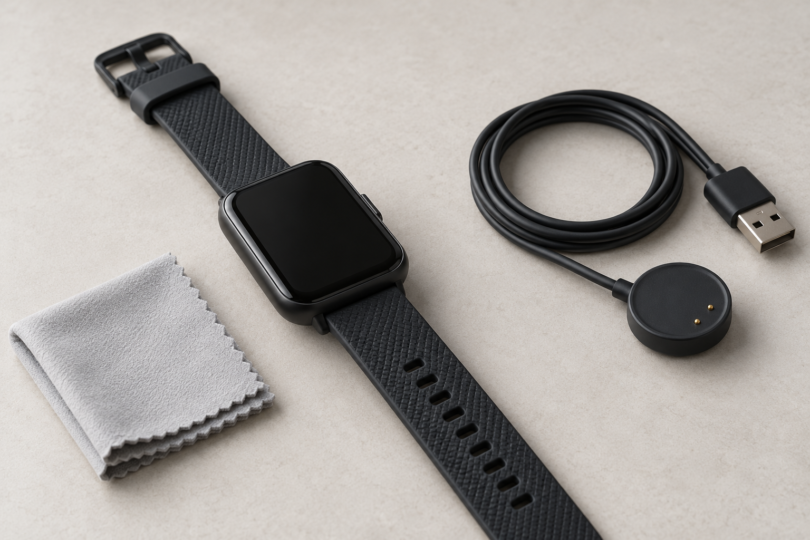

A refurbished Garmin vívoactive HR can still appeal to someone who wants its rectangular screen and straightforward activity tracking. The important question is the condition of the individual watch. A clean case alone tells you little about its battery, charging contacts or repair history.
Garmin introduced the vívoactive HR in February 2016. Before buying this older model, insist on an identifiable seller, a usable return window and written details of what was checked. Compare the total cost with a newer watch before committing.
Make sure the listing is for the vívoactive HR
The Garmin vívoactive HR is a specific model. A vívoactive 3, vívoactive 4, vívosmart HR or replacement wristband is a different item, even when it appears in the same search results.
Ask for photographs of the actual watch, including its back and its powered-on screen. Confirm the model, regular or extra-large fit, included charging cable and strap condition. A stock photograph and the word “refurbished” are not enough to establish what will arrive.
The original HR combines built-in GPS, a sunlight-readable touchscreen, wrist-based heart-rate estimates and activity profiles including running, cycling and pool swimming. It also offers compatible-phone notifications and controls for music playing on a phone. Those music controls should not be confused with the onboard music storage available on some later Garmin watches.
Battery condition matters more than the original headline
Garmin’s vívoactive HR owner’s manual lists up to eight days in smartwatch mode with heart rate and up to 13 hours in GPS mode. These are the model’s published specifications, not a promise about a refurbished unit.
Request a recent runtime check rather than a screenshot showing a full charge. Useful details include the time since charging, whether GPS was used, whether wrist heart rate and notifications were enabled, and how much charge remained. A seller who only confirms that the watch powers on has not answered the battery question.
The watch has a built-in rechargeable battery. Garmin’s battery-service guidance describes these batteries as non-user-replaceable. If a seller says the battery was changed, ask who performed the work and what warranty covers it. Confirm repair options with Garmin before buying a unit that already has power problems.
What does “refurbished” actually include?
Ask the seller to describe the work in plain terms. Was the watch merely cleaned, or were the display, buttons, charging system, sensors and battery checked? Were any parts replaced? Is the charging cable original or compatible, and is it included?
- Display and buttons: look for cracks, lifting edges, dead areas on the touchscreen and buttons that stick or fail to respond.
- Charging contacts: request a clear close-up and confirmation that charging remains steady when the cable is attached normally.
- Strap and attachment points: check for tears, missing hardware and damage where the strap joins the case. Verify that a proposed replacement strap explicitly fits the HR.
- GPS and syncing: ask whether the seller recorded an outdoor activity and successfully transferred it to Garmin Connect.
- Returns: get the deadline, who pays return shipping and whether a faulty battery or connection problem qualifies for a refund.
Warranty and water resistance need separate checks
Garmin distinguishes its own Recertified devices from a seller’s general refurbished description. Its published guidance says a recertified device purchased from an authorized Garmin dealer carries a one-year manufacturer’s warranty; a Garmin replacement device has different coverage. This does not establish that an individual vívoactive HR listing qualifies.
Ask who provides the warranty, when it begins, which faults it covers and what proof of purchase is required in your region. A marketplace return policy and a manufacturer’s warranty are separate protections.
The HR’s original water rating is 5 ATM, with pool swimming covered in its manual. That specification does not prove the sealing condition of a repaired or heavily used watch. Ask specifically about water-resistance checks after any case or battery work. If the answer is unclear, choose another unit for swimming. The manual also notes that wrist heart rate is unavailable while swimming on this model.
Check support and phone compatibility before ordering
Garmin still provides a vívoactive HR support page and its manual. Published documentation does not guarantee future software updates, replacement parts or a repair for every serial number. Confirm any service you may need directly with Garmin.
Also check the current Garmin Connect phone requirements. Old marketplace descriptions can quote operating-system requirements from years ago. During the return window, pair the watch through Garmin Connect, sync a short recorded activity and check the notifications you actually use.
Treat activity and heart-rate readings as fitness estimates. Garmin’s accuracy guidance explains that its wearables are not medical devices and readings can be inaccurate.
Two newer alternatives to compare
- Garmin vívoactive 6: a newer general-fitness option with an AMOLED display, sports apps, Garmin Pay and music downloads. Garmin’s April 2025 announcement explains its features; the official product page is the place to check the exact version and current offer.
- Garmin Forerunner 165: worth comparing when running workouts are the priority. The 165 series has an AMOLED touchscreen, five-button controls and adaptive training features. For onboard music, the separate 165 Music version is required.
Buying decision: choose a refurbished vívoactive HR only when you specifically want this model and the seller can document its condition, battery behavior and after-sales cover. If those answers are vague, a newer watch with clearer support and warranty terms is the more straightforward purchase.


