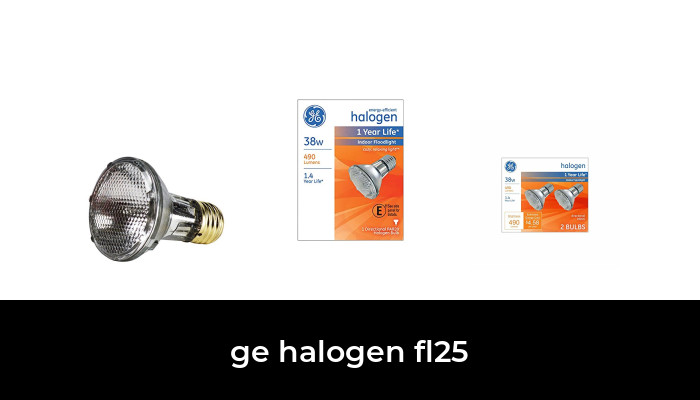

A bulb marked “GE halogen FL25 beam 38W 120V” cannot be identified by those words alone. They describe its technology, beam, power and voltage, but do not establish the reflector size or neck length. GE sold several lamps with that combination. Before buying, read the complete code on the old bulb and compare its dimensions with the fixture.
The useful starting point is a PAR-family identification check, followed by a choice between a matching legacy halogen and an appropriately specified LED. Neither a similar photograph nor a “50W replacement” label is enough to establish compatibility.
What does the marking mean?
- Halogen: the original lamp technology.
- FL25: a flood beam with a nominal 25-degree spread. It is not the lamp’s diameter or a 25-watt rating.
- 38W: actual electrical power for the original halogen.
- 120V: the lamp’s rated supply voltage.
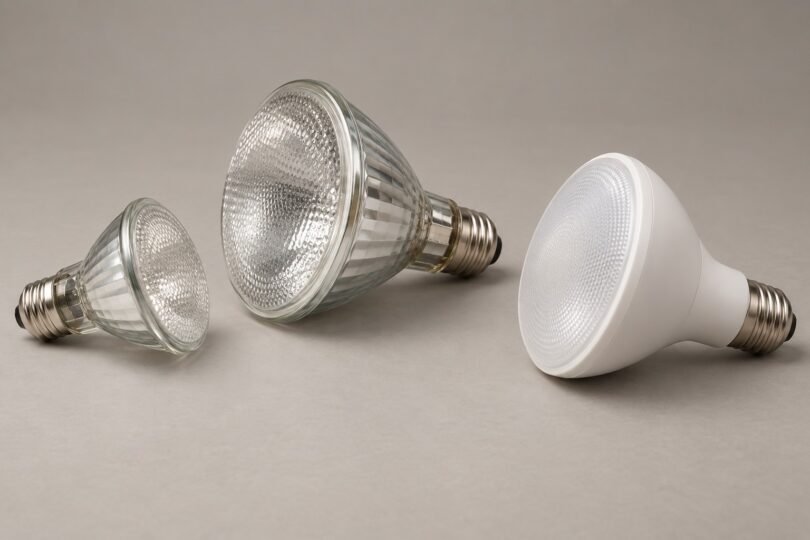
- PAR20, PAR30, PAR30L or PAR38: the missing shape information that matters when shopping. “L” distinguishes a long-neck PAR30.
Do not shorten the full product code when asking a supplier for help. A difference such as FL25 versus SP10 changes the beam; a difference such as PAR20 versus PAR30 changes the physical lamp.
Identify the exact GE halogen first
The manufacturer-authored GE Lamp & Ballast Products Catalog, in its halogen sections 2-5 and 2-6, documents these distinct 38W, 120V flood lamps. These are historical identification references, not statements of current stock.
| GE code and order number | Shape | Overall length | Listed light output |
|---|---|---|---|
| 38PAR20H/FL25, 69163 | PAR20 | 3.13 inches | 490 lumens |
| 38PAR30H/FL25, 69166 | PAR30, short neck | 3.62 inches | 580 lumens |
| 38PAR30L/H/FL25, 69168 | PAR30, long neck | 4.75 inches | 550 lumens |
| 38PARH1500FL25, 69136 | PAR38 | 5.31 inches | 520 lumens |
For the frequently encountered 69163 specifically, GE’s individual specification sheet identifies a PAR20 halogen with a medium-skirt E26 base, 2.50-inch diameter, 25-degree beam and 120V rating. That establishes a precise reference if your old bulb actually says 38PAR20H/FL25. It does not establish that every bulb bearing the shorter search phrase is this model.
Switch off power and let the lamp cool before removing or measuring it. Photograph the old bulb’s printing before discarding it. Measure the widest part and the complete tip-to-face length, and note whether a retaining ring or glass cover must close around it. Take those details and the fixture model to the seller if the printing is incomplete. Never force a larger reflector into a tight opening.
Two LED specifications worth comparing for a confirmed PAR20 fixture
The following are conditional comparison candidates for a confirmed 120V medium-base PAR20 application. They are not exact optical copies of the old 25-degree halogen. A PAR30 or PAR38 fixture needs its own fit check and a lamp selected for that fixture.
Current LED5DP20W/9SC/BC, order 93322373
Current’s LED PAR specification sheet lists this E26 PAR20 at 5.5W and 120V, with 500 lumens, selectable 25- or 40-degree beams and color settings from 2700K to 5000K. It is 3.4 inches long, dimmable, damp-location rated and marked for enclosed applications.
The 25-degree option makes this a useful candidate when preserving a narrow flood pattern matters. Even so, matching a nominal beam angle does not guarantee an identical light pattern. It is longer than the 3.13-inch 69163 halogen, so check clearance, the lamp’s complete dimensions and the exact dimmer combination. Damp-location suitability is not permission for an exposed wet location.
Halco 7PAR20-FL-LED-9CS-D-T20, product 83217
Halco’s product page specifies an E26 PAR20, 7W, 120V, a 40-degree beam and selectable settings of 2700K, 3000K, 3500K, 4000K and 5000K. The page identifies TRIAC dimming, damp-location suitability and a closed-fixture rating; its listed maximum operating temperature is 40°C/104°F.
This gives more explicit enclosure information, but the 40-degree beam is substantially different from FL25. Halco’s dimension drawing shows a nominal 2½-inch diameter and 3-inch length. Compare those lamp dimensions with the fixture, and use the sheet’s dimmer compatibility list rather than assuming every TRIAC control works. Box dimensions are not lamp dimensions. Closed-fixture suitability does not turn a general-lighting LED into an oven or high-temperature appliance lamp.
Make five compatibility checks before ordering
- Match the socket and supply. Read both labels. A reflector face does not identify its connector: screw bases, GU10 connections and two-pin MR16 lamps are different systems. Do not use an adapter to turn an uncertain match into a guessed one.
- Check the complete physical envelope. Diameter, overall length and neck shape all matter. A replacement must seat correctly and leave the fixture’s required clearances. The front lens should not prevent a retaining ring or cover from fitting as intended.
- Compare actual watts with the fixture rating. A 7W LED advertised as a 50W replacement consumes 7W; the replacement number is a light-output comparison. It does not authorize installing a 50W halogen in a fixture limited to 38W.
- Match the environment. Read the bulb and fixture requirements for enclosed operation, moisture and temperature. “Indoor,” “damp” and “wet” are not interchangeable permissions. For a range hood or other appliance, start with that appliance’s specified lamp and operating conditions.
- Check the controls. “Dimmable” is only the starting point. Confirm that the exact LED and dimmer are supported together, including the number of lamps on the circuit.
GE Lighting’s dimming guidance recommends LED-compatible controls and warns against assuming older incandescent/halogen TRIAC dimmers will suit LEDs. If a compatible system needs low-end adjustment, follow the dimmer manufacturer’s instructions. Flicker, dropout or buzzing is a reason to investigate the combination rather than assume every LED behaves that way. Have electrical alterations handled by a qualified professional.
Choose the light pattern, not just the watt-equivalent claim
Write down what the old lamp is doing: lighting a small countertop area, highlighting an object or spreading light around a room. That makes the beam-angle difference easier to evaluate. A wider flood can move light outside the intended area even when total lumens look similar. Lumens alone do not promise the same brightness at the center of the beam.
For a multi-lamp fitting, compare one correctly specified replacement before buying a large quantity. Look at the illuminated surface and adjacent lamps, not directly into the bulb. Check whether the color and spread are acceptable through the dimming range you normally use. This practical comparison is more useful than assuming two packages with the same watt-equivalent number will look identical.
When a legacy halogen listing needs extra scrutiny
If you want the original lamp, ask for the complete GE model and order number rather than a listing containing those words somewhere in its title. Confirm whether the offer is one lamp, a twin pack or a case. “Replacement for GE” may describe another manufacturer’s product, so verify the supplied brand and its own specification sheet.
Do not treat an old catalog page as proof of present availability or assume a retailer’s substitution has the same beam. If the original cannot be sourced, choose a replacement using the fixture requirements above. A seller should be able to identify the actual lamp being shipped, not merely repeat the search phrase.
Quick answers
Does FL25 mean PAR20?
No. FL25 describes the nominal flood beam. The full GE code and physical measurements establish the reflector family.
Can any 120V E26 LED replace it?
No. The socket and voltage are two checks. Shape, clearance, beam, controls and permitted operating environment still have to match.
What should I send a supplier?
Send the complete bulb code, clear photographs of its base and printing, measured diameter and length, the fixture model and any dimmer model. That is enough to have a specific compatibility conversation before spending money.