
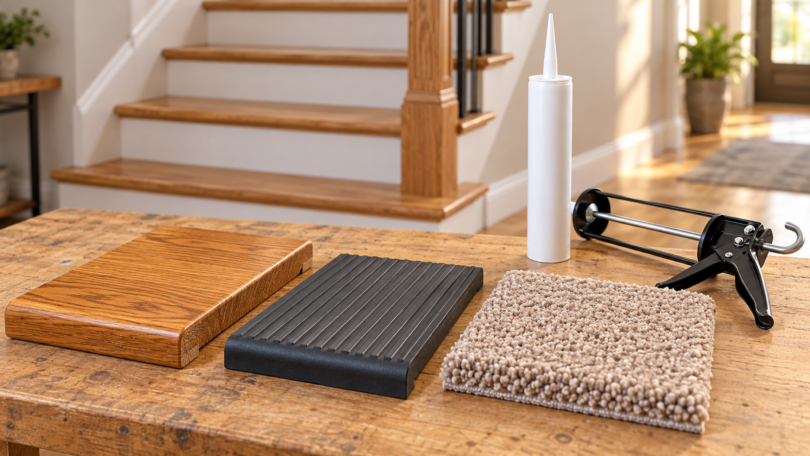

The right glue for stair treads depends on the tread, its backing and the surface underneath. A wood overlay on plywood, a flexible rubber covering on concrete and a removable carpet pad need different installation systems. Start with the tread manufacturer’s named adhesive and fastening instructions, rather than choosing the tube with the biggest strength claim.
For compatible wood retreads, Bostik Tread-Lock is a purpose-made option. Loctite PL Premium Polyurethane is the specified choice for WoodStairCo’s wood treads. Tarkett 965 serves specified Tarkett rubber and vinyl products. None is a universal substitute for the others.
Choose by the type of stair tread
- Wood retread or overlay: check the exact wood product’s installation guide. Confirm that the adhesive accepts both the underside of the overlay and the existing stair surface.
- Structural wood tread: a load-bearing step attached to stringers needs its specified construction and fastening method. Do not treat instructions for a thin decorative overlay as structural installation instructions.
- Rubber or flexible vinyl covering: use the tread manufacturer’s specified flooring adhesive and any required nosing compound. Check whether the substrate is porous or nonporous.
- Laminate, rigid vinyl or composite cap: identify the exact cap and backing. A recommendation for solid wood or flexible vinyl does not establish compatibility with a different composite system.
- Carpet tread pad: first check whether it already has an attachment system. Additional construction adhesive may defeat the intended removable installation.
Keep the product name, model, backing description and substrate details together when contacting technical support. “Rubber on wood” is less useful than the exact tread model and whether that wood is bare, painted or coated with a floor finish.
Three adhesive options, with important limits
Bostik Tread-Lock: for compatible wood retreads over wood
Bostik Tread-Lock is intended for stair retreads and remodel risers. It remains flexible after curing and is sold in 10.1-ounce cartridges. Its formulation is a silyl-modified polymer, so do not assume it satisfies another manufacturer’s requirement for a particular polyurethane adhesive.
The Tread-Lock technical sheet lists plywood, OSB and sanded existing hardwood treads as suitable substrates. It excludes concrete, exterior installations, wet areas and new structural stair treads. The bonding surface must be properly prepared, rather than relying on a finish coat to hold the assembly.
Critical limitation: Bostik requires mechanical fasteners to prevent movement during cure. Follow the complete fastening and support instructions. For vinyl-covered stairs, obtain written guidance from Bostik before selecting this product.
Best fit: a wood-overlay installation whose tread maker permits this adhesive and whose existing stair construction meets its substrate requirements. Choose another documented system when those conditions do not match.
Loctite PL Premium Polyurethane: when the wood-tread maker specifies it
WoodStairCo names PL Premium as its only recommended adhesive and warns that substitutions can affect its product warranty. That is a reason to match the exact formulation, not to buy any tube carrying the Loctite or PL name. WoodStairCo also cautions against excess moisture from unsuitable adhesives causing wood treads to cup.
Henkel describes PL Premium as a moisture-curing polyurethane construction adhesive. Its technical sheet lists wood, plywood, OSB and concrete among supported materials, but excludes flexible vinyl and flexible sheet goods and flags possible bonding problems with some rubbers and plastics. Those limits matter when a tread has an unfamiliar backing.
Best fit: a wood-stair product that explicitly calls for PL Premium Polyurethane. Broad material compatibility does not establish that a particular stair assembly, coating or backing is suitable.
This is the original PL Premium polyurethane formulation in a single 10-fluid-ounce cartridge, not PL Premium MAX or Fast Grab. Use it only when the tread maker approves it for the specific material and installation. Follow the required mechanical fasteners and cure instructions.
The card price may refer to a different offer. Confirm the formulation, cartridge quantity, item condition, seller and current price on Amazon before ordering.
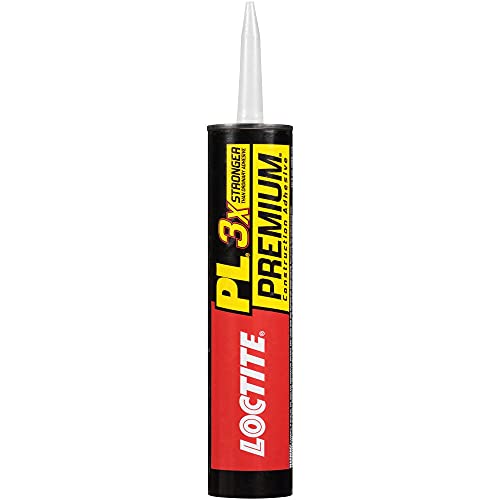
Loctite PL Premium Polyurethane Construction Adhesive, 10 fl oz Cartridge, 1 Pack - Versatile Construction Glue for Wood, Concrete, Stone, Metal & More
As an Amazon Associate we earn from qualifying purchases.
Tarkett 965: for the specified Tarkett rubber or vinyl system
Tarkett 965 Flooring and Tread Adhesive is a water-based acrylic adhesive for listed Tarkett products, including rubber and vinyl stair treads and nosings. Its specification covers properly prepared concrete and underlayment-grade plywood, with different trowel requirements for porous and nonporous surfaces.
This is an interior system, not a recommendation for weather-exposed steps. The sheet calls for substrate preparation, environmental conditioning and concrete moisture and pH testing. It also requires adhesive transfer to the back of the covering and a small hand roller for stair treads.
Best fit: the exact Tarkett tread and site conditions covered by its current instructions. Do not substitute it for a wood-retread adhesive simply because both products mention stairs. Check the tread’s separate nose-fitting requirements before ordering the installation materials.
The nosing may need a different material
The projecting front edge of a resilient tread deserves its own check. In Shaw’s Smart Step rubber stair-tread instructions, the installation uses both the specified adhesive and an epoxy nose-caulking compound. The compound fills the nose area so it makes full contact with the step edge.
Shaw also distinguishes porous from nonporous substrates when describing adhesive preparation. Its instructions call for rolling the tread and riser, but not the nose where that would displace the compound. This illustrates why a generic instruction to spread glue, press down and walk away can miss an essential part of the installation.
Use the nose detail for your exact system. A separate epoxy compound is not automatically required for every wood overlay, carpet pad or other brand’s rubber tread.
Carpet pads and peel-and-stick treads need a separate approach
Some carpet tread pads already have a pressure-sensitive backing. For example, Oak Valley Designs’ installation guide describes removing the protective liner, positioning the tread on a pre-cleaned step and applying firm, even pressure. It does not call for a separate bead of construction adhesive.
For a removable pad, ask whether the intended attachment method is compatible with both the carpet backing and the stair finish. Do not rely on a general-purpose rug-tape claim as proof for every finished staircase. Check the removal and cleaning instructions before using an additional adhesive, and do not add it unless the tread manufacturer permits it.
A loose or curled pad needs attention before the stair is used again. More glue is not necessarily the answer: the pad may be the wrong shape, the backing may be contaminated, or the attachment method may not suit the surface.
What to check before buying
- Exact product identity. Record the adhesive’s complete name and formulation. PL Premium, PL Premium MAX and other construction adhesives are not interchangeable merely because their branding is similar.
- Both bonding surfaces. Identify the tread underside and the existing stair material. Note finishes, paint, residual adhesive, foam backing and any repair compounds.
- Location and conditions. Check interior or exterior suitability, moisture limits, application temperature and conditioning requirements. A waterproof adhesive claim alone does not establish an exterior stair system.
- Fastening and support. Obtain the tread maker’s fastening schedule and the adhesive’s cure-support requirements. High initial grab does not authorize omitting either.
- Complete installation materials. Include approved patching materials, the required applicator, any nosing compound and appropriate protective equipment. A cartridge of glue may be only one part of the job.
- Time out of service. Plan an alternative route while the staircase is unavailable. Do not use a step as a test of whether its adhesive has cured.
Preparation matters more than adding extra adhesive
Dry-fit each tread before opening the adhesive. Check its fit at the back, sides and nose, and address unstable or damaged steps before covering them. A thick bead should not be used to disguise an unresolved fit or support problem.
WoodStairCo’s installation guidance includes measuring individual steps, removing the old covering, fitting the components and using finish nails with the specified adhesive. Those instructions apply to its retrofit products; they are not permission to cut or modify every staircase in the same way.
Check older materials before disturbing them. The EPA advises against sanding, scraping or otherwise disturbing suspected asbestos-containing materials. If old flooring or adhesive may contain asbestos, stop preparation and consult a qualified professional. Surface-preparation directions do not override that precaution.
Read the exact adhesive label and safety data sheet before use. Follow its ventilation and protective-equipment requirements, protect adjacent finishes, and keep children and pets away from the work. Use only the cleanup method approved for both the adhesive and the finished surface.
How much adhesive should you buy?
Calculate from the prescribed bead pattern or trowel coverage, not just the number of steps. Henkel’s PL Premium sheet gives approximately 30.6 linear feet from a 10-fluid-ounce cartridge with a 1/4-inch bead, versus 13.6 feet with a 3/8-inch bead. A wider bead uses substantially more material.
For a cartridge system, total the required bead lengths for every tread and riser, then divide by the specified yield and round up to whole cartridges. For a troweled system, total the covered area and use the coverage for that substrate and notch size. Include any separate nosing material in the shopping list. Do not increase the bead size or change the trowel merely to use up a container.
Frequently asked questions
What is the best glue for wood stair treads?
Choose the adhesive specified for the exact wood-tread system. WoodStairCo recommends PL Premium Polyurethane for its products. Bostik Tread-Lock is another purpose-made option for compatible wood retreads, but its own substrate and fastening restrictions still apply. Neither is a universal choice for every staircase.
Can I glue stair treads without nails or screws?
Only when the exact tread system’s instructions permit that installation. Bostik requires mechanical fasteners with Tread-Lock during cure. Do not infer that an adhesive’s fast-grab claim replaces structural fastening, or apply wood-retread fastening instructions to a different type of covering.
Can the same construction adhesive bond wood, rubber and vinyl treads?
Do not assume so. A multi-material adhesive may still exclude a particular flexible backing. Use the tread maker’s specified adhesive for the exact backing and substrate, including any required nose compound.
How long should I keep people off newly glued stairs?
Follow the complete system’s traffic restrictions. Tarkett 965 requires no traffic for 24 hours and no heavy traffic for 72 hours. Henkel’s PL Premium technical sheet lists a 24–48-hour cure at 78°F and 50% relative humidity, with longer curing in cold or dry conditions. Neither figure is a universal permission to reopen another stair system.
Should I put construction adhesive under peel-and-stick carpet treads?
Not unless the tread manufacturer specifically allows it. Some carpet treads are designed to attach using their own pressure-sensitive backing. Extra glue can change that intended installation and removal method. Follow the exact pad’s preparation, placement and maintenance instructions instead.


