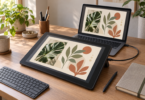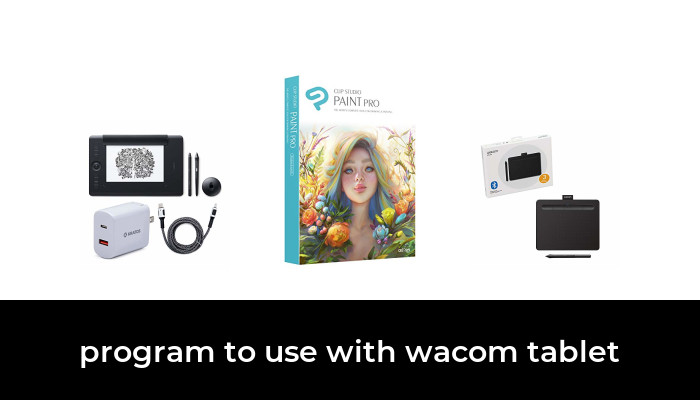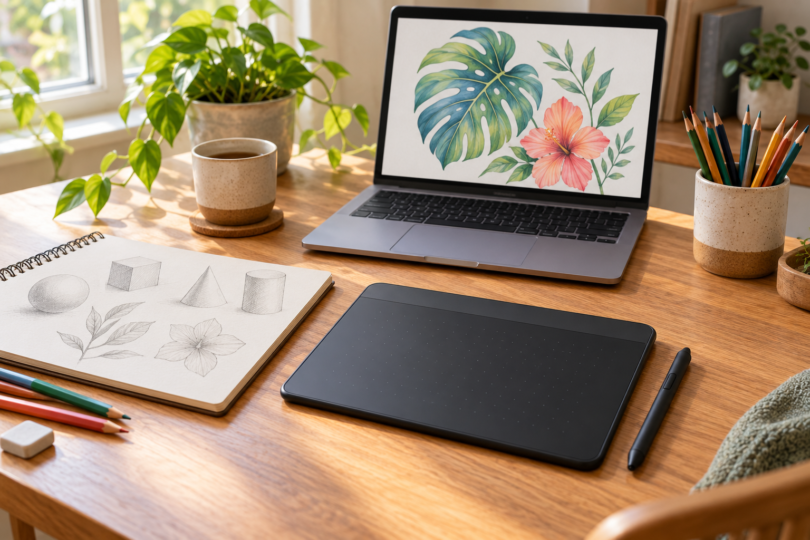

The Wacom Intuos Small is our starting choice for a beginner who already owns a compatible computer and wants a compact drawing pad. The Huion Inspiroy 2 S adds a scroll wheel and more shortcut keys. If you would rather draw directly on the picture, the Huion Kamvas 13 (Gen 3) is the display option to compare.
These are computer-connected drawing devices. The two screenless tablets use your computer’s screen; the Kamvas has its own display but still needs a compatible host. Our picks are based on manufacturer documentation and exact product configurations. We have not tested drawing feel, line accuracy, latency or long-term durability.
Best graphics tablets for beginners at a glance
| Pick and exact version | Why choose it | Main limitation |
|---|---|---|
| Wacom Intuos Small CTL-4100, wired, black | 6.0 × 3.7-inch drawing area; four shortcut keys | No built-in display; this version has no Bluetooth |
| Huion Inspiroy 2 S H641P-Black | 6.3 × 3.9-inch drawing area; six keys and a scroller | No display; Small does not have the M/L tilt specification |
| Huion Kamvas 13 Gen 3 GS1333, black, stand package | 13.3-inch 1920 × 1080 display; two dials | Needs a compatible computer and video connection |
1. Wacom Intuos Small: best straightforward starting point
The wired CTL-4100 keeps the basic setup compact: a 200 × 160 mm tablet body, a 152 × 95 mm active drawing area and a battery-free Pen 4K. You draw on the pad while watching your computer screen. We would choose it for a small desk and a beginner who wants to start with a few useful controls instead of managing a second display.
Wacom specifies 4,096 pressure levels and four customizable ExpressKeys, with ExpressKey support on Windows and Mac. Pressure levels describe an input specification, not a measure of how good your artwork will be. Map a couple of frequently used actions, such as undo and brush size, and leave the rest alone until you need them.
Match the model carefully. CTL-4100 is the wired Small version; CTL-4100WL is the Bluetooth Small, and CTL-6100WL is the Medium Bluetooth model. The included cable connects through USB-A, so check whether your computer needs an adapter. The standard package includes the pen and three spare nibs.
Before buying, check Wacom’s current driver page for your operating system and model. Older product listings retain older OS minimums, which are not the same as support for the latest driver. Any included software offer also has its own registration, operating-system and redemption conditions; do not choose a tablet on the assumption that every pictured app is permanently free.

Wacom Intuos Small CTL-4100 Wired Drawing Tablet, Black
As an Amazon Associate we earn from qualifying purchases.
2. Huion Inspiroy 2 S: best for more shortcut controls
The Inspiroy 2 S offers a slightly larger 160 × 100 mm active area than the Wacom Small, plus six programmable keys and a scroller. Those controls are its clearest reason to be on this shortlist: consider it if you expect to change brush sizes or zoom frequently and prefer controls beside your drawing hand. The selected H641P-Black is one small black tablet, not the Medium or Large.
Its PW110 pen is battery-free, and Huion lists 8,192 pressure levels. Do not interpret twice the Wacom’s advertised pressure levels as twice the drawing quality. Huion’s Small specification lists no tilt support, while the Medium and Large list ±60°; avoid transferring features from those larger models to this one.
Huion lists Windows, macOS, ChromeOS, Android and Ubuntu support, but check the current driver and your chosen drawing app before relying on a particular system. Its driver can rotate the tablet for left-handed use. The tablet itself connects by USB-C and still needs a host device; it does not run drawing apps independently.
Choose the Small H641P-Black configuration if you want the dimensions and controls described here. Huion’s comparison page shows the S, M and L together, so check the selected column rather than reading a larger model’s specifications as universal.

3. Huion Kamvas 13 Gen 3: best if you want to draw on a screen
The GS1333 has a 13.3-inch, 1920 × 1080 IPS display, a battery-free PW600L pen, five programmable keys and two dials. Drawing directly on the displayed image is the main reason to move from a screenless pad to this model. It also takes more desk space: Huion lists a 361.21 × 202.77 mm body.
Check ports before paying for a display tablet. The included 3-in-1 connection uses HDMI for video and USB for pen data and power. A USB-C-only setup requires a full-featured cable and a host port supporting at least USB 3.1 Gen 1 and DisplayPort 1.2; the connector’s shape alone is not enough. Huion’s connection guide also explains when an additional power connection is needed.
The selected black Amazon configuration lists one GS1333 display, PW600L pen, ST300 adjustable stand, 3-in-1 cable, USB extension cable, pen holder, ten nibs, glove and cleaning cloth. Huion treats the stand as optional on its general product page, so package contents matter. Do not assume a separately sold full-featured USB-C cable or power adapter is included.
This is our choice for a beginner who specifically wants a pen display and has checked the host connection. It is more equipment to position and connect than either screenless pick. Its advertised 16,384 pressure levels and tilt support should not outweigh app compatibility or a comfortable setup; Huion notes that tilt support depends on the software.

How to choose your first graphics tablet
Start with the way you want to draw. Choose a screenless pad if you are willing to look at the computer monitor while moving the pen on your desk. Choose the Kamvas if drawing on the image is the feature you want most. If you want a device that runs apps by itself, look for a standalone tablet instead; these three do not fill that role.
Compare the active area separately from the outer dimensions. The Wacom and Inspiroy Small give you roughly a six-inch-wide drawing surface, while the Kamvas offers a larger display and a larger body. Measure the space beside your keyboard, including room for cables, before deciding. A larger drawing surface is not automatically the more convenient choice for a compact desk.
Check three things together: the exact tablet model, its current driver for your operating system and your drawing app’s pen support. Manufacturer compatibility lists are a starting point, not a guarantee for every app or computer. Install the correct driver, test pressure response in the app and learn a small set of shortcuts before adding more controls.
Compare the whole setup cost: the tablet, any necessary adapter or display cable, a stand where needed and your chosen software. Confirm the seller’s exact bundle and return terms. This guide does not quote live prices or promise that one retailer is cheapest.
Frequently asked questions
Does a beginner need a graphics tablet with a screen?
No. A screenless Wacom Intuos Small or Inspiroy 2 S is a valid starting point when you already have a compatible host and display. Choose a pen display because you prefer drawing directly on the image, rather than treating it as a requirement for learning.
Can these tablets work without a computer?
None is a standalone drawing computer. Some manufacturer documentation describes compatible Android hosts, but that requires the right device, ports and app. For a straightforward first setup, verify the tablet with the computer and drawing software you plan to use.
Which beginner tablet should I buy?
Start with the wired Wacom Intuos Small for a compact pad with four keys. Choose the Inspiroy 2 S if six keys and a scroller better fit your workflow. Choose the Kamvas 13 Gen 3 stand package when an on-screen drawing surface is worth the extra space and connection requirements.