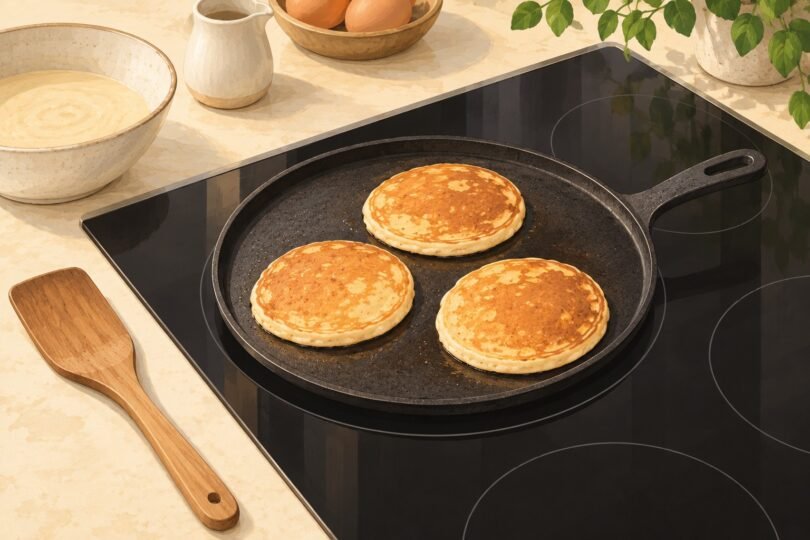

The best griddle for an induction cooktop is the one that matches your cooking zones as well as your breakfast plans. A magnetic pan can be induction-compatible yet still be too small for detection, too large for even heating, or unsuitable for the way your cooktop combines burners. Start with the appliance manual, then choose the griddle.
For one cooking zone, the Lodge L9OG3 10.5-inch round griddle is a straightforward seasoned-cast-iron option. For an approved two-zone setup, compare a purpose-built double-burner griddle such as the Cuisinart MCP45C-25NS or STAUB 40509-340-0. These are specification-based choices for different needs; they are not the results of hands-on comparative testing.
First, check these three kinds of compatibility
1. A magnetic cooking base
Induction needs suitable magnetic material in the pan’s base. Cast iron is a familiar example; stainless steel and aluminum cookware need a compatible construction. An aluminum core inside an induction-ready pan is different from an ordinary aluminum pan. A magnet sticking to the underside is a useful first check, but it does not establish correct size or placement. Bosch’s cookware guidance explains the basic material test.
2. A stable, suitable underside
Inspect the bottom rather than relying on a photograph of the cooking surface. It should sit as required by your cooktop’s manual, without rocking. A reversible grill/griddle can have ridges, recesses, or a rim on its underside. Do not assume that every cast-iron plate has the same contact profile or will be detected by every appliance.
GE’s induction size-and-shape guidance calls for magnetic cookware that makes full contact with the glass and explains that the flat magnetic area can be smaller than the advertised pan diameter. That distinction matters particularly with cookware built around a small induction disc.
3. The correct zone arrangement
A long griddle should not automatically be placed across two unrelated burners. Check whether your appliance permits that arrangement and whether it offers a bridge, flex zone, or synchronized controls. The names are not interchangeable promises about the heating area. For example, GE explains that its Sync Burners feature controls two burners together, while the space between those burners does not itself heat.
Follow your exact model’s placement diagram. A griddle that works well on one induction range is not proof that it will behave the same way on another.
Three griddles worth comparing
Lodge L9OG3: a round griddle for a single zone
The 10.5-inch Lodge L9OG3 is seasoned cast iron with a low cooking rim. Lodge lists induction compatibility, a 15.87-inch overall length, 10.62-inch width, 1.5-inch overall height, and 4.65-pound weight for this selected size. The handle length counts when checking cupboard space and clearance around other pans.
This is the most sensible starting point here for small batches of pancakes, tortillas, or sandwiches when you do not need a double-burner plate. The trade-offs are weight, a handle that needs heat protection, and regular cast-iron care. The nominal 10.5-inch size is not a guarantee that it matches your zone’s required magnetic footprint.
Choose it if: you want a dedicated low-sided pan and are happy to hand-wash, dry, and lightly oil it. Choose a larger approved setup only if batch capacity is genuinely limiting you.
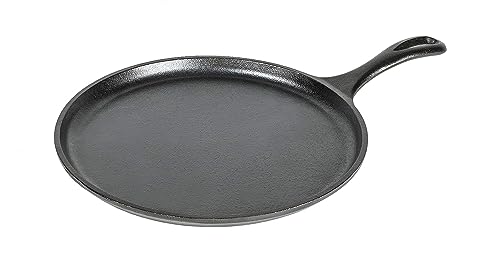
Lodge L9OG3 10.5-inch round cast-iron griddle, black, single pan
As an Amazon Associate we earn from qualifying purchases.
Cuisinart MCP45C-25NS: a ceramic-nonstick double-burner option
The current Cuisinart MCP45C-25NS uses tri-ply construction with an aluminum core and a ceramic-nonstick interior. Cuisinart explicitly lists induction compatibility and overall dimensions of 21 inches long, 10 inches wide, and 3.1 inches high. Those overall measurements should not be treated as the dimensions of the flat cooking area.
Choose it if: you prefer a coated surface and your cooktop permits a griddle across the intended zones. Hand washing is recommended on its product page. Its linked care instructions advise low-to-medium heat for most cooking, no unattended empty pan over a hot burner, and avoiding metal utensils on nonstick cookware.
Check the model number carefully. The older MCP45-25NSP1 still appears in retail listings, but Cuisinart’s manuals directory marks it discontinued. Do not transfer the newer model’s ceramic-coating description to the older version merely because both are called a double-burner griddle.
STAUB 40509-340-0: an enameled cast-iron plancha
The STAUB double-burner griddle is another option for an approved elongated cooking area. Its manufacturer describes black enamel with a matte top and glossy underside, and lists induction use. The same page specifies 47.3 by 25 centimeters including the handles and a 38 by 22-centimeter cooking surface; these are more useful for fit than treating the product title’s nominal size as one universal measurement.
Choose it if: you want a rectangular enameled cast-iron cooking surface and have confirmed the footprint. Allow room to lift it safely and to wash it. Enamel does not remove the need to respect heating, cooling, or utensil instructions, and a large plate does not make the area between small induction coils into an extra burner.
Measure before choosing single or double burner
Write down four measurements before comparing listings:
- Permitted cookware footprint: the minimum and maximum dimensions or placement requirements in your appliance manual.
- Magnetic base: the underside area that will sit over the zone, which may differ from the top rim.
- Overall size: handles included, with clearance from touch controls, trim, adjacent cookware, and counter edges.
- Storage and cleaning space: the shelf, drawer, sink, and drying area where the pan will actually go.
A paper outline can help visualize the overall space on a cold, switched-off cooktop; remove it before use. It cannot test magnetic detection or heat distribution. If the seller provides only package dimensions, ask for the pan’s base measurements instead of guessing.
Use heat and cleaning routines that suit the pan
Induction can put heat into cookware quickly. Lodge recommends preheating cast iron slowly with oil rather than heating it aggressively. Do not use maximum power or boost simply to rush an empty griddle to temperature. Stay with the pan and follow the lower limit when cookware and appliance instructions differ.
Lift cookware instead of dragging it over glass. Use appropriate heat protection, including for short helper handles. After cooking, let the pan cool according to its care instructions; do not plunge a hot griddle into cold water. Wash seasoned iron by hand, dry it thoroughly, and apply the light oil coating Lodge recommends. For the Cuisinart coated model, use a soft cleaning tool and follow its care manual.
Common buying questions
Why does an induction-ready griddle fail to heat?
Check the appliance’s pan-detection requirements, the magnetic area, and centering first. GE notes that induction burners require a minimum pan size. If the griddle still is not detected, consult the appliance maker with both model numbers rather than repeatedly increasing power.
Will a double-burner griddle heat evenly everywhere?
Not necessarily. The pan’s construction and the cooktop’s coil layout both matter. Keep early batches modest while learning where food browns fastest. A synchronized setting is convenient, but it does not by itself guarantee identical temperature across the whole plate.
Is nonstick or cast iron the better choice?
Choose by the maintenance you will actually do. A coated pan brings coating-specific utensil and heat limits. Seasoned iron needs drying and oiling. Enameled iron has its own care requirements. None should be purchased on a blanket claim that it cannot stick, scratch, warp, or overheat.
Bottom line: buy for the cooking zone you have. Start with a manageable single-zone griddle for everyday small batches, and move to a double-burner model only after confirming its base, dimensions, and permitted placement.