
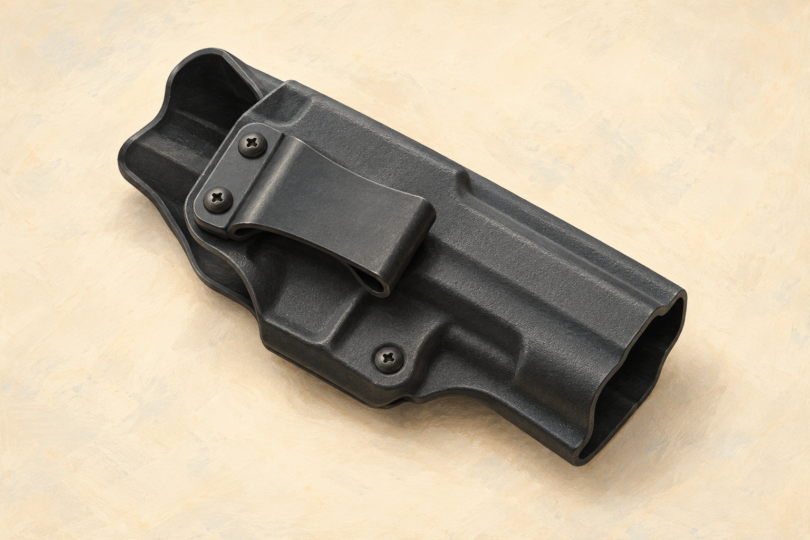

A right-hand holster should be chosen for the exact handgun model, not simply because the listing says “9mm” or “for women.” Begin with manufacturer-confirmed compatibility, complete trigger protection and secure retention. Then assess comfort and whether the attachment system works with the clothing and belt you actually use.
There is no single holster that safely fits every 9mm handgun or every body. A purse, elastic garment or universal pouch should not be treated as an equivalent substitute just because its advertising mentions the same caliber.
Research checked October 4, 2026 using holster-manufacturer warnings and firearm-storage guidance. This is a general safety-focused buying guide, not personal fitting advice, tactical training or a hands-on retention test. Follow the firearm and holster manuals and obtain instruction from a qualified firearms-safety professional.
Two starting points for finding a compatible option
| Starting point | Why consider it? | What must be confirmed? |
|---|---|---|
| Blade-Tech Klipt IWB | A manufacturer-listed right-hand-only holster family | The exact handgun variant and required belt attachment |
| Safariland Holster Finder | A manufacturer route to model-specific fit options | The complete firearm configuration, hand designation and product instructions |
These are places to begin a compatibility check, not assurances that either offers a suitable product for your particular firearm. If the manufacturer does not confirm your exact configuration, do not infer compatibility from appearance or a customer review.
Blade-Tech Klipt: a right-hand-only example
The Klipt IWB product page explicitly identifies the family as right-hand only and describes a belt clip for belts up to 1.5 inches. The holster is sold in firearm-specific selections. This makes it a useful example to compare when the manufacturer lists your exact model and the attachment requirements suit your equipment.
Limit: the Klipt name alone is not a fit confirmation. A product selected for one pistol should not be assumed to fit another pistol of the same caliber. Blade-Tech’s other similarly named holsters can have different handedness or features, so match the complete product and variant.
We have not assessed its comfort on different bodies, tested retention or verified a specific firearm fit in person. Treat manufacturer descriptions as specifications to check, not an independent safety certification.
Safariland: use the exact-model fit process
Safariland’s Holster Finder is another starting point when you need a manufacturer-confirmed match. Record the complete holster part number and hand designation rather than buying by a general family name.
The manufacturer’s safety warnings emphasize the importance of close firearm-and-holster tolerances. Small firearm-design differences can affect safety. If the exact version is unclear, contact the manufacturer before purchase or use.
Limit: a finder result does not remove the need to read the specific product instructions and have the fit checked appropriately. The retention and attachment system must be understood before use. Do not reshape, cut, heat or otherwise modify a mismatched holster to force compatibility.
Why “9mm” is not a complete fit description
Caliber does not describe the external shape of a handgun. A useful fit inquiry includes the maker, model, generation or version, barrel configuration and any installed accessories that affect the holster interface.
Safariland’s fit guidance explains that accessories such as lights or optics can change compatibility. Do not assume an accessory-equipped firearm fits a holster intended for the plain version. Equally, do not assume that a holster designed around one accessory will retain a firearm correctly without it.
If you cannot identify the exact configuration, ask the manufacturer or a qualified professional to help. Do not conduct improvised fit experiments with a loaded firearm.
Safety features to evaluate before comfort
- Trigger protection: the intended fit should prevent unintended access to the trigger while the firearm is properly holstered.
- Retention: use the system only as the manufacturer directs. A loose or damaged fit needs professional assessment, not a workaround.
- Attachment: confirm the clip, belt or other attachment is suitable for the specified equipment and can remain secure during normal movement.
- Condition: inspect for cracking, deformation, loose hardware or material wear according to the manual. Remove questionable equipment from use.
- Instructions and support: favor a seller that identifies the actual model and provides the manufacturer’s documentation, warranty and return terms.
Comfort still matters, but a “women’s” label cannot establish it. Body shape, clothing, mobility and personal preference vary. Have a qualified instructor or fitter help assess a suitable system using safe, manufacturer-approved procedures. This article does not prescribe a body position or a drawing technique.
A carry bag is not secure firearm storage
A bag can be set down, lost or accessed by someone else. Do not assume that a small zipper lock provides the protection of a purpose-designed secure storage device. A holster and a storage device serve different roles.
Project ChildSafe advises storing firearms unloaded, securely and separately from ammunition when not in use. Its storage resources describe purpose-designed safes, lock boxes and locking devices. Follow the firearm and storage-device instructions and applicable local requirements.
Keep firearms inaccessible to children and other unauthorized people. If you cannot maintain control of a firearm, use an appropriate secure-storage arrangement rather than leaving it in a handbag, pocket or unattended vehicle.
Questions to ask before buying
- Does the manufacturer explicitly list this exact firearm version and accessory configuration?
- Is the selected item the right-hand version, with the complete part number recorded?
- What attachment equipment is required, and is it compatible with what you use?
- Where are the specific safety instructions, maintenance requirements and service notices?
- Can the item be returned if a qualified fit check finds it unsuitable?
Frequently asked questions
Do women need a separate category of holster?
Not automatically. Exact firearm fit and safety requirements come first. Comfort is individual, and gender-focused marketing does not prove suitability.
Does right-hand mean it fits any right-handed user?
No. It identifies a product orientation, not universal firearm, body or clothing compatibility. Check the whole system.
Can I rely on a review saying another pistol fits?
No. Obtain compatibility confirmation from the manufacturer for the exact configuration. A customer report is not a substitute for a supported fit.
Bottom line: use model-specific manufacturer information to shortlist a right-hand holster, prioritize trigger protection and retention, and get qualified fitting and safety guidance. Keep secure storage separate from the carrying decision.
Image note: AI-generated generic editorial illustration; it does not identify a product, confirm handedness or firearm compatibility, or demonstrate carrying or use.


