
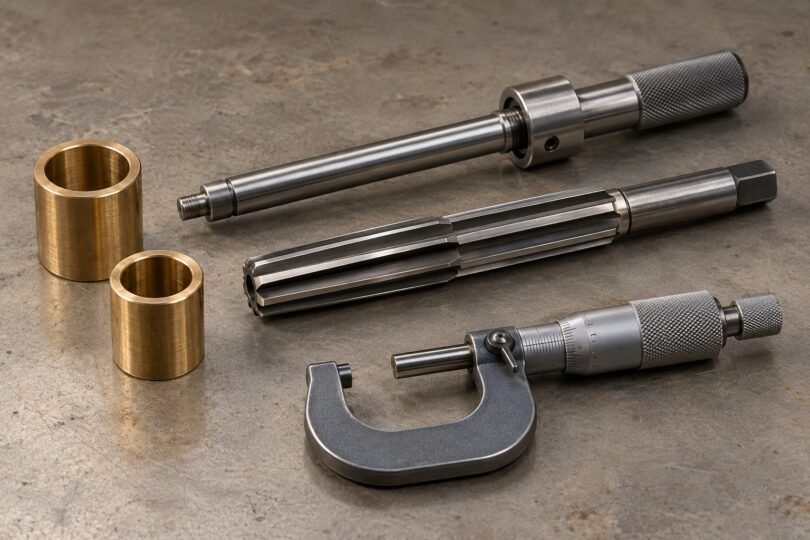

The right king pin bushing reamer is the one that matches the axle service procedure, the installed bushing size and the distance between the bushings. A large adjustable range is useful only when the tool also has the right pilot, guide sleeve and working length. Buying a generic reamer set before identifying the axle can leave you with a tool that cuts the hole but cannot keep the two bushings aligned.
This guide compares documented tooling options and explains what to check before ordering. Kingpin work affects steering and vehicle control. Have a qualified steering or axle-service technician establish the required fit, machining method and inspection criteria; a shopping guide cannot supply those specifications for every vehicle.
Start with the axle and bushing kit
Record the vehicle identification, axle manufacturer and model, and the exact replacement kingpin-kit number. The vehicle model alone may be insufficient if different axles were offered or the assembly has been replaced. Ask the parts supplier to confirm the kit against those identifiers before choosing a cutter.
Also establish whether the replacement bushings require sizing. STEMCO PlusKit, for example, uses pre-sized bi-metal bronze bushings intended for no-ream installation. That does not make every bronze bushing a no-ream part. The kit’s instructions determine the process, and a pre-sized kit still needs correct installation and fit checks.
If the housing bores, kingpin or knuckle are worn or damaged, a different reamer does not automatically solve the underlying problem. Ask the technician to inspect the assembly before committing to tooling. The useful purchasing question is “What approved operation does this exact assembly require?” rather than “Which tool covers the most sizes?”
Verified long-pilot reamer options
Chadwick & Trefethen Model LP
The Model LP manufacturer chart lists a one-piece body and pilot with a floating guide sleeve. Carbon-steel and high-speed-steel versions have separate ordering numbers. Examples include:
- Size 26: carbon 09260 or HSS 29260; 13/16–7/8-inch adjustment range; 12 3/4-inch overall length.
- Size 29: carbon 09290 or HSS 29290; 1 1/8–1 1/4-inch range; 16-inch overall length.
- Size M: carbon 09630 or HSS 29630; 1 25/32–2 3/32-inch range; 22-inch overall length.
These are examples of available tool sizes, not vehicle-fit recommendations. Use the exact fractional limits rather than rounding a catalog decimal when the required working size is near an endpoint. Obtain pilot and sleeve dimensions before ordering if the assembly’s spacing is uncertain.
ICS long-pilot HSS hand reamers
ICS catalog page 194A identifies its long-pilot tools as right-hand-cut, high-speed-steel hand reamers. Item LPAHR060, size H, covers 15/16–1 1/16 inches, with a 2 3/4-inch blade length and 12 3/8-inch overall length. Item LPAHR152, size M, covers 1 13/16–2 7/32 inches, with a 4-inch blade length and 18-inch overall length.
Notice that the ICS and Chadwick size-M ranges differ. A letter designation is not enough to establish interchangeability. Compare the numeric range, cutting length, pilot arrangement and actual space in the component. An overall-length figure also does not tell you how much usable guidance remains when the cutter reaches the opposite bushing.
An approved pilot for an existing reamer
If the shop already owns a compatible tool, a separate pilot may avoid duplicating the cutter. Chadwick’s screw-on pilot assembly is intended for its genuine Critchley reamers, replacing an end nut to create an aligning arrangement. The size-26 assembly, 07260, is listed for 13/16–7/8-inch reamers with a 5-inch overall length.
That is a manufacturer-specific pairing. Do not assume a pilot with a similar thread or size label fits another brand. Confirm the exact reamer, pilot, sleeve and included hardware as a complete combination.
Why the pilot and guide matter
Two individually round holes can still be out of line. In a typical long-pilot arrangement, the guide sleeve locates in one bushing while the cutting section works in the other. ICS describes this arrangement specifically for spaced holes requiring in-line reaming.
Before buying, have the shop check bushing spacing, the usable pilot length, where the sleeve seats and whether the cutter can complete its travel without interference. Ask whether the guide sleeve is included; a photograph showing a long shaft does not establish a complete guided setup. A missing or unsuitable guide can turn an otherwise suitable cutter into the wrong purchase.
Do not confuse bushing alignment with wheel alignment. The first concerns the relationship of the bores inside the steering assembly. The second concerns the vehicle’s suspension and steering geometry. A service provider should perform the manufacturer’s required final inspections and alignment checks after the repair.
Reaming, honing and burnishing are different processes
Reaming uses cutting edges to remove material. Precision honing uses abrasive stones and a different method of controlling the bore. Neither term means simply polishing until the kingpin can be pushed through.
The permissible method is application-specific. Hendrickson bulletin 59310-011 Rev F, for the STEERTEK NXT and STEERTEK applications it covers, describes either an adjustable straight-flute reamer with an extension pilot or a precision-finish cylinder hone. It prohibits burnishing those bushings. It also calls for measurement and inspection before installation and removal of machining debris, including material in grease channels.
By comparison, Ridewell’s RSS-233/232 service guide specifies a fixed-size reamer for its standard-kingpin procedure and says not to hone or burnish the bushings before reaming. These instructions are not interchangeable. An adjustable reamer recommended for one axle is not automatically approved for another.
No universal clearance, stock-removal allowance or number of passes belongs in a buying recommendation. The correct target depends on the specific assembly and service instructions. If the tool instructions and axle manual appear to disagree, ask their technical-support teams to resolve that before work begins.
What to include in the tooling decision
- Measurement capability: the technician needs suitable instruments for the relevant pin and bore dimensions, plus the skill to interpret taper, out-of-roundness and alignment.
- Bushing material: identify the actual replacement part rather than choosing a blade material from appearance alone.
- Workholding and access: the approved process must fit the shop’s equipment and protect the assembly’s machined surfaces.
- Tool condition: inspect used cutters, blade seats, adjustment hardware and guides before relying on them.
- Service support: ask about replacement blades, sharpening and the manufacturer’s procedure for checking the tool after service.
Chadwick’s reamer guidance warns that most of its reamers are intended for hand use and that driving them with power tools can damage the cutter, workpiece or operator. It also explains that blade adjustment needs measurement and offers factory blade replacement and test cutting. A square shank should not be treated as permission to attach a drill or impact driver.
Tools that do not replace a kingpin bushing reamer
A kingpin press removes a pin. A bushing driver installs or removes a bushing. A hub-seal installer, transmission bushing kit or pipe deburring tool performs a different job. None establishes the finished, aligned kingpin-bushing bore merely because its name includes “kingpin,” “bushing” or “reamer.”
Taper reamers also require care when shopping. A cutter intended for a tapered steering-joint hole is not a substitute for a specified cylindrical bushing-sizing tool. Confirm the working geometry, not just the automotive category or product photograph.
When to stop and ask a specialist
Binding can indicate more than an undersized bushing. In its QwikKit fit-check guidance, STEMCO notes that a pin fitting each bushing separately but not both together can indicate a spread spindle requiring further attention. Cutting additional material without identifying that problem is not a sound repair strategy.
For a one-off repair, ask an experienced axle-service shop for a quote covering identification, inspection, the approved sizing operation and final checks. For repeat professional use, buy the exact documented cutter-and-guide combination the work requires. In both cases, verified fit and competent inspection matter more than the number of pieces in the box.
