
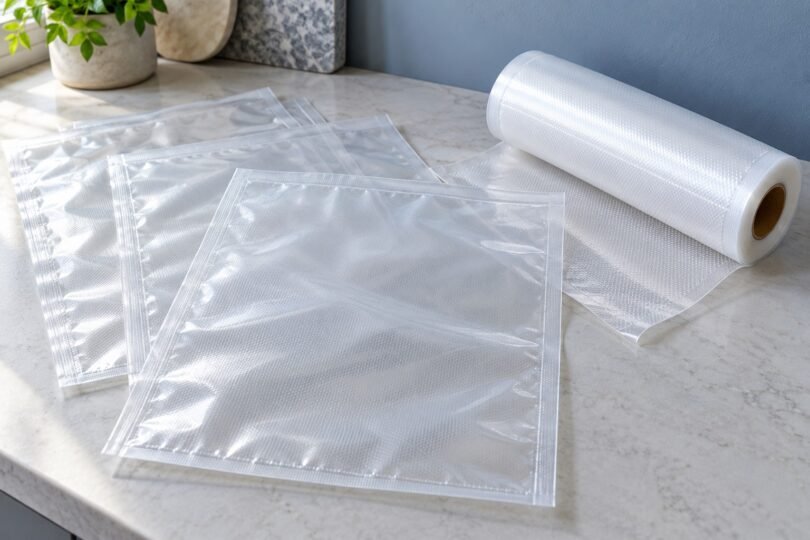

The right large sous vide bags must fit three things: the food, the vacuum sealer and the planned cooking conditions. A gallon-size label alone does not answer any of those questions. Start with the bag’s actual dimensions, then check the exact manufacturer’s instructions for hot-water use and sealing.
For a compatible FoodSaver countertop sealer, the standard 11-inch-wide roll below has a published sous vide temperature ceiling. Avid Armor’s 11 × 16-inch precut bags are a convenient large-format alternative, but their public page leaves numerical cooking limits unspecified. If you are considering an expandable roll for a bulky roast, confirm its own cooking limits rather than borrowing the limits of a different roll.
Large bags and rolls worth comparing
FoodSaver standard 11-inch × 12-foot roll: a stated temperature limit
FoodSaver model 2185540 contains one multilayer roll measuring 11 inches wide by 12 feet long. You cut the length required, seal one end, fill it, then vacuum-seal the other. The manufacturer identifies the material as BPA-free multilayer plastic without listing a complete polymer composition.
FoodSaver expressly lists sous vide use up to 195°F/90°C for this product. That is a packaging limit, not a recommended cooking temperature. The page does not supply a maximum cooking duration, so confirm suitability before a prolonged cook. Compatibility is with FoodSaver appliances except Compact and Handheld models. Check your particular machine’s manual, especially its maximum sealing width.
This format suits someone who needs varied lengths but can stay within an 11-inch opening. Buying a longer roll does not make that opening wider.
Avid Armor 11 × 16-inch gallon bags: precut convenience
The Avid Armor gallon pack contains 100 embossed bags, each 11 × 16 inches. The older manufacturer listing identifies SKU ASB1116100. The current page specifies BPA-free, food-contact-safe material and external-suction compatibility; it does not identify every polymer layer. These bags arrive sealed on three sides, avoiding the first seal needed with a roll.
Avid Armor markets this exact format for sous vide, boiling and simmering. However, the inspected product information does not state a numerical maximum temperature or duration. Ask the manufacturer to confirm both against your intended cook, particularly for a long or near-boiling application. Its broad compatibility language also does not override your sealer’s width and bag requirements.
Choose precut bags when repeated portions fit comfortably. If every bag requires trimming, a roll may waste less material.
Anova precut bags: a smaller option with an explicit boiling-duration limit
Anova Precision Vacuum Sealer Bags come in a 50-bag pack and measure 22 × 30 cm, approximately 8.7 × 11.8 inches. They are smaller than the gallon bags above. Anova describes two LDPE layers with a 1% prodegradant additive and one PA/nylon layer, with no BPA.
The manufacturer states that these bags tolerate multi-day cooking and boiling temperatures for up to four hours. The multi-day statement is not permission to boil for multiple days. Follow the product instructions and confirm the time-and-temperature combination if it is not covered. These are heat-seal vacuum bags, not zipper bags or chamber pouches.
They can be a practical alternative when you divide a large purchase into thinner portions. Do not transfer their four-hour boiling statement to Anova rolls or other bags just because the brand is the same.
FoodSaver expandable rolls: check the separate cooking question
The selected Amazon listing identifies FSFSBFEX626-000, clear, two expandable rolls, each 11 inches × 16 feet. This is a heat-seal roll package, not a bag with a zipper, despite a conflicting generic attribute in the listing.

FoodSaver FSFSBFEX626-000 clear expandable heat-seal rolls, 11 inches × 16 feet each, 2-pack
As an Amazon Associate we earn from qualifying purchases.
FoodSaver’s separate single-roll product page describes BPA-free multi-ply material and simmering suitability. It does not establish an exact time-and-temperature specification for the Amazon two-roll package. Treat this as a bulky-food storage option pending confirmation of the selected pack’s hot-water instructions. It is not our verified choice for an extended sous vide cook, and the standard roll’s 195°F limit must not be applied to it.
Measure the food before buying the bag
Flat dimensions describe an empty pouch. A thick roast takes up width as the bag wraps around it, and the seal needs additional clean material above the food. Measure the actual cut and compare it with usable bag space, not just the nominal gallon capacity. Allow the headroom required by your sealer and the bag instructions.
A longer custom bag helps with a long, narrow item. It will not solve insufficient width. An expandable bag adds room through folded sides, which must be arranged correctly at the seal. Never force an oversized bag into the machine or improvise a narrower seal across a stuffed opening.
Also check the vessel. A bag that fits the food still needs space in the bath without blocking the circulator. One enormous packet may be less practical than several thinner packets, especially when you need to cool the food afterward.
Vacuum, chamber and zipper bags are different
- External-suction bags and rolls: usually use embossed channels so the machine can remove air through the opening. Match both the material and width to your sealer.
- Chamber pouches: are designed for a chamber machine. Do not assume a smooth pouch will work in an external-suction sealer. Anova’s chamber-sealer guidance treats chamber pouches as a separate format.
- Zipper or valve bags: need their own approval for immersion cooking and their own sealing method. A handheld vacuum valve is not the same connection as a countertop heat-sealing strip.
For ordinary freezer bags, follow the brand’s actual instructions. Ziploc says its polyethylene bags should not be used for sous vide; it identifies its silicone Endurables range for that use instead. “Food-safe,” “BPA-free” and “microwave-safe” do not independently establish suitability for a long hot-water bath. This guide does not recommend generic storage bags for cooking.
Separate packaging limits from food-safety requirements
A bag can survive the bath while the food remains unsafe. Use a validated cooking procedure for the specific food, thickness and starting condition; do not create a recipe from the bag’s heat rating. The NSW Food Authority’s sous vide guidance emphasizes thinner portions, accurate temperature control and the risks of insufficient heating. It cautions against experimental methods and combining risks such as large, mechanically tenderized cuts with prolonged low-temperature cooking.
For conventional home cooking, the U.S. safe-temperature chart specifies internal food temperatures, including 165°F for poultry and 145°F plus a three-minute rest for intact beef and pork steaks, chops and roasts. Those figures are not a substitute for a complete lower-temperature sous vide time-and-temperature process.
If you will not serve the food immediately, plan rapid cooling in advance. USDA advises dividing large amounts into smaller portions, using shallow containers or an ice/cold-water bath, and refrigerating promptly. Do not leave a large warm pouch in the switched-off cooking bath to cool slowly. Refrigerate leftovers within two hours, or one hour when the surrounding temperature exceeds 90°F. Keep the refrigerator at 40°F or below and normally use cooked leftovers within three to four days.
USDA also warns that vacuum packaging does not make perishable food shelf-stable. Some harmful bacteria thrive in low-oxygen conditions. A tight seal is not a reason to extend storage beyond safe guidance.
Before checkout
Confirm the exact bag dimensions, pack count, sealer type and manufacturer cooking limits. For reusable products, also check cleaning and reuse instructions for the foods involved. Replace damaged packaging and reject a seal with wrinkles, contamination or leaks. The useful purchase is the bag that fits your equipment and a safe cooking plan, even when that means choosing several smaller bags instead of one oversized pouch.

