
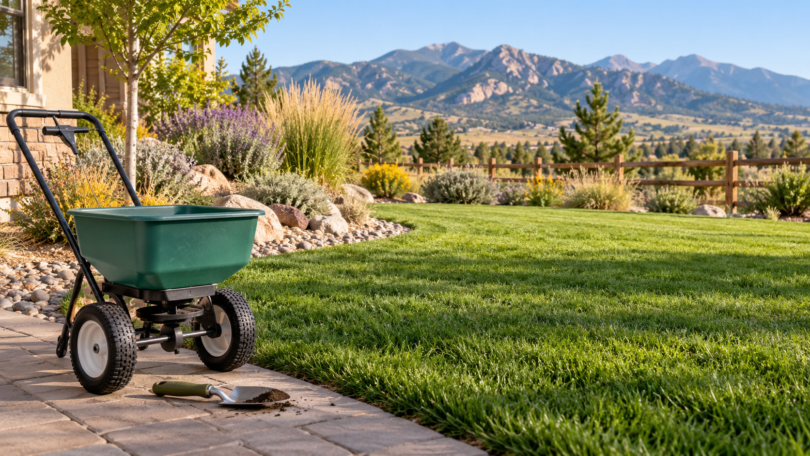

For an established Colorado lawn that needs nitrogen but not added phosphorus, Pennington Full Season Lawn Fertilizer 32-0-5 is a useful starting comparison. Milorganite 6-4-0 is a slow-release alternative when its added phosphate fits the soil’s needs, and Scotts Starter Food 24-25-4 is a separate option for a justified new-grass feeding. The right purchase depends on the grass, soil, recent feeding and available water.
These are label- and specification-based comparisons, not field-tested rankings. We have not measured lawn color, rooting or drought performance. Colorado State University Extension supplies the local turf guidance; it does not endorse the brands selected here.
Compare the current formula, not just the brand
The nitrogen figures below are calculations at the stated bag coverage: bag weight × nitrogen percentage ÷ coverage in thousands of square feet. They describe the amount applied, not a recommendation to fertilize every lawn at that dose. Compare the exact bag in the store with the formula and size shown here.
| Exact option | Analysis and documented bag coverage | Calculated nitrogen per 1,000 sq. ft. | When to consider it |
|---|---|---|---|
| Pennington Full Season Lawn Fertilizer | 32-0-5; 11.2 lb covers up to 4,000 sq. ft. | About 0.90 lb N | Established, actively growing turf when that nitrogen dose fits and added phosphorus is unnecessary |
| Milorganite | 6-4-0; 32 lb covers 2,500 sq. ft. | About 0.77 lb N | A biosolids-based slow-release choice when phosphate is also appropriate |
| Scotts Turf Builder Starter Food for New Grass | 24-25-4; 15 lb covers 5,000 sq. ft. | 0.72 lb N | New grass where a phosphorus-containing starter fits the soil recommendation |
| Scotts Turf Builder Lawn Food, SKU 23500: conditional comparison | 38-0-4; 12.64 lb at the standard 4,000-sq.-ft. rate | About 1.20 lb N | Only where the label and a lawn-specific nutrient plan agree; too much for many lower-dose CSU applications |
1. Pennington Full Season 32-0-5: phosphorus-free comparison
Pennington Full Season Lawn Fertilizer 32-0-5 contains 32% total nitrogen, with ammoniacal and urea nitrogen in its guaranteed analysis. The maker identifies polymer-coated urea for controlled release and 5% iron. Its 11.2-pound bag covers up to 4,000 square feet, equivalent to 0.896 pound of nitrogen per 1,000 square feet at that coverage.
This is the most straightforward phosphorus-free comparison here when an established lawn’s plan calls for roughly that dose. It is still more nitrogen than a 0.5-pound feeding. If your lawn needs less, do not guess a reduced spreader setting: choose a product with a suitable labeled rate or confirm a calibrated plan with the maker and local Extension office.
Pennington specifies actively growing turf, preparation by mowing and watering one to two days beforehand, and watering the product in afterward. Its package says one application per growing season and its product page identifies spring use. Treat the extended-release period as part of the season’s nitrogen budget; do not automatically add another bag at every date on a general schedule.
2. Milorganite 6-4-0: slow-release choice when phosphate fits
Milorganite 6-4-0 in the 32-pound bag supplies 6% total nitrogen: 4 percentage points are water-insoluble nitrogen and 2 are water-soluble. The guaranteed analysis also lists 4% available phosphate and 2.5% iron, with nutrients derived from biosolids. At its stated 2,500-square-foot coverage, one bag supplies about 0.77 pound of nitrogen per 1,000 square feet.
Consider it when the nutrient plan warrants phosphate and you prefer this nitrogen source. It is a weaker fit when phosphorus is already sufficient: CSU notes that phosphate fertilizer is unnecessary for lawns in most Western soils. Its low first number does not mean you can apply unlimited product without adding nutrients.
CSU explains that organic nitrogen sources generally release more effectively in warm, moist soil. That makes soil conditions part of the choice, especially for a late fall or drought-limited lawn. Count the full application toward your nitrogen plan, and do not assume a national brand calendar fits your Colorado elevation or turf.
3. Scotts Starter 24-25-4: a separate new-grass purchase
Scotts Turf Builder Starter Food for New Grass 24-25-4 is intended for planting or reseeding grass and installing sod, sprigs or plugs. The selected 15-pound bag covers 5,000 square feet. Its linked label gives 3 pounds of product per 1,000 square feet, which supplies 0.72 pound of nitrogen and 0.75 pound of available phosphate at the listed analysis.
Choose a starter because the establishment plan and soil needs justify it, not because an existing lawn looks pale. This is the fertilizer-only Starter Food, not the differently formulated Triple Action Built for Seeding weed-control product. Keep any nutrient already applied with seed or other products in the total.
The label permits application immediately before or after planting new grass and stresses keeping the soil surface moist during germination and early growth. A new lawn’s watering needs differ from established-turf care. Check that you can supply the necessary water before seeding and feeding.
The selected 15-pound manufacturer listing was marked out of stock when checked. That observation applies to this maker listing only; verify any retailer’s exact 24-25-4 bag and current availability before buying.
Scotts Lawn Food 38-0-4: check the higher dose carefully
The current Scotts Turf Builder Lawn Food SKU 23500 is 38-0-4 in a 12.64-pound bag. Its label lists 7.6 percentage points of slowly available nitrogen from polymer-coated sulfur-coated urea. At standard coverage of 4,000 square feet, the bag supplies about 1.20 pounds of total nitrogen per 1,000 square feet. The separate Max Greening coverage of 3,000 square feet raises that to about 1.60 pounds.
Those doses exceed many of CSU’s 0.5–1-pound seasonal entries, so this is a comparison to scrutinize rather than our default for a low-input lawn. A lower-rate instruction for certain other states is not a Colorado prescription. Obtain a lawn-specific plan if considering it; do not reuse settings from an older or differently formulated Turf Builder bag.
The current label calls for active growth, daytime temperatures consistently between 60°F and 90°F, dry turf at application and watering in afterward. It excludes the higher Max Greening rate above 80°F and on centipedegrass or zoysiagrass. These restrictions reinforce why a generic “apply in fall” instruction is insufficient.
Match Colorado timing to the actual grass
Use CSU’s established-lawn guidance as the local starting point and reconcile it with the product label. Record previous fertilizer and whether clippings are returned. A soil test is especially useful for deciding whether phosphorus or other nutrients are actually needed.
- Kentucky bluegrass, perennial ryegrass and turf-type tall fescue: follow their separate CSU rows. A spring feeding may be unnecessary after a late fall feeding if spring green-up and growth are satisfactory, and the table does not require nitrogen in July to early August. Fall decisions still depend on active green turf and local freezing conditions.
- Fine fescue: CSU gives an average annual need of only 1–2 pounds of nitrogen per 1,000 square feet, with higher needs in some circumstances. Summer feeding may reduce heat tolerance. Do not copy a high-maintenance bluegrass program.
- Buffalograss and blue grama: these belong to CSU’s warm-season group, with nitrogen concentrated in the May-to-early-August growing period. Its table calls for none in early spring or fall. An autumn winterizer promotion does not change that cycle.
- Elevation and freezing: CSU’s bluegrass fall guidance places lower-elevation feeding in late September through early November, earlier in the mountains. The final fall application should be while grass remains green and at least two to three weeks before the ground freezes.
- Sandy soil and clippings: CSU favors slow-release nitrogen on sandy soils and advises no fertilization after late September on very sandy sites. Returning clippings can reduce nitrogen needs by roughly one-quarter to one-third. Adjust the nutrient plan, not an uncalibrated spreader dial.
Water availability can change the buying decision
Check irrigation restrictions and fall shutoff dates before buying. CSU’s fall drought guidance distinguishes green, actively growing lawns from long-dormant brown lawns and explains that water cutoffs can change or eliminate the benefit of a fall application. If you cannot meet the exact product’s growth and watering conditions, postpone the application and resolve the plan locally.
Keep fertilizer away from water, storm drains and drainage ditches, avoid an application before heavy rain, and sweep granules off paving back onto the lawn. The selected labels include these precautions. Fertilizer should not be bought as a fix for every brown patch; check water delivery, soil and the lawn’s actual condition first.
Frequently asked questions
What is the best all-around fertilizer for Colorado?
There is no statewide formula that fits every lawn. Pennington Full Season 32-0-5 is a useful phosphorus-free comparison when its roughly 0.90-pound nitrogen dose suits the plan. Milorganite and Starter Food contain phosphate, so select them for a justified nutrient need.
Is a bigger first NPK number better?
No. It indicates nitrogen concentration, not the right dose for your lawn. Compare total nitrogen delivered per 1,000 square feet. Here the standard new Scotts 38-0-4 bag coverage delivers about 1.20 pounds, versus about 0.90 from the selected Pennington 32-0-5 bag.
Should I use weed-and-feed?
For a feeding-only purchase, choose fertilizer without a weed-control ingredient. A separate weed problem needs correct identification and a product labeled for that weed and your turf species. This comparison does not provide pesticide selection, mixing or application instructions.
Can I fertilize buffalograss in fall?
Do not borrow the cool-season fall program. CSU’s established-lawn table calls for no fall nitrogen for buffalograss and blue grama; their feeding window is during warm-season growth.
Should I fertilize a brown lawn before winter?
First determine whether it is dormant, drought-stressed or damaged, and whether irrigation is available. CSU’s drought guidance says long-dormant brown lawns receive little or no immediate fall benefit. Follow the actual product’s active-growth requirement and ask local Extension for a plan when the lawn’s condition is uncertain.
