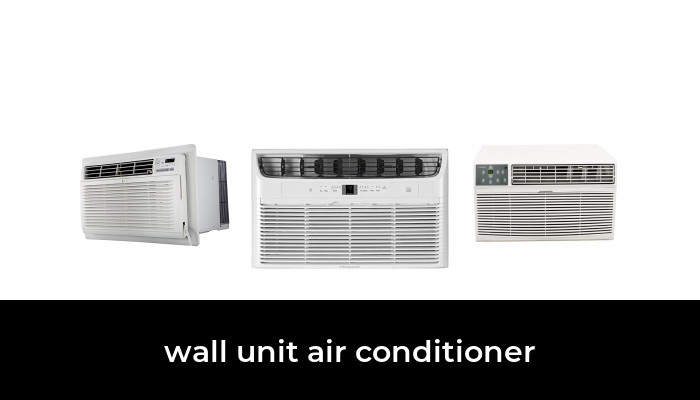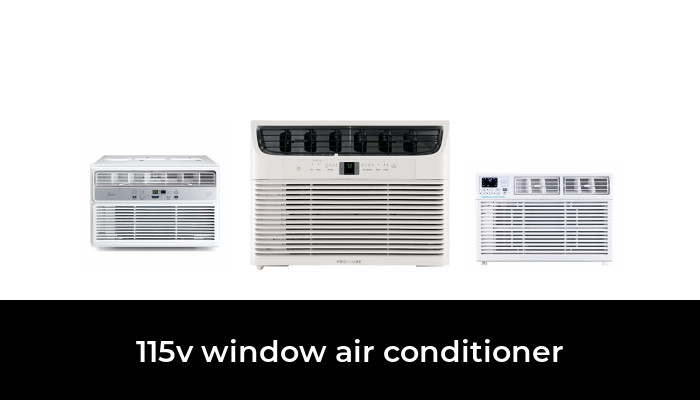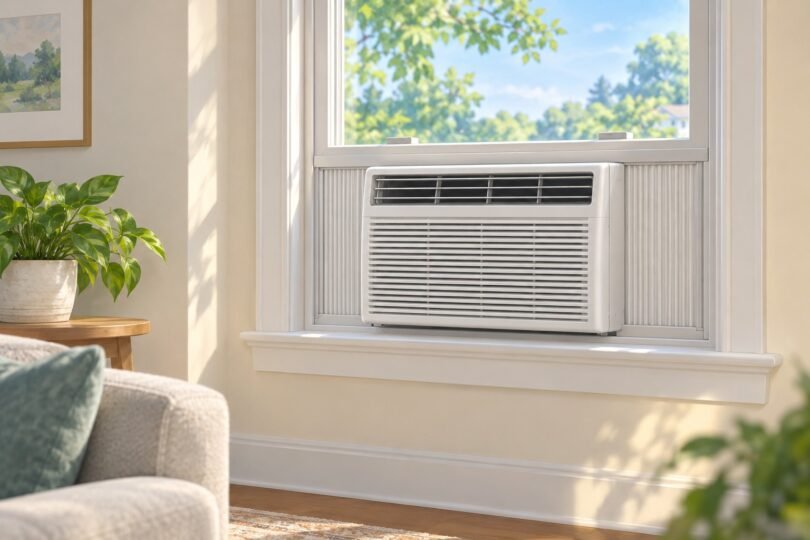

The LG LW1217ERSM is a 12,000 BTU window air conditioner with Wi-Fi, a handheld remote and an estimated cooling area of up to 550 square feet. If you already own one, or are considering an older, used or open-box unit, the important questions are whether it fits your window, suits your room and is in serviceable condition.
Quick take: consider this model only after checking the full model label, the installation hardware and the electrical supply. A familiar model name or an attractive asking price does not establish that an older unit is a good purchase. The similarly named LW1217ERSM1 is a separate model and should not be substituted when checking specifications or ordering parts.
LG LW1217ERSM specifications at a glance
These are U.S.-model figures from LG’s LW1217ERSM specification sheet. Dimensions and weight are approximate; use the appliance label and matching manual for your particular unit.
| Specification | LG LW1217ERSM |
|---|---|
| Cooling capacity | 12,000 BTU/h |
| Estimated room coverage | Up to 550 sq. ft. |
| Electrical rating | 115 V, 60 Hz; 990 W cooling; 9.3 A rated current |
| Cabinet dimensions, W × H × D | 23 5/8 × 15 × 22 3/16 inches |
| Net weight | 81 lb |
| Listed efficiency | CEER 12.0; EER 12.1 |
| Controls | Electronic panel, remote and Wi-Fi |
| Fan settings | Three cooling fan speeds and three fan-only speeds |
| Other features | 24-hour on/off timer, automatic restart, four-way air direction and filter reminder |
Cabinet size is not the required window opening. Installation needs additional width for the side panels and enough vertical clearance for the frame and sash.
Will 12,000 BTU cool your room?
The 550-square-foot figure is a sizing estimate, not a guarantee for every home. ENERGY STAR’s room-sizing guidance places 12,000 BTU/h in the 450–550-square-foot range using an eight-foot ceiling as the starting point.
Measure the space you actually want to cool. A 22-by-25-foot room is 550 square feet, but a room opening into a hallway or kitchen may present a larger cooling load. Strong sun, high ceilings, heat-producing appliances and extra occupants also change the calculation.
- For a very sunny room, the ENERGY STAR guide adds 10% capacity.
- For a heavily shaded room, it subtracts 10%.
- It adds 600 BTU/h for each regular occupant beyond two and 4,000 BTU/h for a kitchen.
A smaller bedroom may need a smaller unit. Oversizing can cool the air before enough moisture has been removed, leaving an uncomfortable, clammy room. For an unusual layout or a persistently hot space, get a sizing assessment rather than choosing solely from floor area.
Window fit, support and electrical requirements
The official LG manual and support page should be the installation reference. The manual lists a standard double-hung window opening 27–39 inches wide with at least 16 inches of clear height. Measure the opening itself, not the outside trim. A sideways-sliding or casement window needs a different solution.
This is a heavy, slide-out-chassis appliance. Have a qualified installer assess the window, sound supporting structure, sill supports, locking bracket and sealing materials. Missing hardware is a reason to obtain the correct replacement kit before installation. The side curtains do not replace the specified supports. Follow building rules and keep required escape routes clear.
LG specifies an outward tilt of about half an inch, unobstructed exterior cabinet louvers and more than 20 inches of clearance behind the cabinet. The installer should follow the full manual, including any storm-window requirements. Do not improvise a wall-sleeve installation or balance the unit on an unsuitable sill.
Although the specification sheet calls it a 115 V appliance, the manual describes a grounded 120 V, 15 A receptacle and a dedicated circuit with the specified protection. Have an electrician verify the circuit and grounding if either is uncertain. Plug directly into the suitable wall outlet. Do not use an extension cord, power strip, surge protector or grounding adapter, and never remove the ground pin or bypass the protective plug.
Remote control, Wi-Fi and everyday operation
The handheld remote and the front panel provide ordinary cooling controls without requiring phone setup. The manual describes Cool, Fan, Dry and Energy Saver modes. Fan mode circulates air without running the compressor; Dry mode uses a fixed low fan speed. In Energy Saver mode, the unit can stop and restart its fan while checking whether more cooling is needed.
LG’s original model sheet describes smartphone adjustment of temperature, schedule, mode and fan speed under the former SmartThinQ name. The current app is LG ThinQ. The manual specifies a 2.4 GHz Wi-Fi network; a 5 GHz-only connection will not meet that requirement.
Follow the current app’s pairing instructions and check compatibility with your phone and the exact unit before paying extra for smart features. Old packaging can mention integrations that have since changed. App services and available functions can vary, so do not assume every historical voice-control or connected-home claim still applies. Test the remote and front-panel controls separately from Wi-Fi when inspecting a used unit.
Efficiency claims need a date and an exact model
There is a notable difference between LG’s documents: the original 2017 LW1217ERSM sheet lists ENERGY STAR qualification, while the exact-model sheet dated October 2023 lists it as “No.” Both show CEER 12.0 and EER 12.1. An old ENERGY STAR badge is therefore insufficient evidence of current certification or rebate eligibility.
For a purchase, check the actual unit’s EnergyGuide label, the current certification listing and your utility’s rules. The rated wattage is not a prediction of your bill: operating hours, compressor cycling, thermostat setting, room heat gain and local electricity rates all affect cost. No particular saving can be promised from the model number alone.
What to inspect before buying an older unit
- Identity: request a clear photo of the full model and serial label. Match the suffix when asking LG about parts, manuals or service.
- Condition: inspect for a damaged cabinet, significant corrosion, missing panels, a dirty or damaged filter, unusual odors and damage to the cord or plug. Do not operate a damaged appliance to see whether it still works.
- Completeness: confirm the correct side panels, sill supports, locking hardware, remote and seals. Find out whether missing parts are available before committing.
- Operation: for an intact, safely installed unit, ask to see cooling, each fan speed, the controls and the remote working. A brief demonstration cannot establish remaining compressor life or replace a technician’s inspection.
- Terms: get the seller’s return policy and any warranty in writing. Include installation, replacement hardware and possible service in the total cost.
LG’s support page lists a one-year parts-and-labor limited warranty for this model, subject to its terms. Do not assume that an older or secondhand purchase comes with fresh manufacturer coverage. Ask LG about eligibility using the serial number and proof of purchase.
Filter care and when to call for service
Check the filter at least every two weeks during use, and sooner in dusty conditions. Turn the appliance off, disconnect power and wait for the fan to stop before cleaning. Use the model manual’s removal method. LG’s filter-care guidance calls for lukewarm water below 104°F and a fully dry filter before reuse. Avoid sharp metal fins, spraying the appliance or opening electrical compartments.
The Clean Filter light is a timed reminder, not a measurement of filter cleanliness. The manual says it appears after 250 operating hours. Once the filter is clean and reinstalled, reset the reminder using the temperature-up and temperature-down buttons together on the unit’s control panel.
For weak cooling, start with the selected mode, temperature setting, filter and blocked airflow. If those checks do not resolve it, arrange service. Indoor water leakage, repeated protection trips, persistent icing or severe vibration also need investigation. If there is smoke, a burning smell or visible electrical damage, stop using the unit and disconnect power only if safe; seek qualified help.
Some condensate in the outdoor base pan can be normal: the unit uses a slinger fan to move that water over the condenser. Do not drill drainage holes or alter the sealed refrigerant system. LG lists R32 refrigerant for this model and requires appropriately trained service personnel. Internal cleaning, cord replacement and refrigerant work belong with qualified service providers.
Check safety notices using the full model and serial number
Before buying or reinstalling an older air conditioner, review CPSC recall notices and LG’s public safety notices. The LG portable-air-conditioner recall notice reviewed for this guide names LP0711WNR, LP0813WNR and certain LP0814WNR units, rather than LW1217ERSM.
That distinction is not an exhaustive recall clearance or proof that an individual appliance is safe. Ask LG to check your exact model and serial number if its history is uncertain, and follow any applicable stop-use notice.
Similar LG models are separate purchase options
If you are comparing a legacy listing with other units, start with the full model number. LG has separate official pages for the LW1217ERSM1 and LW1223ERSM, both described as 12,000 BTU Wi-Fi window models for up to 550 square feet.
Those pages are useful comparison starting points, not confirmation of local stock or an identical fit. Compare each candidate’s own installation manual, power requirements, efficiency label, warranty and return terms. Do not transfer the original LW1217ERSM’s weight, sound figures, parts or energy data to a similarly named model.
Bottom line
The LW1217ERSM can be a sensible unit to keep using when it is correctly sized, securely installed and working properly. For an older purchase, prioritize condition, complete hardware, verified electrical suitability and meaningful return protection. If the installation is unsuitable or repairs are uncertain, compare the full cost with another correctly sized model before buying.