
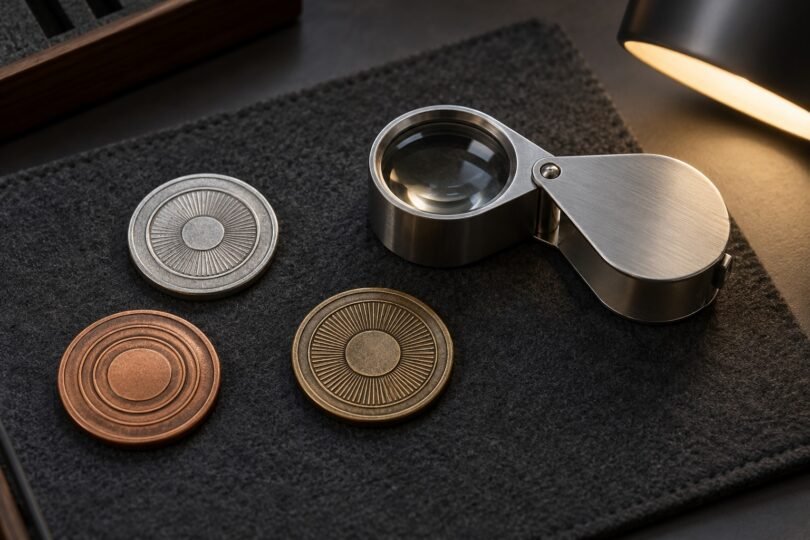

The best magnifying glass for coins is usually a clear, manageable loupe in the 5×–10× range, used under lighting you can control. Start with enough magnification to read a date, mint mark, or surface detail comfortably. A huge advertised number is less useful if you can only see a tiny patch of the coin or struggle to hold it in focus.
For portable inspection, consider a folding optical loupe. For a steadier tabletop view, look at a stand magnifier. A digital microscope earns its place when you want to save images or show a detail on a screen. The choices below are based on published specifications and documented designs, rather than hands-on optical testing.
Choose the format before the magnification
- At a coin show or shop: a folding loupe is compact and lets you inspect a coin while changing its angle under the light.
- At a desk: a stand loupe supports the lens, reducing the need to hold both the magnifier and coin steady.
- When the room is dim: an illuminated, focusable loupe supplies its own light, although an adjustable desk lamp gives you more freedom to change lighting direction.
- For records and discussion: a digital microscope makes it easier to save close-ups, but the image needs context and does not authenticate a coin.
Coin magnifiers worth considering
Eschenbach 1184-10: a folding loupe for portable detail checks
Eschenbach’s 1184-10 is the 10× version of its Metal Precision Folding Magnifier. Its achromatic lens design addresses color fringing, and the black metal lens frame folds into a chrome-plated brass handle. The manufacturer’s technical catalogue specifies a 15 mm lens for the 10× model; the related 20× model has different specifications.
Choose it for: a compact optical tool to carry alongside a reference book or checklist. Consider the limitation: the small lens is intended for close inspection, not an expansive tabletop view. You still need a steady hand and suitable external lighting. Achromatic is the documented lens type here; do not assume that every retailer’s “triplet” description refers to the same construction.
See Eschenbach’s folding magnifier specifications and its technical lens-size catalogue.
Carson LumiLoupe LL-77 and LL-10: two straightforward desk options
The LL-77 is a 7× pre-focused stand loupe with a 1.75-inch lens. Its clear acrylic base admits ambient light. That combination makes it a sensible starting point for someone who wants to rest the magnifier on a desk instead of continuously holding it near an eye.
The LL-10 provides 10× magnification through a smaller, 1-inch lens. Choose that version when closer inspection of a particular feature matters more than the larger lens opening. These lens diameters describe the optics, not the exact area of coin visible through them. Neither specification guarantees a whole silver dollar will fit in view.
Important distinction: both use pre-focused dual lenses and ambient light. The LL-10 is not the LL-20 model with a measuring reticle. Carson’s LL-10 instructions advise starting on a flat surface, keeping the eye reasonably close, and raising the loupe as needed to focus. Check clearance around the coin or holder so the base cannot scrape the surface.
Carson LumiLoupe LL-77, 7×, 1.75-inch Lens, Clear, 1 Count
As an Amazon Associate we earn from qualifying purchases.
Carson LED VersaLoupe LH-50: adjustable focus with built-in light
The Carson LH-50 adds a focusing ring and five LEDs to a 10× dual-lens stand design. The listed lens diameter is 1 inch, and it uses one CR2032 battery. The focus adjustment is useful when the inspection surface sits at a different height, such as a coin viewed through a protective holder.
Choose it for: short desk inspections where available light is inconsistent. Consider the limitation: built-in illumination does not replace changing the coin’s angle. Reflections from a shiny coin or slab can still obscure detail. Keep replacement button batteries secured away from children, and follow the manufacturer’s battery and care instructions.
Celestron Handheld Digital Microscope Pro: for saving close-up images
The Celestron Handheld Digital Microscope Pro, item 44308, pairs a 5-megapixel sensor with an adjustable stand, USB computer connection, and adjustable LED illumination. Celestron advertises 20×–200×, explicitly noting that final magnification depends on monitor size. That number is not directly comparable with a handheld optical loupe’s power.
Choose it for: documenting a small feature or discussing a close-up with another collector. Consider the limitation: it needs a compatible computer and software, and a tight detail view is not a full-coin photograph. Check the exact hardware revision before downloading software: Celestron distinguishes the original 44308 from the 44308-B. Confirm current operating-system support for the version offered.
What magnification is useful for coins?
PCGS describes 5×–10× as common working magnification among graders and collectors. That is a practical starting range, not a promise that one power suits every eye or collecting specialty. Begin with an overall view, then magnify the particular feature you are trying to understand.
Higher power has tradeoffs. Edmund Optics explains that field of view and depth of field decrease as magnification increases. A high-power loupe also typically brings the object closer to the lens. You may see less of the design at once and need finer movement to maintain focus.
Keep three specifications separate: lens diameter is the physical opening; field of view is the area you can see; working distance is the space between lens and object. A large housing, an impressive LED count, or a “30×/60×” label does not establish useful resolution. Check which lens provides each power and whether you can comfortably use the main lens for your intended task.
Does “triplet” make a loupe better?
A triplet is a compound lens made from three cemented elements, not simply three separate flip-out magnifiers in one case. Multiple-element designs can correct optical aberrations that interfere with fine detail. Edmund Optics describes triplets as offering a flatter, better-corrected view than simple lenses.
Still, the label alone is not a comparative test. Look for a named model, a documented lens design, and clear specifications. Treat claims such as “distortion-free” as manufacturer descriptions unless independent measurements are supplied. Before keeping a purchase, check whether fine printed lines stay usable across the viewing area and whether the focus position feels comfortable. This is a practical acceptance check, not a calibrated optical test.
A careful inspection routine
- Prepare a safe area. Work over a clean, soft surface. Keep coins in protective holders when possible. The American Numismatic Association advises handling raw coins by their edges, avoiding finger contact with the faces.
- Look without magnification first. Identify the overall design and choose a specific question: an unclear date, a mark beside a letter, or a change in the surface.
- Bring a handheld loupe close to your eye. Move the coin toward the lens until it focuses, rather than holding the magnifier at arm’s length. A stand loupe needs a different posture: support it safely and bring your eye toward the viewing lens.
- Change the lighting angle. Gently rotate and tilt the coin while maintaining a secure edge grip. PCGS emphasizes rotation because a single angle can conceal surface marks. Avoid interpreting one bright reflection as a defect.
- Record observations before conclusions. Save an overall photograph alongside any detail image, then compare with an appropriate reference. A loupe cannot by itself establish authenticity, a professional grade, or value.
Care for the lens without cleaning the coin
Keep the loupe covered when stored and follow its lens-care instructions. For the LL-10, Carson specifies a microfiber lens cloth and says to avoid abrasives, chemical cleaners, and solvents. Do not transfer that cleaning routine to a coin.
Do not polish or rub a collectible coin to improve the view. The ANA’s coin-care guidance warns against routine cleaning. If deposits prevent examination, seek knowledgeable conservation advice rather than experimenting with household cleaners. Better lighting, a comfortable viewing position, and a suitable reference are safer first steps than more magnification or a brighter-looking coin.


