
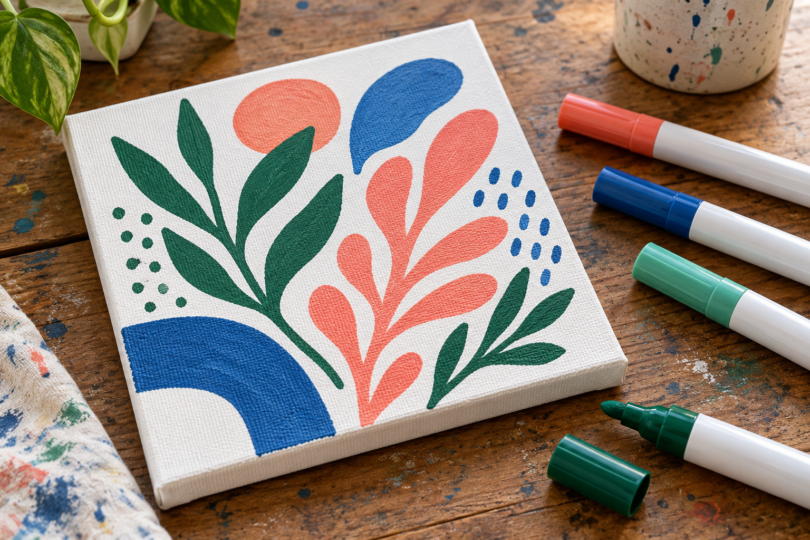

For painting on a primed artist’s canvas, start with POSCA PC-5M for outlines and modest areas of color, POSCA PC-3M for smaller details, or Sharpie Creative Brush Tip for expressive strokes. The useful difference is the nib and paint system, not the largest number of markers on the box.
These picks are for canvas artwork. A washable coloring marker, a conventional permanent marker and a fabric laundry pen are different tools. If your project is a tote bag, shoe or garment that must survive washing and flexing, check that specific textile application before buying.
Best markers for canvas
1. POSCA PC-5M, 8-count round-tip set: best starting set
The PC-5M 8-count set, model PC5M8C, is the most straightforward starting point here. Its medium bullet nib is rated at 1.8–2.5mm, making it a useful choice for outlines, lettering and filling smaller shapes. POSCA uses opaque, water-based pigment paint; the PC-5M tip is washable, reversible and replaceable.

POSCA PC-5M Water-Based Paint Markers, Medium Round Tip, 8 Count
As an Amazon Associate we earn from qualifying purchases.
The selected pack contains eight markers, not the brush-tip or larger-count variants offered on the same product family page. The medium nib provides a broader working line than PC-3M, so choose it first for simple designs on a small canvas.
Trade-off: this is still a marker nib, not a wide paintbrush. For a large background, a brush and bottled paint are usually a more practical format. Use PC-3M for small lettering or fine ornament rather than trying to force a medium nib into every detail.
2. POSCA PC-3M, 8-count fine-tip set: best for details
Choose the PC-3M 8-count assorted set, model PC3M8C, when narrower lines matter more than covering an area quickly. Its 0.9–1.3mm bullet nib and slimmer barrel suit outlines, decorative patterns and small accents. It uses the same water-based POSCA paint approach, with a washable, reversible and replaceable tip.

Trade-off: filling a background with a fine nib takes more strokes, and a rough canvas weave can make a tiny line harder to control. For detailed lettering, test on the same primed texture before committing to the final piece. A fine nib does not guarantee a perfectly smooth line on every canvas.
The exact selection is one eight-marker pack. Do not confuse a retailer’s “number of items: 1” field with a single marker; here the selected eight-count variation, model number and package photo agree on the contents.
3. Sharpie Creative Brush Tip, 12-count assorted: best for brush-style strokes
The Sharpie Creative water-based acrylic brush-tip set, item 2196907, contains 12 markers. Its flexible brush tip offers a different mark-making approach from the POSCA bullet nibs, making it the option to consider for varying stroke widths and brush-style lettering.
Sharpie explicitly lists canvas among the supported surfaces. These markers do not require pump priming; uncap and use them, then store horizontally as Sharpie recommends. Choose this exact Creative acrylic range rather than assuming ordinary black Sharpie permanent markers use the same ink.
Trade-off: the brush shape gives a variable line rather than the nominal fixed nib widths above. Sharpie’s product page does not provide a numbered full-cure schedule for canvas. Do not treat it as a guarantee of laundry, prolonged soaking or outdoor durability. Sharpie’s consumer-care guidance also says this range is not specifically formulated as a fabric marker and may fade or wash out on clothing.
Check the Sharpie Creative Brush Tip 12-count set, including the selected tip and pack size.
How to choose the right marker for your canvas
Match the surface, then the nib
Primed stretched canvas, raw cotton fabric and a glossy varnished painting are not equivalent surfaces. POSCA’s canvas instructions call for a properly primed canvas before drawing. A sealed or heavily coated painting may behave differently from that starting surface, so test your actual layers on a spare piece.
Choose PC-5M for a general-purpose medium line, PC-3M for smaller marks, and the Sharpie brush tip for a more variable stroke. Think about the smallest detail in the design. If most of the project is a large block of color, markers may be best reserved for the outlines and finishing details.
Prime the marker away from the artwork
POSCA’s user guide says to shake the capped marker, then press the nib on spare paper until it fills with paint. Make a test stroke to remove excess paint before touching the canvas. If flow slows, recap, shake and re-prime on the spare paper.
That pump procedure is for the POSCA markers here. It is unnecessary for the Sharpie Creative brush markers. Mixing up the two systems can lead you to press harder when what you need is the correct preparation method.
Allow each layer to dry
POSCA describes drying as taking a few minutes at most under its general guidance, with the surface affecting the time. Check that your actual layer is dry before drawing over it. Wet POSCA can be mixed or worked with water; once dry, another layer can cover it.
Dry-to-the-touch, ready for another paint layer and ready for a protective coating are different decisions. Do not assume that every marker, primer and varnish combination has a 24-hour cure time. Follow the coating manufacturer’s instructions and test the complete combination on a spare sample first.
Are canvas paint markers permanent and waterproof?
POSCA describes its results on properly prepared canvas as permanent and says a special fixative is not required. It suggests an optional water-based spray varnish to help preserve the work, applied from about 30cm away in slow circular movements. Let the artwork dry and check the varnish instructions before applying it.
That is not a promise that every painted object is washable, dishwasher-safe or unaffected by prolonged water exposure. POSCA’s own guidance distinguishes porous surfaces, where the paint is permanent, from many smooth non-porous surfaces, where it can be removed. The substrate and topcoat matter. Do not transfer a canvas instruction to a glass, garment or outdoor sign.
For artwork you want to keep, make a small sample with the same primer, paint layers and intended coating. Check the appearance and whether the coating disturbs the marks before applying it across the finished canvas. A marker’s “water-based” label describes its formulation; it does not by itself settle the finished work’s water resistance.
Which set should you buy?
Choose the eight-count PC-5M if you want one general starting set. Add the eight-count PC-3M when your designs need finer detail. Choose the 12-count Sharpie Creative brush set if variable brush strokes and no pump priming suit the way you draw. Buy the nib and colors you need, prepare the canvas properly and test any protective finish.
