
A good metal suit of armor starts with a clear job: something to wear, a full-size display, or a small collectible. For a costume or historical impression, prioritize fit, movement and the maker’s intended use. For a room display, prioritize the assembled dimensions, stand and delivery arrangements. A shiny photograph and the word “wearable” do not answer either set of questions.
This guide compares published manufacturer information and practical buying considerations. Costume armor is not evidence of protection against weapons or impacts. For any organized activity, get the maker’s confirmation of the intended use and the event organizer’s approval before buying; a costume listing is not a substitute for activity-specific equipment requirements.
Choose the right kind of metal suit
- Wearable costume or LARP armor: Look for a size chart, clear material specification, adjustable closures and an itemized component list. Check the event’s rules first: Epic Armoury’s buying advice notes that some games restrict metal armor.
- Historical reenactment armor: Decide on the period and activity before choosing a silhouette. A visually convincing outfit and equipment accepted for a particular reenactment activity are separate requirements. Discuss both with the maker and your group.
- Decorative armor: Treat it as a large display object unless the manufacturer explicitly supports wearing it. Articulated parts alone do not establish wearable fit.
- Collector figures: “Metal suit” searches also return fictional mobile suits. Those belong in a separate shopping category with scale, edition and accessory compatibility as the main concerns.
For example, Bandai’s METAL BUILD Gundam Exia – Store Limited Edition is approximately 180 mm tall and uses ABS, PVC and die-cast parts. It is a display figure, and “metal” does not mean every component is metal. Check whether a collector listing contains the main figure or only an option set.
Three useful starting points
Epic Armoury Milanese Complete Armour: a coordinated costume set
The Milanese Complete Armour is worth comparing if you want coordinated metal pieces for a LARP character rather than selecting everything individually. The maker specifies 1 mm mild steel with full-grain leather straps and fittings. Its component list covers a breastplate, pauldrons, faulds and tassets, and elbow guards.
The important limitation is in that list: “Complete” is the product name, not a promise of head-to-toe coverage. Budget separately for the clothing and padding you need, and confirm any additional helmet, hand or leg pieces. Select the correct size and finish before comparing weights or ordering. The maker’s LARP positioning does not establish suitability for other activities.
ArmStreet Gothic Armour Knight Kit: a made-to-measure option
The third-generation Gothic Armour Knight Kit is a more involved route for buyers seeking an articulated, historically inspired harness. The page offers mild or stainless steel and different polish options. Its detailed specification lists 1.5 mm stainless steel, with 1 mm used in smaller articulated areas; confirm specifications for your selected configuration.
The itemized kit includes a gorget, cuirass with tassets, pauldrons, arm harness, demi-legs, full-wrap greaves and sabatons. Helmet and gauntlets appear as extras. Because the introductory description also mentions gauntlets among the pieces, get a written contents list with your quote. This is a custom-order conversation, particularly if you have a fixed event date or need compatibility with existing equipment.
Marto Armadura Medieval Lisa: a full-size display reference
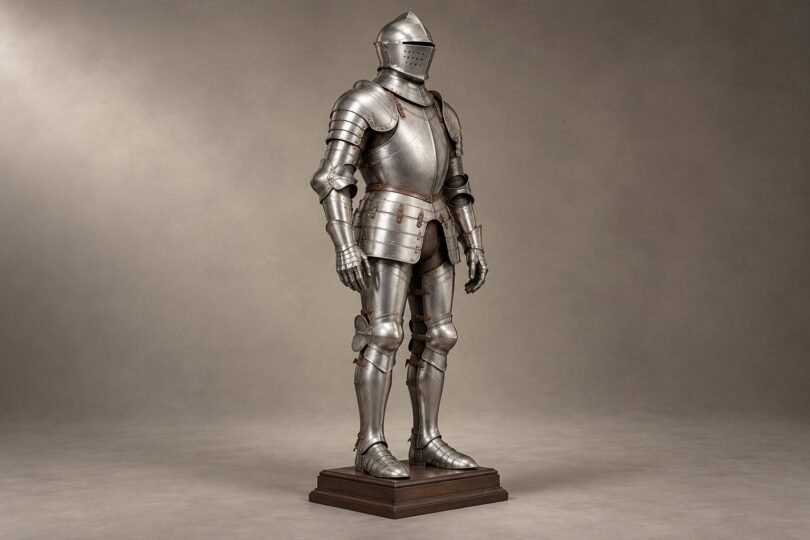
For a decorative centerpiece, compare Marto’s Armadura Medieval Lisa. The official catalog describes a 200 cm full-size reproduction with articulated pieces, a blue skirt and an included pedestal. That makes the dimensions and display arrangement more useful starting points than clothing sizes.
Marto’s catalog uses a quotation process rather than ordinary online checkout. Ask for the assembled width and depth, total weight, pedestal footprint, packing and delivery details. Do not infer that a decorative reproduction fits a person simply because it has movable joints. Confirm whether the stated height includes the base before planning its location.
Material and gauge: what the numbers actually tell you
Mild steel, stainless steel and tempered spring steel are different specifications, not interchangeable quality labels. Ask for the alloy or material description, thickness and finish together. Stainless steel generally demands less corrosion care than mild steel, but its name does not establish impact protection. A polished or darkened finish describes appearance, not a safety rating.
Gauge is a thickness convention. Within the same gauge system, a lower number generally means thicker sheet, but the measurement depends on the material and standard. Continental Steel’s gauge chart gives separate columns for sheet steel, stainless steel and aluminum. Ask for millimeters rather than assuming that every “18-gauge” listing is directly comparable.
Thickness alone is also an incomplete explanation of weight. A torso-only set and a head-to-toe harness can use similar sheet thicknesses yet have very different total weights. Record the actual wearable weight for your size, plus any separate helmet, padding and footwear. Do not confuse shipping weight with what you will carry on your body.
Fit and movement matter more than a dramatic photo
A height range or “one size” label cannot capture torso length, shoulder shape and limb proportions. Follow the individual maker’s measurement method, ideally with another person helping. ArmStreet’s custom-order guide specifically recommends measurements with and without the intended gambeson, so the maker can account for the layers.
- Ask which measurements control the fit and how much adjustment the straps actually provide.
- Confirm how the pieces attach to each other and to any required undergarments.
- Ask about ordinary movement: sitting, bending elbows and knees, turning your head and reaching forward.
- Find out whether you will need assistance dressing and removing the suit.
- Clarify the remedy for a sizing problem before ordering, especially with custom-made pieces.
Historical armor was not universally immobile. The Metropolitan Museum of Art explains that well-fitted plate armor distributed its weight around the body and used articulated elements. That historical observation does not guarantee comfort or movement in a modern replica. Judge the specific design, measurements and intended use.
Check the stand, assembly and delivered cost
For a display, measure the full footprint rather than only the advertised height. Leave room around projecting shoulders and feet, and keep the display clear of door swings and busy walkways. Ask whether the supplied stand is intended for that exact suit and whether the maker specifies any stability or installation precautions.
Get assembly instructions before delivery. Check whether the armor arrives on its stand, in sections, or in multiple cartons, and whether two people are needed to handle it. For a wearable purchase, establish whether a stand is included at all; a photographed pedestal can be a studio prop.
Compare the complete quote: armor, necessary clothing, missing components, stand, shipping and any import charges. Ask about production time separately from transit time. Also confirm delivery access requirements, damage-reporting deadlines, return shipping responsibility and custom-order cancellation or return restrictions. A large box that can reach your front door may still be awkward to move upstairs.
Plan for care before buying
Choose a finish you are willing to maintain. Epic Armoury’s care guide highlights the rust risk from moisture on mild steel and the need to dry metal equipment before storage. Follow the instructions for the actual finish and leather components rather than applying a generic polish to everything.
After wear, remove moisture as directed and let the pieces dry fully. Store them in a dry location and check straps, fastenings and surfaces before the next outing. Ask the manufacturer which protective product is suitable and how it should be applied. If you find a damaged fastening, sharp edge or binding joint, stop using the piece and contact the maker rather than modifying it yourself.
Before you place the order
You should be able to answer five questions: What is this suit intended for? Will this exact configuration fit? What is included? What will the complete delivered setup cost? What happens if it arrives damaged or does not fit? If the listing cannot answer them, ask for a written specification or keep looking. Clear information is more valuable than a long list of impressive-sounding claims.