
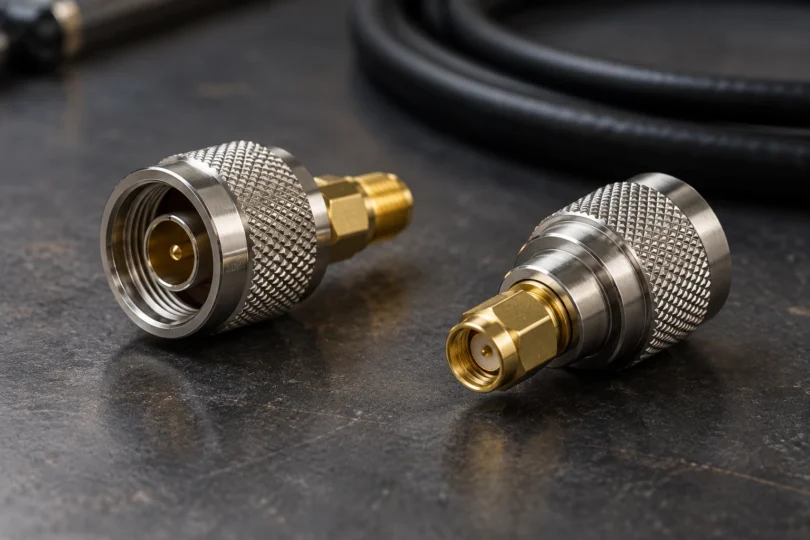

The right N-type male to SMA male connector has a standard male plug at each end and specifications that cover your equipment. Start with the Pasternack PE9080 when you want a compact adapter with published dimensions and VSWR. The Amphenol RF 242114 is a useful alternative when you prefer an Amphenol part available through electronics distributors. Both are straight, 50-ohm adapters rated to 11 GHz.
These are rigid adapters for joining compatible female connections. A cable assembly adds length and flexibility, while an RP-SMA adapter changes the center-contact arrangement. Those differences matter more than an adapter’s color or a long list of advertised radio brands.
The two adapters at a glance
| Adapter | Documented specifications | Best reason to choose it | Check before ordering |
|---|---|---|---|
| Pasternack PE9080 | 50 ohms; DC–11 GHz; maximum VSWR 1.3:1; 32.51 mm long | A published size and electrical specification for planning a compact connection | Both ports must accept standard male plugs |
| Amphenol RF 242114 | 50 ohms; 11 GHz maximum; nickel-plated brass body | An exact Amphenol part number for distributor purchasing | The manufacturer lists its IP rating as “Not Rated” |
1. Pasternack PE9080: the straightforward first choice
The PE9080 has standard-polarity SMA male and N male interfaces in a straight body. Pasternack’s PE9080 datasheet specifies 50-ohm impedance, operation from DC to 11 GHz and a maximum VSWR of 1.3:1. Its listed length is 1.28 inches (32.51 mm), with a width of 0.787 inches (19.99 mm).
That dimensional information is useful beside a recessed connector or a crowded equipment panel: compare the adapter envelope with the available space, including room to turn the coupling. The body is nickel-plated brass with gold-plated brass contacts. Those are construction details, rather than proof that it will improve reception.
Choose it if: you need this exact male-to-male connection and its published size fits your installation. Trade-off: it provides no flexible span between equipment and cable, and its 11 GHz limit should not be replaced with a higher rating borrowed from a different SMA product.
2. Amphenol RF 242114: an alternative for distributor orders
Amphenol identifies the 242114 as a straight N-type plug to SMA plug adapter. Its manufacturer specifications list 50-ohm impedance, an 11 GHz maximum frequency, a nickel-finished brass body, gold-finished brass contacts and PTFE insulation. It is not a panel-mount part.
The practical difference from the PE9080 is the purchasing and documentation route. If you are already ordering components through a distributor, an exact manufacturer part number is easier to match than a marketplace listing covering several connector combinations. Amphenol also explicitly lists this part as having no IP rating, so do not treat its metal construction as evidence of weatherproofing.
Choose it if: you want an identifiable Amphenol component for a compatible 50-ohm setup. Trade-off: it has the same 11 GHz ceiling as the PE9080; the available specifications do not establish a performance winner between them.
Check the exact Amphenol RF 242114 at DigiKey.
How to avoid ordering the wrong connector
Check the center contact as well as the thread
A standard SMA male plug has a center pin and threads inside its coupling. An RP-SMA male plug has a center socket with the same inside-threaded arrangement. A standard SMA female jack has a socket, whereas RP-SMA female has a pin. Campbell Scientific’s connector guide illustrates these distinctions. A listing that merely says “SMA” or “fits Wi-Fi” is not enough to confirm compatibility.
For either pick here, verify that the equipment presents a standard SMA female connection and a compatible 50-ohm N female connection. Match both ends against the equipment manual before buying; a familiar brand name on a compatibility list cannot replace the actual port specification.
Separate an adapter from a cable assembly
Choose a rigid adapter when the connections can meet at one point. If you need to bridge a gap, route around a case or avoid hanging a heavy cable directly from a small port, look for a cable assembly with the required ends. Then compare its length, cable type and manufacturer-specified loss at your operating frequency. The adapter specifications above do not describe any cable assembly.
Use the exact part’s limits
Check impedance, operating frequency, installation clearance and environmental requirements together. An adapter that screws on still needs to meet the electrical requirements of the complete setup. For exposed installations, obtain a documented sealing solution appropriate to the equipment instead of assuming a threaded connection is waterproof.
Which should you buy?
Choose the PE9080 when its documented dimensions and VSWR match your requirements. Choose the 242114 when the Amphenol part and distributor route fit your order. If your equipment needs RP-SMA, a different connector gender or a flexible cable, resolve that requirement before choosing either adapter.


