
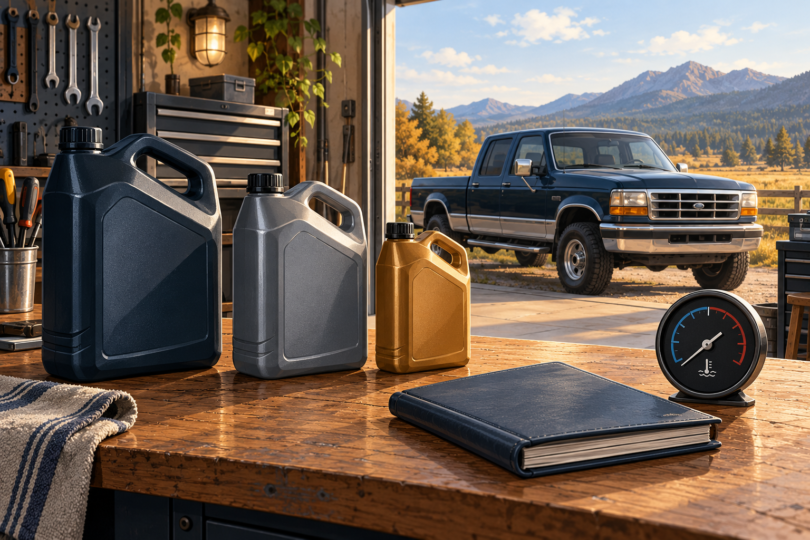

The best oil for a 7.3L Power Stroke depends on the temperatures it will see before its next oil change. For a truck running an approved 15W-40 in warm weather, Motorcraft Super Duty 15W-40 is a straightforward starting point; Shell Rotella T4 15W-40 is a useful alternative to compare by total service cost. For an approved 5W-40 application, Shell Rotella T6 5W-40 is the full-synthetic choice on this shortlist.
This guide concerns the older 7.3L Power Stroke diesel. The later 7.3L gasoline engine and 6.7L Power Stroke have different requirements. The capacity and historical viscosity examples below come specifically from Ford’s 2002 7.3L diesel supplement; use your own year’s supplement and current Ford guidance before buying.
Compare the three oil choices
| Oil | Best reason to choose it | Main buying limit |
|---|---|---|
| Motorcraft Super Duty 15W-40 | Ford’s own diesel oil; explicit 7.3L application guidance | Check ambient temperature and buy the diesel formulation |
| Shell Rotella T4 15W-40 | A second 15W-40 option with current Ford specification coverage | Current T4 is a synthetic blend; older listings may describe an earlier formulation |
| Shell Rotella T6 5W-40 | Full synthetic with a lower winter viscosity grade | Confirm the 5W-40 application; it does not authorize a longer drain interval |
1. Motorcraft Super Duty 15W-40: best starting point for warm-weather service
Motorcraft’s current product page specifically includes the 7.3L Power Stroke. It lists API CK-4 and Ford WSS-M2C171-F1, and recommends this oil above 20°F. For the 2002 example, the older manual’s chart marks 15W-40 as preferred from about 30°F upward. That distinction matters when overnight temperatures fall during the service interval: check the guidance for your particular truck instead of treating either figure as a universal year-round rule.
The current five-quart package is XO-15W40-5Q3SD; Motorcraft also lists one-quart bottles. Three five-quart jugs total 15 quarts, making it easy to compare the cost of a complete service quantity with gallon-based alternatives.
- Pros: explicit manufacturer guidance for the 7.3L diesel; clearly identified Ford specification; convenient five-quart package option.
- Limits: 15W-40 is not the cold-weather default. A familiar red bottle or the Motorcraft name alone does not identify the correct oil.
Check Motorcraft Super Duty 15W-40 specifications and package sizes.
2. Shell Rotella T4 15W-40: best alternative to compare on service cost
T4 makes sense alongside Motorcraft when 15W-40 suits your truck’s operating temperatures. Shell’s current data sheet lists API CK-4, earlier diesel categories including CH-4, and Ford WSS-M2C171-F1. Those named specifications are more useful buying checks than a generic “heavy-duty” label.
One detail has changed: Shell now describes T4 15W-40 as a synthetic blend. Older shopping titles may still call it conventional. Check the actual grade and specifications on the container you receive; do not assume every old listing describes the current formulation.
- Pros: clear current specification documentation; a direct comparison with another 15W-40; gallon packaging makes cost-per-quart calculations simple.
- Limits: the same cold-weather grade decision still applies. A case of three one-gallon jugs contains 12 quarts, so it is short of the 2002 example’s full oil-and-filter refill.
Check Shell Rotella T4 15W-40 and its current technical data sheet.
3. Shell Rotella T6 5W-40: best full-synthetic option when 5W-40 is approved
T6 5W-40 is a distinct choice from the two 15W-40 oils. Shell specifies a full-synthetic diesel formulation and lists API CK-4, CH-4 and Ford WSS-M2C171-F1. Its data sheet identifies improved low-temperature flow compared with conventional 15W-40, making it worth considering when cold starts drive the buying decision.
Do not read 5W-40 into the old 2002 chart: that chart does not list it. Later Motorcraft 5W-40 technical guidance recommends Motorcraft’s own qualifying diesel oil for North American Ford diesels across a broad temperature range. That is relevant later guidance, but confirm the grade for your year and conditions before substituting a different brand. T6’s current Ford specification listing provides an additional product check.
- Pros: full-synthetic formulation; lower winter grade; documented diesel and Ford specifications.
- Limits: compare the complete refill cost. The label does not promise more horsepower, fix injector faults or permit extending Ford’s service schedule.
Check Shell Rotella T6 5W-40 and its technical data sheet.
How to buy the right oil for your truck
Match the year, engine and climate first. Ford’s 2002 7.3L diesel supplement, pages 22–23, bases viscosity on the expected temperature range for the whole service interval. Its chart also includes 10W-30 and colder-weather grades. A lower-priced 15W-40 is poor value if it does not suit the conditions you will encounter.
Separate the old specification from current product labels. The 2002 materials table lists WSS-M2C171-C and CH-4/SJ/SH. Today’s shortlisted products list CK-4 and WSS-M2C171-F1. The latter is a current product qualification, not a quotation from the old manual. API explains that CK-4 covers CH-4 performance requirements, while FA-4 is not interchangeable with CK-4 and earlier diesel categories. Do not select an FA-4 oil simply because the viscosity looks similar.
Count oil and filter separately. The 2002 supplement specifies 15 US quarts, including the oil filter, and identifies FL-1995/F4TZ-6731-A. Check current filter fitment for your VIN. Four US gallons provide 16 quarts; a three-gallon case provides 12. Buy enough, then verify the actual level by the manual’s procedure rather than pouring in every container.
Compare the whole job. Divide the delivered oil price by the number of US quarts, then add the correct filter. Check that the listing says 5W-40 or 15W-40 as intended, that the pack contains the stated number of jugs, and that each jug’s size is clear. A fuel treatment, friction modifier or filter is not a replacement for engine oil.
Our verdict
Start with Motorcraft Super Duty 15W-40 when the grade fits your warm-weather use. Compare Rotella T4 15W-40 on the full service quantity and delivered price. Choose Rotella T6 5W-40 when you have confirmed a 5W-40 application and want a full-synthetic option. Keep the viscosity decision ahead of brand loyalty, and keep Ford’s maintenance schedule ahead of broad oil-marketing claims.
Frequently asked questions
What is the best oil for a 7.3L Power Stroke?
Motorcraft Super Duty 15W-40 is a sensible warm-weather starting point when that grade suits your truck. Rotella T4 15W-40 is an alternative; Rotella T6 5W-40 is the full-synthetic option when 5W-40 is approved for your application.
Can I use 5W-40 instead of 15W-40?
Confirm the grade against current guidance for your truck and climate. Later Motorcraft guidance supports its 5W-40 diesel oil across a broad range, but the 2002 supplement itself does not list 5W-40. Check the replacement oil’s exact specifications too.
How much oil should I buy?
The 2002 7.3L supplement specifies 15 US quarts with the filter. Three five-quart jugs cover that quantity; three one-gallon jugs do not. Verify your own model’s capacity and check the final level as instructed.
Is Rotella T4 15W-40 still conventional oil?
Shell’s current T4 15W-40 product page and technical sheet describe a synthetic blend. Older listings may use the conventional description. Match the actual container’s grade and specifications to the product you intend to buy.
Does synthetic oil let me extend the change interval?
Do not extend the interval solely because the bottle says synthetic. Follow the service schedule for your year and operating conditions, including its severe-service requirements. Broad mileage or fuel-economy marketing is not a truck-specific maintenance instruction.


