


A page magnifier can help you study small notation, but it is not automatically a workable solution for reading music while playing. The lens must stay at a useful distance from the score, remain in focus from your playing position and leave your hands free. Those practical checks matter more than a large “3×” or “5×” label.
For a simple page-sized lens, start by comparing Carson’s rigid-frame DM-21 PageMagnifier and flexible DM-11 MagniSheet. Both are rated 2×. They are general reading aids, and neither verified listing promises a complete music-stand mounting system. These recommendations use manufacturer specifications; we have not tested them during a rehearsal or performance.
Which page magnifier fits the job?
| Option | Verified design | Good starting use | Main limitation |
|---|---|---|---|
| Carson DM-21 PageMagnifier | 2× acrylic Fresnel lens, rigid frame, approximately letter-size | Studying a score while holding the frame steady | No included music-stand mount or lighting identified |
| Carson DM-11 MagniSheet | 2× flexible Fresnel sheet, approximately 8¼ × 10¾ inches | A lightweight backup in a music folder | Flexing and unsupported placement can make positioning harder |
| Large-print or modified score | Notation enlarged or reformatted to the reader’s needs | Hands-free playing when a floating lens is awkward | More pages and a different page-turn plan may be necessary |
Carson DM-21: choose the rigid frame for easier handling
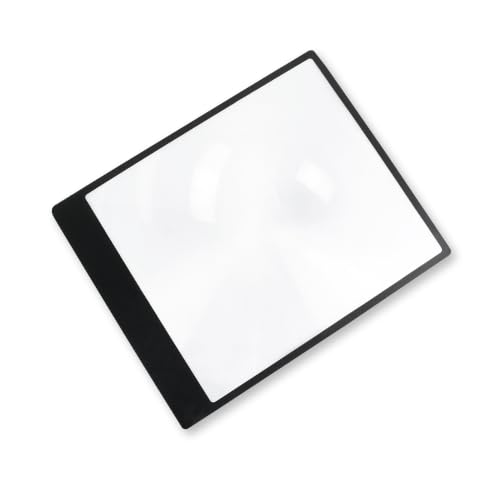
The DM-21 is a 2× full-page Fresnel magnifier with a rigid frame. Its Amazon listing identifies an acrylic lens and a nominal 8.5 × 11-inch format; Carson’s guide gives approximate outer dimensions of 8.4 × 11 inches. These dimensions describe the product, not a guarantee that every part of a score will be equally clear at once.
The rigid surround gives you a defined edge to hold while checking a passage. That makes it the more natural starting point of these two for a musician who studies printed scores at a desk, checks fingerings or reviews an unfamiliar section before playing.
The manufacturer’s instructions say to move the lens closer to or farther from the subject until it focuses for your vision. It should not be treated as a transparent sheet that automatically enlarges music when laid directly on top of the page.
Choose it only after considering how you will support it. The frame alone does not make a hands-free playing setup, and adding a holder introduces its own clearance and stability requirements.

Carson PageMagnifier Rigid Frame 2x Sheet Magnifier Reading Aid
As an Amazon Associate we earn from qualifying purchases.
Carson DM-11: choose the flexible sheet for portability
The DM-11 MagniSheet is the lighter, flexible alternative. Its verified listing gives 2× magnification and dimensions of approximately 8¼ × 10¾ inches. Carson’s guide lists a weight of about 0.07 pound, making it easy to keep with a folder for occasional reading.
The Amazon instructions suggest holding it roughly four inches above the subject as a starting point, then adjusting for focus. That separation is important: a flat Fresnel magnifier still needs suitable optical spacing even though the sheet itself is thin.
Choose this model when easy carrying matters more than a rigid grip. Keep it protected from scratches and avoid bending it during use. Flexibility is helpful for storage, but a curved or moving sheet is less convenient when you are trying to follow several staves accurately.
The DM-11 guide confirms the flexible design and 2× rating. It does not establish that this lens can be clipped to a standard stand and read comfortably from any distance.
Why stronger magnification may make music harder to follow
Music reading requires context: the next measure, a dynamic marking, another staff or an upcoming repeat. Magnifying one small area is less helpful if you continually lose the surrounding notation.
Carson explains that higher magnification generally comes with a shorter focal distance and a smaller viewing area. A powerful handheld lens can therefore be useful for checking a tiny symbol while being awkward for playing through a score. Start with the least enlargement that lets you read comfortably rather than selecting the largest advertised power.
A “full-page” description is about lens format. It does not guarantee full-page visibility, edge-to-edge sharpness or a comfortable viewing distance in your particular arrangement. Head position, lens angle, page curvature and lighting all affect the result.
Test the complete playing position
- Use your normal instrument and chair. Put the score where it would sit in practice, not unusually close to your face.
- Adjust page, lens and head position. Find a comfortable view without leaning forward or twisting your neck.
- Check more than the notes. Read accidentals, ledger lines, fingerings, articulation marks and quiet dynamic instructions across the page.
- Follow several lines. Confirm that you can move between staves and recover your place after looking at your hands or conductor.
- Try a page turn. Any support must leave room for turning the page and keep the lens steady afterward.
- Check the lighting. Reposition the lamp or score if reflections obscure notation; more brightness alone may not solve glare.
If a holder is needed, check its supported lens size, reach and clamp clearance before buying it. Neither of the recommended lenses comes with verified compatibility for a particular music stand. Avoid a setup that can tip the stand or put the lens in the way of your instrument.
When an enlarged score is the better choice
If maintaining lens position interrupts playing, consider an authorized large-print score or a digital score displayed at a suitable size. RNIB’s modified stave notation guidance explains that accessible music can change symbol sizes, line thickness and spacing rather than simply enlarging everything equally.
That distinction can help when small fingerings or thin staff lines are the real problem. A digital display may also offer contrast adjustments and hands-free page-turn options, but the screen must be large enough for the amount of notation you need to see. Plan page turns before relying on a new format in a performance.
Care and final checks
Use the microfiber lens-cloth cleaning approach specified by Carson, and avoid abrasive cleaners or solvents. Store magnifiers out of direct sunlight. Before ordering, confirm the exact model number and return conditions so you can assess your normal reading setup promptly.
Bottom line: the DM-21 is the more structured option for score study, while the DM-11 is a portable backup. For continuous hands-free playing, successful positioning is essential; an accessible score layout may solve the problem more effectively than increasing lens power.
Image note: Illustrative full-page reading magnifiers. The image does not demonstrate usable magnification at a musician’s playing distance.


