


The most useful paper airplane kit is one that matches the maker’s patience and the kind of activity you want. For a short folding-and-decorating session, consider Creativity for Kids Paper Airplane Squadron. For a reusable instruction book with a range of designs, look at The Klutz Book of Paper Airplanes. For comparing different flights, Tuttle’s Record Breaking Paper Airplanes Kit offers more designs to explore.
This guide compares the contents documented by the manufacturers and publishers with identifiable retail editions. These are source-based recommendations, not results from hands-on flight testing. No kit can promise a particular distance or flight time in your home.
Paper airplane kits at a glance
| Kit | Best suited to | Verified contents | Check before buying |
|---|---|---|---|
| Creativity for Kids Paper Airplane Squadron, model 1994000 | A compact first craft or small-group activity | 20 printed papers, two sticker sheets and instructions | Manufacturer age guidance is 6+ |
| The Klutz Book of Paper Airplanes, ISBN 9781570548307 | Learning several folds from one instruction book | 56-page book, 10 designs and 40 paper sheets | Publisher age guidance is 7+; used copies may lack paper |
| Record Breaking Paper Airplanes Kit, ISBN 9784805313640 | Trying different designs and comparing flights | 64-page book, 16 designs and 48 folding sheets | Choose the physical book-and-paper kit rather than a digital edition |
1. Creativity for Kids Paper Airplane Squadron: a compact starting point
Faber-Castell’s Paper Airplane Squadron keeps the supply list short: printed papers, decorating stickers and folding instructions in a small kit. The manufacturer identifies it as model 1994000 and recommends it for ages six and older. The linked retail listing matches that model and the 20-airplane format.
Choose it for a rainy afternoon, a small gift or an activity where decorating matters as much as the flying. Twenty sheets give a beginner room to make mistakes without using the whole supply immediately. For a party, divide the paper supply by the number of children before ordering; one box does not mean one kit per child.
Trade-off: it is a small craft set rather than an extensive design library. An adult may still need to demonstrate the first folds. Follow the instructions enclosed with the package, as listing descriptions and packaging can change.
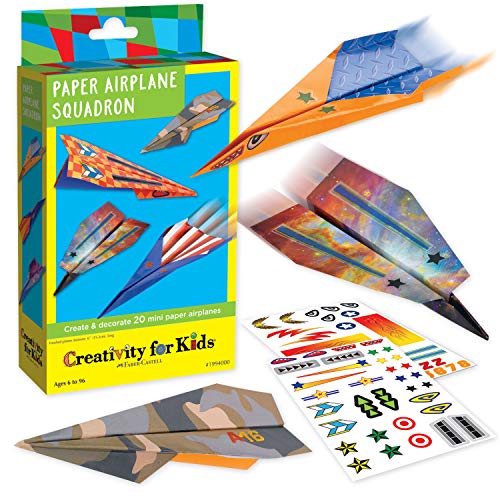
Creativity for Kids Paper Airplane Kit, Make 20 Airplanes
As an Amazon Associate we earn from qualifying purchases.
2. The Klutz Book of Paper Airplanes: a book to return to
Scholastic lists this Doug Stillinger title with 10 airplane designs, 40 double-sided paper sheets and a 56-page book. The edition’s ISBN is 9781570548307, and the publisher recommends it for ages seven and up.
This is the stronger fit when the aim is to learn a few reliable designs over several sessions. Keep the book after the included paper is used, and check each design’s paper requirements before substituting your own sheets. Working through one model at a time also makes it easier to see which folding steps need more practice.
Trade-off: a used book can be a poor bargain if its paper has already been removed. Check the condition description for complete materials. Match the ISBN when comparing offers, because similarly named books and newer editions may include different contents.

3. Tuttle Record Breaking Paper Airplanes Kit: for experimenting with designs
Tuttle’s kit by Andrew Dewar, illustrated by Kostya Vints, includes 16 designs, 48 folding sheets and a 64-page instruction book. The papers have printed fold guides. The book also introduces flight principles and the history of record-setting paper airplanes. The matched physical kit is ISBN 9784805313640.
It makes sense for someone who wants to compare several models, keep simple flight notes or revisit the activity beyond one afternoon. You could select two designs, make each carefully and compare how they behave in the same clear space.
Trade-off: the title describes the inspiration for the designs, not a guarantee that your airplanes will set records. The number of models is also different from the number of sheets: 48 sheets support 16 designs. Check that an offer includes the paper kit, rather than only an ebook or incomplete secondhand book.

How to choose a paper airplane kit
Start with the maker’s experience
Age guidance is a useful first check, but the more practical question is whether the maker can follow a sequence of diagrams and line up edges accurately. A child who likes decorating may prefer a simple kit with stickers. Someone who already folds a basic dart may enjoy a book with more models. For a first session, plan to build one plane together before expecting independent work.
Count sheets, designs and finished airplanes separately
A box may advertise the number of airplanes you can make, the number of different models, or both. These are not interchangeable. Repeated sheets can be useful for practice or for a group that wants everyone to build the same model. A larger design count is more useful when variety matters. Neither number tells you how clearly the instructions are written.
Check the type of construction
Folded-paper kits, pop-out cardstock gliders and rubber-band-launcher kits involve different activities. Choose folding paper if learning creases is the goal. Choose a pop-out kit if assembly is more appealing, and check whether glue or other supplies are required. With any launcher set, read the age guidance and supervision instructions before buying. A powered attachment is a separate purchase category with its own charging and operating requirements.
Look at the replacement-paper plan
The supplied paper is a consumable. Before buying a refill, check the required sheet dimensions, shape and any weight recommendation in the instructions. Square origami paper is not automatically a substitute for rectangular airplane paper. Thick decorative cardstock can also behave differently from a thin sheet. Start with the included materials while learning the design.
Compare the complete purchase
Compare the price of the complete kit, its usable paper supply and any delivery charge. A low-priced used book with missing sheets may require an extra purchase. A large bulk kit can be wasteful for someone who only wants to try the activity once. Check the exact model or ISBN, selected edition, seller and condition rather than relying on the search-result photo.
A simple first-session plan
- Set up a clear work surface. Put the instructions beside the paper so the maker can compare each step without turning the sheet around repeatedly.
- Build one design carefully. Align edges before pressing a crease and compare both wings before launching.
- Choose a clear flight area. Keep planes away from faces, pets, traffic, fragile objects and anyone not taking part. Follow any kit-specific safety instructions.
- Use the same starting point. A consistent launch area makes comparisons easier than moving around the room.
- Change one thing at a time. Record the design, paper used and a brief observation. This is a suggested learning activity, not a standardized product test.
Keep early flights gentle. If a plane behaves poorly, return to the folding diagram before adding weight, cutting parts away or bending several surfaces at once. The useful outcome is learning what changed, even when the flight is short.
Frequently asked questions
Do I need a kit to make paper airplanes?
No. Paper and clear instructions can be enough. A kit is most useful when you want coordinated printed sheets, a gift-ready activity or an instruction book in one purchase. Start with ordinary paper if you are unsure the activity will hold your interest.
Which kit is easiest for a beginner?
The compact Creativity for Kids set is a practical starting point for a short craft session. Klutz is worth considering if the maker wants to learn from a book over time. Match the choice to the child’s reading and folding confidence, and expect to help with the first model.
Are more sheets always better?
Only if you will use them. More paper is useful for groups and repeated attempts; clear instructions and appropriate difficulty matter more for a first-time folder. Check how many distinct designs are included as well as the sheet count.
Can I use the same kit for a classroom or party?
Yes, if its age guidance and contents fit the group. Budget sheets per person, leave extra for practice and decide how children will share the instructions. It can help to demonstrate one design to everyone before allowing individual choices.
The bottom line
Choose a small folding-and-decorating set for a brief introduction, a reusable book for learning, or a larger design collection for repeated experiments. Check the exact contents and condition of the offer before buying. A well-matched kit should make the next folding session easier to start, without needing inflated promises about how far the planes will fly.
Image note: Examples of paper airplane books and kits; pictured editions may differ from the selected options.
